
Dubai mortgage rates 2026 have moved back up for the first time in three years. On 17 September 2026 the Central Bank of the UAE raised its base rate by 0.25 percentage points to 3.90%, following the first US Federal Reserve hike since 2023, and the three-month EIBOR rate that most home loans track has climbed from about 3.85% in June to around 4.45% in late October.
For buyers this does not change the case for Dubai property, but it does change the maths. The gap between a good mortgage and an average one is now worth hundreds of dirhams a month, and existing owners coming off a fixed rate face a noticeably higher reversion rate. This guide explains what happened, what rates banks are offering, how much you can borrow and what to do next.
Key takeaways
- The UAE base rate rose from 3.65% to 3.90% on 17 September 2026; 3-month EIBOR was about 4.45% on 22 October.
- Fixed rates still start below 4%: roughly 3.75–4.89% for one year and 3.95–4.39% for three years in October 2026.
- Variable deals are priced at EIBOR + 1.00% to 1.99%, which means about 5.45–6.45% today.
- Expat residents can borrow up to 80% on a first home under AED 5 million; off-plan purchases are capped at 50%.
In this guide
- What happened to UAE interest rates in 2026?
- What is EIBOR and how does it set your mortgage rate?
- Dubai mortgage rates today: fixed and variable
- Fixed vs variable mortgage in the UAE: which is better in 2026?
- How much can you borrow in Dubai? LTV, DBR and stress tests
- What does a Dubai mortgage cost on top of the rate?
- What should existing owners do after the rate hike?
- Should Dubai mortgage rates 2026 change your buying plan?
- Frequently asked questions
What happened to UAE interest rates in 2026?
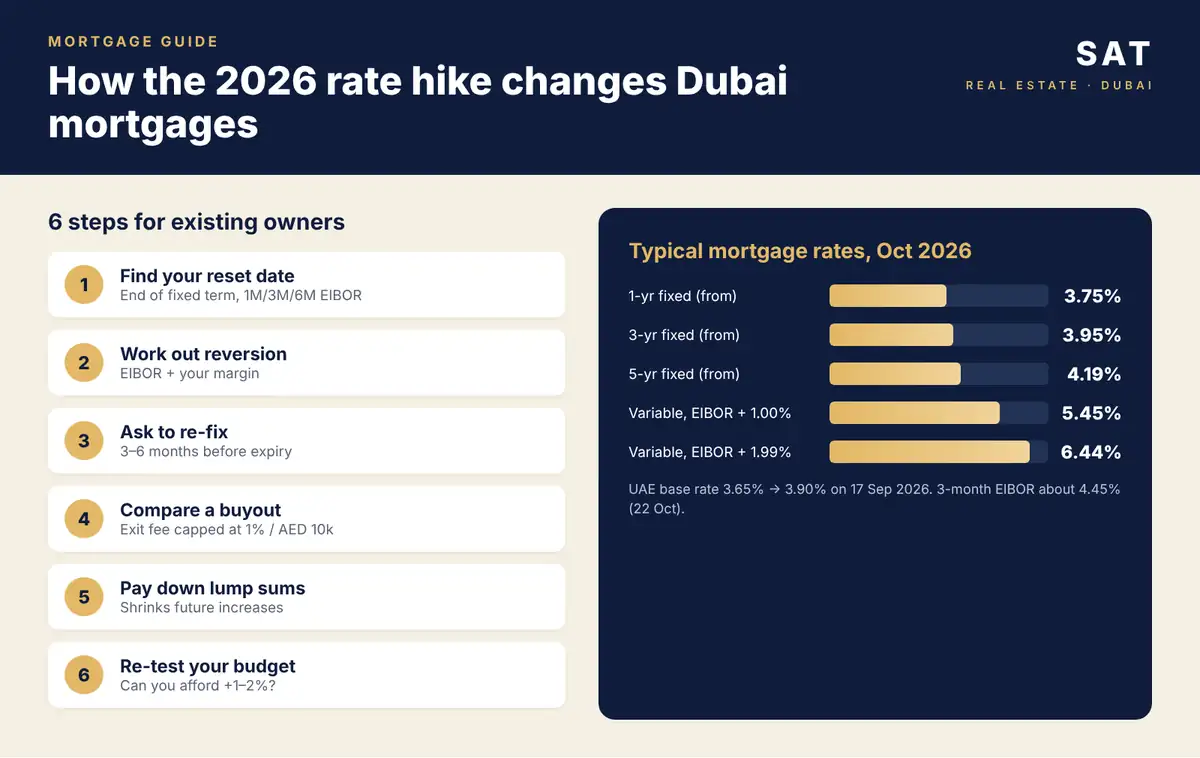
The UAE dirham is pegged to the US dollar, so the Central Bank of the UAE (CBUAE) follows the US Federal Reserve. After a long series of cuts from late 2024 through 2025, the base rate stood at 3.65% for most of 2026. On 16 September 2026 the Fed raised its target range to 3.75–4.00%, its first increase since 2023, and the CBUAE matched it the same evening. The new base rate of 3.90% took effect on 17 September.
The base rate is the rate banks earn on overnight deposits with the central bank. It does not set your mortgage directly, but it moves the interbank market that does. The three-month Emirates Interbank Offered Rate (EIBOR) was about 3.85% in late June 2026, 4.39% on 8 October and around 4.45% on 22 October.
| Indicator | Mid-2026 | October 2026 |
|---|---|---|
| CBUAE base rate | 3.65% | 3.90% (from 17 Sep) |
| 1-month EIBOR | about 3.8% | 4.09% (8 Oct) |
| 3-month EIBOR | about 3.85% | 4.39–4.45% |
| 6-month EIBOR | about 3.9% | 4.41% (8 Oct) |
What happens next depends on US inflation and the Fed. If the Fed pauses, EIBOR should settle near current levels. Another hike would push it higher, and a return to cuts would bring it down. Nobody can promise which, so the right mortgage is the one that still works if rates move against you.
What is EIBOR and how does it set your mortgage rate?
EIBOR is the average rate at which UAE banks lend to each other for a set period, published daily for terms from overnight to 12 months. Almost every variable home loan in Dubai is priced as EIBOR plus a fixed bank margin. If your loan is “3-month EIBOR + 1.50%” and 3-month EIBOR is 4.45%, you pay 5.95%.
How quickly a rate change reaches you depends on which EIBOR your loan uses:
- 1-month EIBOR: usually reviewed monthly, so changes appear almost immediately.
- 3-month EIBOR: typically reset at the start of each calendar quarter. A mid-September hike showed up in October instalments.
- 6-month EIBOR: reset twice a year, so changes arrive later but in bigger steps.
- Fixed period: no change until the fixed term ends, then the loan reverts to EIBOR plus the margin in your offer letter.
Some banks also set a minimum rate (a “floor”), which stops your rate falling below a set level even if EIBOR drops. Check your key facts statement for the floor and the reset dates.
Dubai mortgage rates today: fixed and variable
The table shows the range of salary-transfer offers from 13 UAE banks in early October 2026, as tracked by an independent mortgage comparison service. Rates for non-salary-transfer loans and non-residents are usually higher.
| Product | Typical range (Oct 2026) | Notes |
|---|---|---|
| 1-year fixed | 3.75–4.89% | Cheapest headline, earliest reset |
| 2-year fixed | 3.89–4.49% | Popular with buyers planning to refinance |
| 3-year fixed | 3.95–4.39% | Most competitive term across banks |
| 5-year fixed | 4.19–5.05% | Highest certainty, highest rate |
| Variable | 3M EIBOR + 1.00% to 1.99% | About 5.45–6.45% at current EIBOR |
| Islamic (profit rate) | 3.75–4.69% | Ijara and murabaha structures |
The lowest fixed rates come with conditions: salary transfer, life and property insurance, a minimum loan size and sometimes a higher arrangement fee. Compare the full cost, not just the headline rate.
What do these rates mean in dirhams? On a AED 1.6 million loan over 25 years (an AED 2 million home with 20% down):
| Rate | Monthly payment | Total interest over 25 years |
|---|---|---|
| 3.99% fixed | about AED 8,440 | about AED 931,000 |
| 4.50% | about AED 8,890 | about AED 1.07 million |
| 5.45% (EIBOR + 1.00%) | about AED 9,780 | about AED 1.33 million |
| 6.48% (EIBOR + 1.99%) | about AED 10,780 | about AED 1.63 million |
Every 0.25% on a loan of this size adds roughly AED 230–250 a month. The difference between the best and worst variable margin is about AED 1,000 a month.
Fixed vs variable mortgage in the UAE: which is better in 2026?
In 2026 fixed rates are priced below variable rates, because banks use cheap fixed deals to win customers and expect to earn more when the loan reverts. That makes a fixed period the default choice for most buyers right now. The real decision is how long to fix for.
| Choose | If you | Watch out for |
|---|---|---|
| 1–2 year fixed | Expect rates to fall, or plan to sell or refinance soon | Reverting to variable at a higher EIBOR |
| 3 year fixed | Want the best value across most banks | Early settlement fees during the fixed term |
| 5 year fixed | Need certainty for family budgeting or a rental yield plan | Paying more than shorter fixes today |
| Variable | Plan to repay heavily or sell within a year or two | Every EIBOR increase passes straight through |
Two points matter more than the label. First, read the reversion rate: a fixed rate of 3.89% that reverts to EIBOR + 1.99% can cost more over five years than 4.19% that reverts to EIBOR + 1.25%. Second, check the early settlement fee. UAE rules cap it at 1% of the outstanding balance or AED 10,000, whichever is lower, which makes refinancing affordable when a better deal appears.
How much can you borrow in Dubai? LTV, DBR and stress tests
Loan-to-value (LTV) limits are set by the Central Bank and apply to every licensed bank.
| Buyer and property | Maximum LTV | Minimum down payment |
|---|---|---|
| Expat resident, first home up to AED 5M | 80% | 20% |
| Expat resident, first home above AED 5M | 70% | 30% |
| UAE national, first home up to AED 5M | 85% | 15% |
| UAE national, first home above AED 5M | 75% | 25% |
| Second home or investment property | 60–65% | 35–40% |
| Off-plan property (bank-financed) | 50% | 50% |
Three other rules decide the final amount:
- Debt burden ratio (DBR): all monthly loan and credit card payments, including the new mortgage, must stay within 50% of your gross monthly income.
- Stress test: banks test affordability at a rate well above the offer, often 2–4 percentage points higher. The September hike makes this test slightly harder to pass.
- Age and term: the maximum term is 25 years, and the loan usually has to be repaid by 65 for salaried borrowers or 70 for the self-employed.
Non-residents can still get Dubai mortgages from a smaller group of banks, usually with lower LTVs (often 50–60%), home-country income documents and longer approval times. Off-plan buyers often rely on developer payment plans instead; see our guide to post-handover payment plans in Dubai.
What does a Dubai mortgage cost on top of the rate?
The interest rate is only part of the cost. On a typical AED 2 million purchase with an AED 1.6 million loan, budget for:
| Cost | Typical amount | Example |
|---|---|---|
| DLD transfer fee | 4% of price + AED 580 | AED 80,580 |
| Mortgage registration (DLD) | 0.25% of loan + AED 290 | AED 4,290 |
| Bank arrangement fee | 0–1% of loan (often capped) | Up to AED 16,000 |
| Valuation | AED 2,500–3,500 | AED 3,000 |
| Trustee office fee | About AED 4,200 | AED 4,200 |
| Life insurance | About 0.15–0.25% of balance a year | Paid monthly |
| Property insurance | About 0.04–0.08% of value a year | Paid monthly |
Together with agency fees on a resale, total purchase costs usually come to 7–8% of the price on top of the deposit. The Dubai Land Department publishes current registration fees on the DLD website.
What should existing owners do after the rate hike?
If you already have a Dubai mortgage, the hike affects you only when your rate next resets. These steps keep the cost under control.
1. Find your reset date. Check your offer letter or key facts statement for the end of your fixed period and whether your loan tracks 1-, 3- or 6-month EIBOR.
2. Calculate your reversion rate. Add your margin to today’s EIBOR. If you are moving from 3.99% fixed to EIBOR + 1.99%, your rate could rise to about 6.4%, roughly AED 2,300 a month more on a AED 1.6 million balance.
3. Ask your bank to re-fix. Most banks will offer existing customers a new fixed period three to six months before the old one ends. Ask early and in writing.
4. Compare a buyout. Another bank may offer a lower fixed rate or a smaller margin. With early settlement capped at 1% or AED 10,000, switching often pays for itself within a year.
5. Make lump-sum payments. Overpaying while you are on a variable rate reduces the balance that each future increase applies to. Check the bank’s limits on free partial repayments.
6. Re-test your budget. Work out your payment at 1–2 percentage points above today’s rate. If that would strain your finances, a longer fix or a lower balance is worth more than a slightly cheaper headline rate.
Landlords should also re-check their yield. Higher interest costs combined with softer apartment rents can turn a positive cash flow negative; our Dubai rental market 2026 guide covers rents, and our sell, hold or reinvest review sets out the options side by side.
Should Dubai mortgage rates 2026 change your buying plan?
For most buyers, no. Dubai mortgage rates 2026 are higher than in the summer, but fixed deals below 4% are still available, and prices have softened in several communities, which gives buyers more room to negotiate. A small rate rise is easier to manage than overpaying for the property itself, and fixed rates can be refinanced if EIBOR falls again.
What has changed is the margin for error. Fix for a period that matches your plans, compare the reversion rate as carefully as the headline rate, and make sure the payment still works if rates rise another 1–2%. SAT works with mortgage specialists across the UAE’s main banks through our mortgage specialist coordination service. Book a private investment consultation to compare financing against your target property, or browse ready properties that can be mortgaged today.
Related reading
- Dubai property market outlook 2027
- Tenant not paying rent in Dubai: a landlord’s guide
- Etihad Rail and Dubai property
- Dubai Golden Visa through property in 2026
- Dubai rental market 2026
- Off-plan vs ready property in Dubai
- Buying off-plan property in Dubai
- Post-handover payment plans in Dubai
- Best areas to invest in Dubai real estate in 2026
Frequently asked questions
1. What are Dubai mortgage rates in 2026?
In October 2026 fixed rates from UAE banks ranged from about 3.75% to 5.05% depending on the term, with three-year fixes mostly between 3.95% and 4.39%. Variable rates were EIBOR plus 1.00–1.99%, or roughly 5.45–6.45%.
2. Did the UAE raise interest rates in 2026?
Yes. The Central Bank of the UAE raised its base rate by 0.25 percentage points from 3.65% to 3.90% on 17 September 2026, after the US Federal Reserve raised rates for the first time since 2023.
3. What is the EIBOR rate today?
Three-month EIBOR was about 4.45% on 22 October 2026, up from around 3.85% in June. EIBOR is published daily by the Central Bank, so check the latest fixing before you compare offers.
4. Will mortgage rates go down in the UAE?
It depends on the US Federal Reserve, because the dirham is pegged to the dollar. If US inflation eases and the Fed cuts again, EIBOR and UAE mortgage rates should fall; if the Fed keeps raising, they will rise.
5. Is a fixed or variable mortgage better in Dubai?
In 2026 fixed rates are cheaper than variable ones, so a fixed period suits most buyers. Choose the length to match your plans, and compare the rate the loan reverts to after the fixed term.
6. How much deposit do I need to buy in Dubai?
Expat residents need at least 20% on a first home up to AED 5 million and 30% above that. UAE nationals need 15% and 25%, and off-plan purchases financed by a bank need 50%.
7. Can non-residents get a mortgage in Dubai?
Yes, from a smaller number of banks. Expect a lower loan-to-value (often 50–60%), home-country income documents, higher rates and a longer approval process.
8. What fees do I pay when taking a mortgage in Dubai?
The main extra costs are the 0.25% DLD mortgage registration fee plus AED 290, a bank arrangement fee of up to 1%, valuation of about AED 2,500–3,500, and life and property insurance.
9. Can I switch my Dubai mortgage to another bank?
Yes. UAE rules cap early settlement fees at 1% of the outstanding balance or AED 10,000, whichever is lower, so a buyout to a cheaper bank often pays for itself quickly.
10. How can SAT help with financing a Dubai property?
SAT coordinates with mortgage specialists across UAE banks, compares fixed and variable offers against your purchase, and models the payment and yield. Book a private investment consultation to start.