The Etihad Rail impact on Dubai property became a real question rather than a forecast on 30 September 2026, when Dubai’s first national rail station opened at Al Yalayis, beside Jumeirah Golf Estates. Passengers can now board a train to Abu Dhabi in about an hour, from AED 39, and walk across a covered bridge to the Dubai Metro Red Line.
New transport links have shaped Dubai’s property map before: the Metro turned communities such as Al Barsha, JLT and Al Furjan into mainstream rental addresses. But a station does not raise every price around it, and some of the benefit is already priced in. This guide explains what has opened, how it connects, which areas stand to gain and what to check before you pay a premium for being near the line.
Key takeaways
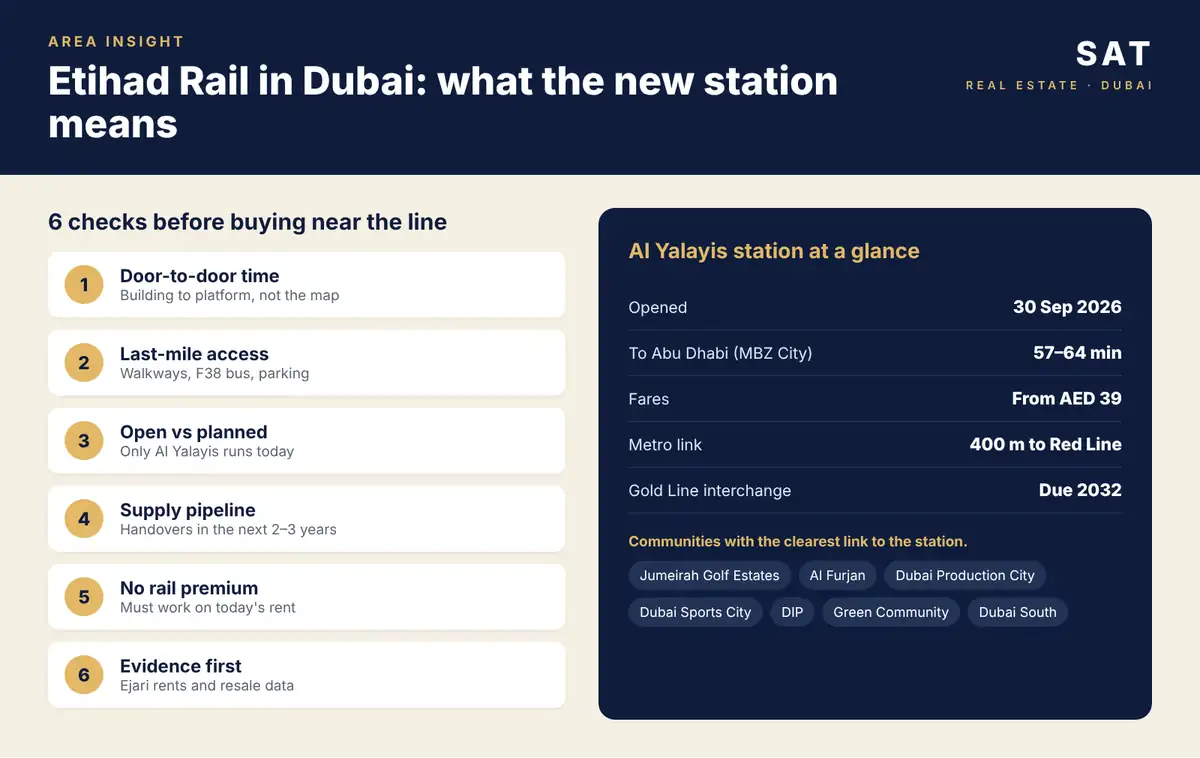
- Dubai’s Al Yalayis station at Jumeirah Golf Estates opened on 30 September 2026, with trains to Abu Dhabi’s Mohamed bin Zayed City in about 57–64 minutes from AED 39.
- A 400-metre covered walkway links it to Jumeirah Golf Estates Metro station on the Red Line; the Gold Line will add an interchange by 2032.
- Communities with the clearest link are Jumeirah Golf Estates, Al Furjan, Dubai Production City, Dubai Sports City, DIP and Dubai South.
- Analysts expect gradual support for rents and liquidity rather than an overnight price jump.
In this guide
- What opened in Dubai on 30 September 2026?
- How does Etihad Rail connect to the Dubai Metro?
- Does a rail station raise property prices in Dubai?
- Which Dubai areas could benefit most from Etihad Rail?
- Who gains most: buyers, landlords or tenants?
- What to check before buying near an Etihad Rail station
- The longer view: Gold Line, Blue Line and Al Maktoum airport
- Is the Etihad Rail impact on Dubai property worth paying for?
- Frequently asked questions
What opened in Dubai on 30 September 2026?
Etihad Rail is the UAE’s national railway, a network of more than 900 km that has carried freight since 2023. Passenger services started on the Abu Dhabi–Fujairah route on 30 June 2026. Dubai joined the passenger network on 30 September 2026 with the opening of Al Yalayis station in Me’aisem First, next to Jumeirah Golf Estates and directly opposite the Jumeirah Golf Estates Metro station. Sharjah’s first station, at Al Dhaid, opened the same day.
| Detail | Al Yalayis station |
|---|---|
| Location | Me’aisem First, beside Jumeirah Golf Estates |
| Road access | E311 (Sheikh Mohammed bin Zayed Road), E44 and D57 |
| Main destination | Abu Dhabi Mohamed bin Zayed City station, near Dalma Mall |
| Journey time | About 57–64 minutes |
| Fares | From AED 39 (comfort) and AED 109 (premium) |
| Parking | First 15 minutes free, then AED 5 per hour |
| Metro link | 400 m covered walkway with travelators to the Red Line |
For comparison, a bus from Ibn Battuta to central Abu Dhabi costs about AED 25 and takes around 105 minutes depending on traffic, and a taxi costs roughly AED 330–420. The train is not the cheapest option, but it is the most predictable, and that is what matters to daily commuters.
More stations are on the way. Al Dhafra stations in Abu Dhabi open between November and December 2026, and Sharjah University City is scheduled for March 2027.
How does Etihad Rail connect to the Dubai Metro?
The value of a station depends on what it connects to. Al Yalayis was designed as an interchange from day one:
- Red Line: the enclosed pedestrian bridge to Jumeirah Golf Estates Metro station opened to commuters in mid-October 2026. The walk takes about five minutes, and a Nol day pass can be added when booking a rail ticket.
- Feeder buses: RTA route F38 links the Metro station with Dubai Production City and Dubai Sports City, and shuttle buses run between the two stations.
- Gold Line: the AED 34 billion Dubai Metro Gold Line, due to open in 2032, will also serve Jumeirah Golf Estates and connect with the national network at Meydan.
- Blue Line: the separate 14-station Blue Line, due in September 2029, will add Metro access for Mirdif, Dubai Creek Harbour and Dubai Silicon Oasis.
Dubai’s 2040 Urban Master Plan aims to have 55% of residents living within 800 metres of a major public transport station. Communities that become interchanges under that plan are the ones most likely to see lasting demand.
Does a rail station raise property prices in Dubai?
Experience from the Dubai Metro suggests transport links support values over time, mainly by widening the pool of tenants and buyers who will consider an area. Commentators quoted when the station opened were measured. Cavendish Maxwell described transport as one of the strongest long-term drivers of residential value, supporting pricing resilience and liquidity. BlackBrick did not expect a significant direct effect on Jumeirah Golf Estates prices, noting that most villa residents there drive.
Three reasons for caution stand out:
- Expectations are partly priced in. The station was announced years ago, and developers have marketed proximity to it since.
- Supply matters as much as access. Several communities near the line, including Al Furjan, Dubai South and Dubai Production City, are receiving large numbers of new apartments, which caps rent growth.
- Not every buyer needs Abu Dhabi. The rail link matters most to people who commute between the two cities, work in logistics or industrial areas, or want an alternative to driving on E11 and E311.
Be wary of headline claims of 20–30% appreciation near stations. They are marketing estimates, not evidence. A better way to think about it is that rail access improves demand and resale liquidity in the right buildings, which makes a good property easier to let and sell.
Which Dubai areas could benefit most from Etihad Rail?
The table summarises the communities with the clearest link to Al Yalayis today and how the benefit is likely to show up.
| Community | Link to the station | Property profile | What to watch |
|---|---|---|---|
| Jumeirah Golf Estates | Next to the station and Metro | Golf villas, townhouses, newer apartments | Already premium-priced; benefit shows in liquidity |
| Al Furjan | Short drive; Red Line stations nearby | Townhouses, mid-market apartments | Large apartment handovers in 2026–2027 |
| Dubai Production City | F38 feeder bus | Affordable apartments | Commuter tenant demand vs new supply |
| Dubai Sports City | F38 feeder bus | Apartments, some villas | Older stock; rents sensitive to new competition |
| Dubai Investments Park (DIP) | Short drive | Apartments, staff housing, logistics | Rental demand from industrial employers |
| Green Community | Short drive | Mature villas and townhouses | Limited supply, family demand |
| Dubai South and Expo City | Under 10 km to Al Maktoum airport | Off-plan apartments and villas | Long-term story tied to the airport expansion from 2032 |
| Meydan (future) | Planned Gold Line and national interchange | Apartments and villas near Downtown | Timing depends on 2032 rail plan |
The strongest near-term case is for ready, well-located homes within easy reach of the station, especially family villas and townhouses where new supply is limited. Our Dubai South area guide covers the airport corridor in more detail, and our best areas to invest in Dubai real estate guide compares the wider market.
Who gains most: buyers, landlords or tenants?
Tenants feel the change first. Someone working in Abu Dhabi can now live in Dubai with a predictable one-hour commute, which opens communities around Jebel Ali and Jumeirah Golf Estates to a new group of renters. Because tenants can move quickly, rental demand usually responds before sale prices.
Landlords in buildings with genuine access to the station should see that demand as shorter void periods and steadier renewals, rather than sharp rent rises, because nearby supply is still growing. Check net yields against our yield and price guides and the trends in our Dubai rental market 2026 guide.
Buyers gain most when they buy for the long term in a community where rail access adds to existing strengths such as schools, parks and limited supply. Buying an apartment simply because it is “near Etihad Rail” in an area with thousands of identical units arriving is the riskiest version of the strategy.
What to check before buying near an Etihad Rail station
Before paying extra for rail access, run through these checks.
1. Measure door-to-door time. Time the full trip from the building to the platform, including walking, parking or the feeder bus. A “near the station” listing can mean a 20-minute drive.
2. Check last-mile access. Look at shaded walkways, bus routes, parking and traffic at peak hours. These decide whether residents actually use the train.
3. Confirm which stations are open and which are planned. Only Al Yalayis operates in Dubai today. The Meydan interchange, Gold Line and high-speed stations are future plans with their own timelines.
4. Compare the supply pipeline. Check how many units are due for handover nearby in the next two to three years. New supply can absorb the demand that the station creates.
5. Underwrite without the rail premium. The property should make sense on today’s rent and price even if the rail effect turns out smaller than expected.
6. Look for evidence, not promises. Recent Ejari rents, achieved resale prices and days on market tell you more than a brochure. The Dubai Land Department publishes transaction data and the official rental index.
The longer view: Gold Line, Blue Line and Al Maktoum airport
The Al Yalayis station is the first piece of a much larger network. By the early 2030s, south-west Dubai is planned to have national rail, two Metro lines and the first phase of the expanded Al Maktoum International Airport, which is less than 10 km from the station. The Jumeirah Golf Estates “Next Chapter” master plan alone covers 4.68 million square metres and more than 50,000 future residents, with the station at its centre.
That long-term story favours patient investors who buy quality homes in established communities, or carefully chosen off-plan properties with realistic handover dates and payment plans. It also means the corridor will keep receiving new supply for years, so selection matters more than location alone. Our Dubai property market outlook 2027 explains how that supply fits into the wider market.
Is the Etihad Rail impact on Dubai property worth paying for?
Sometimes. The Etihad Rail impact on Dubai property is real but gradual: it widens the tenant pool, improves resale liquidity and strengthens the long-term case for south-west Dubai, especially once the Gold Line and Al Maktoum airport expansion arrive. It is not a reason to overpay for an ordinary apartment in an area with heavy new supply.
The best opportunities are homes that would be good investments without the station and become better with it. SAT can shortlist ready and off-plan properties around the rail corridor, compare their rents and supply, and model the numbers for you. Book a private investment consultation or explore our portfolio advisory service to plan your next purchase.
Related reading
- Dubai property market outlook 2027
- Dubai mortgage rates 2026
- Tenant not paying rent in Dubai: a landlord’s guide
- Dubai rental market 2026
- Dubai Golden Visa through property in 2026
- Off-plan vs ready property in Dubai
- Buying off-plan property in Dubai
- Post-handover payment plans in Dubai
- Best places to invest in rental property in Dubai
Frequently asked questions
1. Where is the Etihad Rail station in Dubai?
Dubai’s Etihad Rail passenger station is Al Yalayis, in Me’aisem First beside Jumeirah Golf Estates. It sits opposite Jumeirah Golf Estates Metro station on the Red Line and is reached via E311, E44 and D57.
2. When did the Etihad Rail Dubai station open?
Al Yalayis station opened to passengers on 30 September 2026, the same day as Sharjah’s Al Dhaid station. The walkway to the Metro opened to commuters in mid-October.
3. How long does Etihad Rail take from Dubai to Abu Dhabi?
About 57–64 minutes from Al Yalayis to Mohamed bin Zayed City station in Abu Dhabi, near Dalma Mall. Fares start at AED 39 in comfort class and AED 109 in premium.
4. Will Etihad Rail increase property prices in Dubai?
It is likely to support demand and liquidity over time, especially in communities close to the station, but analysts do not expect an immediate jump because some of the benefit is already priced in and new supply is arriving nearby.
5. Which Dubai communities are closest to Etihad Rail?
Jumeirah Golf Estates is next to the station. Al Furjan, Green Community, Dubai Investments Park, Dubai Production City, Dubai Sports City and Dubai South are a short drive or feeder-bus ride away.
6. Is Jumeirah Golf Estates a good investment because of Etihad Rail?
Jumeirah Golf Estates already has premium villa prices because of its golf courses and limited supply. The station adds convenience and resale appeal, but it should be one reason to buy, not the only one.
7. Does Etihad Rail connect to the Dubai Metro?
Yes. A 400-metre covered walkway links Al Yalayis to Jumeirah Golf Estates Metro station on the Red Line, and the Gold Line will add a further connection by 2032.
8. Will rents rise near the Etihad Rail station?
Rental demand usually responds first, because commuters to Abu Dhabi can now live in Dubai more easily. In areas with heavy new supply, that demand is more likely to shorten voids than to push rents up sharply.
9. What other rail projects affect Dubai property?
The 14-station Dubai Metro Blue Line is due in September 2029, the Gold Line in 2032, and further Etihad Rail stations are planned at Meydan and, for high-speed services, Al Jaddaf and Al Maktoum International Airport.
10. How can SAT help me invest near Etihad Rail?
SAT shortlists ready and off-plan homes along the rail corridor, compares rents, supply and resale evidence, and models returns. Book a private investment consultation to discuss your budget and goals.