
A tenant not paying rent in Dubai is one of the most stressful problems a landlord can face, but the law gives you a clear route to recover the money and, if needed, the property. The catch is that the route only works if every step is done in the right order and in the right form. A notice sent by WhatsApp, a lock changed in frustration or a claim filed too early can cost you months.
With rents softening in many communities in 2026 and more tenants negotiating hard, late payments have become more common. This guide explains what Dubai rental law says about unpaid rent, how to serve a valid 30-day notice, how a Rental Dispute Center case works, what it costs and how to stop arrears happening in the first place.
Key takeaways
- Under Article 25(1)(a) of Dubai’s tenancy law, a landlord can seek eviction if rent is unpaid 30 days after formal notice is served.
- The notice must be served through a Notary Public or registered mail; email and WhatsApp alone do not count.
- Rental Dispute Center eviction fees are 3.5% of annual rent (minimum AED 500, maximum AED 20,000), plus small service charges.
- Landlords must never change locks, remove belongings or cut services; eviction is enforced only through the RDC.
In this guide
- What can a landlord do when a tenant stops paying rent in Dubai?
- What does Dubai law say about unpaid rent?
- How to serve a 30-day payment notice correctly
- Step-by-step: evicting a tenant for non-payment in Dubai
- How much does a Rental Dispute Center case cost?
- What about bounced rent cheques in Dubai?
- What landlords must never do
- How to prevent rent arrears in the first place
- Tenant not paying rent in Dubai: what is the fastest route?
- Frequently asked questions
What can a landlord do when a tenant stops paying rent in Dubai?
When a tenant misses a payment or a rent cheque bounces, a landlord in Dubai has three legal options, which can run together:
- Negotiate a settlement. Agree a short payment plan, replacement cheques or an early exit, and record it in writing.
- Recover the money. File a payment claim at the Rental Dispute Center (RDC) or, where the debt is clear and documented, apply for a Writ of Payment.
- Recover the property. Serve a formal 30-day payment notice and, if rent is still unpaid, file an eviction claim at the RDC.
Most cases end at the first stage. Tenants who receive a properly served legal notice usually pay or agree terms, because they know the landlord can now go to the RDC. The point of doing the paperwork correctly is that it gives you that leverage.
What does Dubai law say about unpaid rent?
The relationship between landlords and tenants in Dubai is governed by Law No. 26 of 2007, as amended by Law No. 33 of 2008. The key provisions for unpaid rent are:
| Provision | What it says |
|---|---|
| Article 19 | Rent must be paid on the dates agreed in the tenancy contract |
| Article 25(1)(a) | The landlord may seek eviction before the lease ends if the tenant fails to pay all or part of the rent within 30 days of a notice demanding payment |
| Article 25 (service) | The notice must be served through a Notary Public or by registered mail |
| Article 31 | Filing a claim does not stop rent from accruing until the judgment is issued and executed |
| Article 34 | The landlord may not cut services or disturb the tenant’s use of the property |
Non-payment is different from the 12-month notice rule under Article 25(2), which applies when a landlord wants the property back at the end of a lease to sell it, live in it or demolish it. For unpaid rent, the 30-day notice is the relevant route, and it applies during the tenancy.
How to serve a 30-day payment notice correctly
The notice is where most landlords go wrong. It must clearly identify the landlord, the tenant, the property, the Ejari contract, the unpaid amount and the demand for payment within 30 days. It should then be served in one of two ways:
- Through a Notary Public, who prepares the notice and arranges formal service, producing a notification report.
- By registered mail, keeping the postal receipt and proof of delivery or acknowledgement.
Emails and WhatsApp messages are useful evidence that the tenant knew about the debt, but on their own they do not meet the legal requirement. Taping a notice to the door is not service either.
The 30 days are counted from the date the notice is served, not from the date the rent was due or the cheque bounced.
| Event | Does it start the 30-day count? |
|---|---|
| Rent falls due and is not paid | No |
| Rent cheque is returned by the bank | No |
| Notice is drafted or notarised | Not by itself |
| Notice is formally served on the tenant | Yes, from the documented service date |
If the tenant pays the full amount within the 30 days, the eviction ground falls away. If they do not, you can file.
Step-by-step: evicting a tenant for non-payment in Dubai
Here is the process we follow for landlords whose tenants have stopped paying.
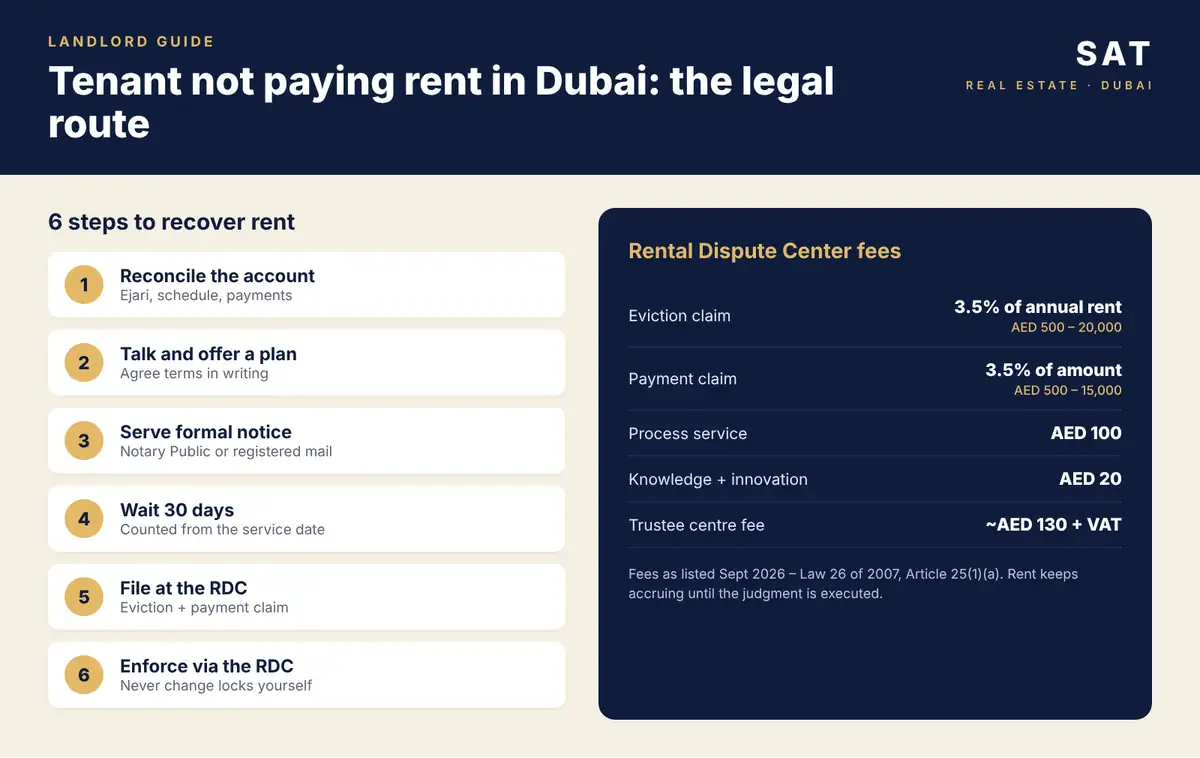
1. Reconcile the account. Check the Ejari contract, the payment schedule and every payment received. Make sure the amount you claim is exact, including any agreed discounts or changes.
2. Talk first and offer a plan. A call or meeting often solves a temporary cash-flow problem. If you agree a plan, put it in writing with dates and amounts, and keep your rights reserved if it fails.
3. Serve the formal notice. Use a Notary Public or registered mail, demand payment within 30 days and keep the notification report or postal proof.
4. Wait 30 days from service. Count from the documented service date. Filing before the period ends gives the tenant an easy defence.
5. File at the Rental Dispute Center. Submit the eviction claim (and a payment claim for the arrears) online or through a Real Estate Services Trustee centre with the required documents.
6. Enforce through the RDC. If the committee rules in your favour, enforcement is carried out through the RDC’s execution process. You never remove the tenant yourself.
Documents you will need include the latest Ejari certificate, the tenancy contract, your Emirates ID or passport (or company documents), title deed, IBAN details, the notice with proof of service, bounced cheques and bank return memos, and any correspondence. Documents not in Arabic must be legally translated. The RDC is part of the Dubai Land Department, where you can check the current requirements.
Timelines vary with the case and how well it is documented. A clear, properly served claim with complete papers moves much faster than one where service or the amount is in dispute.
How much does a Rental Dispute Center case cost?
RDC fees are set as a percentage of the amount in dispute, with minimums and caps. The figures below were listed in September 2026; confirm them on the RDC page before filing.
| Fee | Amount |
|---|---|
| Eviction claim | 3.5% of annual rent, minimum AED 500, maximum AED 20,000 |
| Payment (monetary) claim | 3.5% of the amount claimed, minimum AED 500, maximum AED 15,000 |
| Process service | AED 100 |
| Knowledge and innovation fees | AED 10 each |
| Registering a power of attorney | AED 25 |
| Trustee centre partner fee | About AED 130 plus VAT |
On a flat let at AED 90,000 a year, an eviction claim would cost about AED 3,150 in RDC fees plus small charges. A landlord who wins can ask the committee to order the tenant to pay the arrears and the costs of the case.
What about bounced rent cheques in Dubai?
Post-dated cheques are still the most common way to pay rent in Dubai, so a bounced cheque is often the first sign of trouble. Since the UAE’s cheque reforms, a cheque returned for insufficient funds is treated mainly as a civil debt rather than a criminal case, which means the focus is on recovering the money.
A bounced cheque does not lead to automatic eviction. The bank’s return memo proves the payment failed, but you still need to serve the 30-day notice before an eviction claim. For the money itself, the faster route is often a Writ of Payment: an order for a specific debt that is due and documented. You notify the tenant through a Notary Public or registered mail, and if they have not paid within five days of notification you can apply. A payment claim at the RDC is the alternative where the amount is disputed.
What landlords must never do
Frustration leads some landlords to take matters into their own hands. This can turn a strong case into a claim against you. Dubai law prohibits a landlord from:
- Changing the locks or blocking access to the property.
- Removing or holding the tenant’s belongings.
- Disconnecting electricity, water, chiller or internet.
- Entering the property without consent outside legal processes.
- Refusing valid rent. A tenant whose payment is refused can use the RDC’s Offer and Deposit procedure, and once a judge accepts it the tenant is treated as having paid.
Keep every message factual and professional, because the RDC committee may read it.
How to prevent rent arrears in the first place
The cheapest dispute is the one that never starts. Landlords who rarely have arrears do the same things well:
- Screen tenants properly. Check employment, salary relative to rent, Emirates ID and previous landlord references.
- Match the cheque plan to the tenant. More cheques (four to six) lower the risk of a large single default and are attractive to tenants in a softer market.
- Take a proper security deposit and record the condition of the property at handover.
- Register Ejari promptly and keep copies of every cheque and receipt.
- Act on the first missed payment. A polite call on day one, followed by formal notice if needed, works far better than waiting three months.
- Use professional management. A manager who handles collections, renewals and legal notices every week spots trouble early. See our property management in Dubai and rental supervision services.
Tenant not paying rent in Dubai: what is the fastest route?
The fastest route when a tenant is not paying rent in Dubai is almost always the correct one: reconcile the account, speak to the tenant, then serve a formal 30-day notice through a notary or registered mail. Most tenants pay or agree terms at that point. If they do not, a well-documented RDC claim, combined with a payment claim or Writ of Payment for the arrears, protects both your income and your property.
If you would rather not deal with collections and disputes yourself, SAT’s property management team handles tenant screening, cheques, renewals, notices and RDC coordination for Dubai landlords. Book a private investment consultation to review your tenancy, rent level and options, including whether to sell, hold or reinvest.
Related reading
- Dubai rental market 2026: why rents are falling
- Dubai mortgage rates 2026
- Etihad Rail and Dubai property
- Dubai property market outlook 2027
- Dubai Golden Visa through property in 2026
- Top property management company in Dubai in 2026
- Best places to invest in rental property in Dubai
- Off-plan vs ready property in Dubai
- Buying off-plan property in Dubai
Frequently asked questions
1. What can I do if my tenant is not paying rent in Dubai?
Speak to the tenant first, then serve a formal notice demanding payment within 30 days through a Notary Public or registered mail. If the rent is still unpaid after 30 days, you can file an eviction and payment claim at the Rental Dispute Center.
2. How long does a tenant have to pay after an eviction notice in Dubai?
For non-payment, the tenant has 30 days from the date the notice is formally served. If they pay the full amount within that time, the eviction ground no longer applies.
3. Can I send the payment notice by WhatsApp or email?
Not on its own. Article 25 requires service through a Notary Public or registered mail. WhatsApp and email can support your case as evidence that the tenant knew about the debt.
4. How much does it cost to file a case at the Rental Dispute Center?
Eviction claims cost 3.5% of the annual rent, with a minimum of AED 500 and a maximum of AED 20,000. Payment claims cost 3.5% of the amount claimed, capped at AED 15,000, plus small service fees.
5. Does a bounced rent cheque mean automatic eviction?
No. A bounced cheque proves non-payment but you still need to serve the 30-day notice before an eviction claim. To recover the money, a Writ of Payment or RDC payment claim is usually used.
6. Is a bounced cheque still a criminal offence in the UAE?
A cheque returned for insufficient funds is now treated mainly as a civil debt, so landlords usually recover the amount through civil procedures. Cases involving fraud or bad faith can still be treated differently.
7. Can a landlord change the locks if the tenant does not pay?
No. Landlords cannot change locks, remove belongings or cut services. Eviction can only be enforced through an RDC judgment and its execution process.
8. Does the tenant still owe rent while the case is running?
Yes. Under Article 31, rent continues to accrue until the judgment is issued and executed, so the landlord can claim the full arrears.
9. What documents do I need to file an eviction case in Dubai?
The Ejari certificate, tenancy contract, ID or company documents, title deed, IBAN, the notice with proof of service, bounced cheques and return memos, and relevant correspondence. Non-Arabic documents need legal translation.
10. Can SAT handle a non-paying tenant for me?
Yes. SAT’s property management team handles collections, formal notices, RDC filings and coordination with legal advisers, as well as tenant screening and renewals to prevent arrears.