
The Dubai rental market 2026 has turned, and landlords are feeling it first. After three years of double-digit rent rises, apartment rents in several of the city’s busiest communities fell by more than 10% year-on-year in the third quarter of 2026, and listings are staying online for longer.
This is not a collapse in tenant demand. The number of rental contracts signed in Q3 2026 was roughly the same as a year earlier. What has changed is supply: tenants now have more homes to choose from, so they negotiate. This guide explains where rents are falling, how it affects your yield and the practical steps that protect your income.
Key takeaways
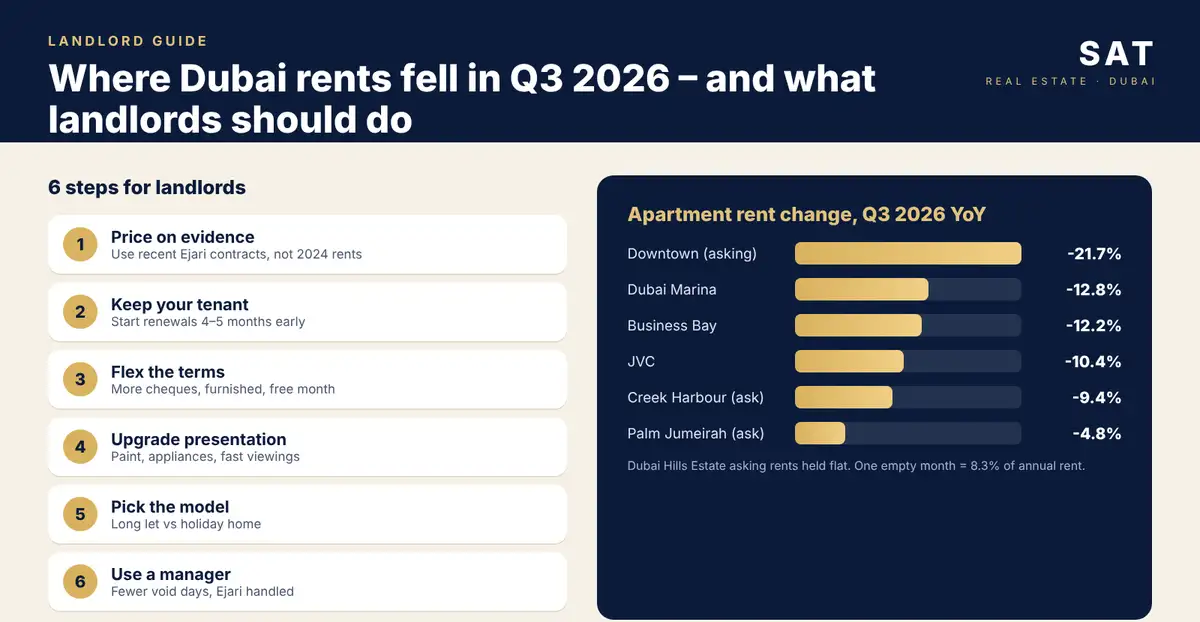
- Apartment rents in Dubai Marina (-12.8%), Business Bay (-12.2%) and JVC (-10.4%) fell year-on-year in Q3 2026, per Savills.
- Rental contracts held steady at about 181,900 in Q3, so demand is intact; choice has increased.
- Advertised rents in Dubai Hills Estate held flat while Downtown listings rose by more than half.
- One month of vacancy costs about 8.3% of annual rent; keeping a good tenant usually beats holding out for a higher number.
In this guide
- Why are Dubai rents falling in 2026?
- Where are Dubai rents falling fastest?
- What does this mean for rental yields in Dubai?
- Can a landlord increase rent in Dubai in 2026?
- What should landlords do when rents fall?
- Should you sell, hold or buy rental property in Dubai now?
- Is the Dubai rental market 2026 still worth investing in?
- Frequently asked questions
Why are Dubai rents falling in 2026?
The simplest answer is new supply. Around 26,500 homes were handed over in the first half of 2026, about 85% of them apartments, and Savills expects 75,000–85,000 completions for the year. Most of those units arrive in the same communities that already had the deepest rental stock, such as JVC, Business Bay, Arjan and Dubai South. Each completed building releases hundreds of units to the rental market within a few months.
Three other factors add to the pressure:
- Investor-owned handovers. A large share of 2022–2024 off-plan buyers were investors. When their units complete, many list them for rent at the same time, often at similar prices.
- Price-sensitive tenants. After sharp increases in 2023–2025, many tenants moved to cheaper communities or larger units in newer buildings. They now compare more listings before signing.
- Slower relocations at the top end. Prime areas such as Downtown saw asking rents drop as listings grew faster than new arrivals.
Demand itself remains healthy. Dubai’s population is still growing, tenant enquiries were up about 20% year-on-year in Q2 according to Betterhomes, and many residents who might have bought in 2026 chose to keep renting.
Where are Dubai rents falling fastest?
Rent changes vary widely by community. The table below combines Savills’ Q3 2026 transaction data with advertised (asking) rents tracked by market analysts.
| Community | Q3 2026 change (YoY) | What it signals |
|---|---|---|
| Downtown Dubai | about -22% (asking, apartments) | Listings up ~55%; tenants trading down |
| Dubai Marina | -12.8% (Savills) to -16% (asking) | Deep stock, new competing towers nearby |
| Business Bay | -12.2% (Savills) | Heavy handovers in 2025–2026 |
| JVC | -10.4% (Savills) | Largest single apartment pipeline in Dubai |
| Dubai Creek Harbour | about -9% (asking) | New phases completing |
| Arjan | about -6% (asking) | Mid-market supply rising |
| Palm Jumeirah | about -5% (asking) | Scarce, resilient |
| Dubai Hills Estate | Flat (asking) | Family demand, community appeal |
Asking rents are usually negotiated down further at signing, so treat these as direction rather than exact achieved rent. Villa and townhouse rents have been steadier overall, though some villa communities with new phases have also softened.
What does this mean for rental yields in Dubai?
Headline gross yields of 6–8% are still quoted widely, and Dubai remains well ahead of London, New York or Singapore. But gross yield is the wrong number to manage. What matters is net yield after costs and vacancy.
| Example 1-bed in a mid-market community | 2025 | 2026 |
|---|---|---|
| Purchase price | AED 1,000,000 | AED 1,000,000 |
| Annual rent | AED 85,000 | AED 76,000 |
| Service charges | AED 14,000 | AED 14,000 |
| Management, maintenance, insurance | AED 6,000 | AED 6,000 |
| Vacancy (1 month) | — | AED 6,300 |
| Net income | AED 65,000 | AED 49,700 |
| Net yield | 6.5% | 5.0% |
A 10% fall in rent combined with one empty month can cut net yield by around a quarter. Service charges do not fall when rents do, which is why buildings with high charges suffer most. Our yield and price guides show current ranges by community.
Can a landlord increase rent in Dubai in 2026?
Rent increases in Dubai are governed by Decree No. 43 of 2013 and the official rental index published by the Dubai Land Department and RERA. A landlord can raise rent at renewal only if the current rent is below the index average for a similar unit, and must give the tenant at least 90 days’ written notice before the contract ends. Every lease must be registered on Ejari.
In 2026 the practical position has flipped. In many apartment communities the index average is now close to, or below, what existing tenants pay, so there is little room for increases. In some cases tenants are asking for reductions at renewal. Check the official rental index calculator on the Dubai Land Department website before you send any renewal notice.
What should landlords do when rents fall?
The landlords who lose least in a softer market act early and price realistically. Here is the approach we recommend.
1. Price against evidence, not memory. Compare your asking rent with recent Ejari contracts in the same building and similar units, not with what you achieved in 2024. Overpriced listings sit, and a listing that has been reduced several times signals weakness to tenants.
2. Protect the tenant you have. Start renewal conversations four to five months before expiry. Offering a small reduction, or holding rent flat, to a reliable tenant almost always costs less than a month’s vacancy, agency fees and a new handover.
3. Offer flexibility instead of a lower headline. More cheques (four to six instead of one or two), a furnished option, a free month spread across the term, or including chiller or maintenance can close a deal without a permanent cut to the rent recorded on Ejari.
4. Upgrade presentation. New buildings set a higher standard. Fresh paint, working appliances, good photos and a quick viewing response are the cheapest way to compete.
5. Consider the right letting model. Holiday homes can earn more in prime tourist areas but carry higher costs and seasonality. Long lets suit family areas and investors who value stable income.
6. Use professional management. A good manager knows real achievable rents, screens tenants, handles Ejari and renewals and reduces void periods. See our property management in Dubai and rental supervision services.
Should you sell, hold or buy rental property in Dubai now?
Falling rents change the maths for each type of owner.
- Holding a well-located unit with a good tenant: usually hold. Short-term rent weakness does not justify selling into a slower market.
- Owning one of many identical units in a building or community still receiving large handovers: review the exit. Selling before the next wave may protect your price. Our sell, hold or reinvest review sets out the numbers side by side.
- New buyers seeking income: this is a better entry point than 2024. Lower rents are already in the price, sellers negotiate, and ready units with proven Ejari history let you underwrite real income. Start with our guide to the best places to invest in rental property in Dubai.
Villas and family townhouses remain the most resilient rental assets, because so little new villa stock is coming. Studios and one-bedroom apartments in high-supply areas are the most exposed.
Is the Dubai rental market 2026 still worth investing in?
Yes, with realistic expectations. The Dubai rental market 2026 is moving from a landlord’s market to a balanced one. Rents are lower than their 2025 peak in many apartment communities, but demand is steady, yields remain high by international standards, and the slowdown in new launches will ease supply pressure from 2028 onwards.
The winners will be landlords who price on evidence, keep good tenants, control costs and choose the right communities. SAT has managed and advised on Dubai rental property since 2013. Book a private investment consultation for a rent and yield review of your property, or let our property management team handle pricing, tenants and renewals for you.
Related reading
- Dubai property market outlook 2027
- Dubai Golden Visa through property in 2026
- Off-plan vs ready property in Dubai
- Buying off-plan property in Dubai
- Post-handover payment plans in Dubai
- Selling off-plan property before handover
- Top property management company in Dubai in 2026
Frequently asked questions
1. Are rents going down in Dubai in 2026?
Yes, in many apartment communities. Savills recorded year-on-year falls of about 10–13% in Dubai Marina, Business Bay and JVC in Q3 2026, while family areas such as Dubai Hills Estate held steadier.
2. Why are Dubai rents falling?
Mainly because of new supply. Tens of thousands of apartments were handed over in 2026, giving tenants more choice, while demand stayed broadly level.
3. Will Dubai rents fall further in 2027?
Apartment rents in high-supply areas may stay under pressure as more buildings complete in 2027. Villa rents and prime family communities are expected to be steadier.
4. What is a good rental yield in Dubai in 2026?
Gross yields of 6–8% are common, but a realistic net yield after service charges, management and vacancy is often 4.5–6% for apartments. Always compare net, not gross, figures.
5. Can my landlord increase the rent in Dubai?
Only at renewal, only if your rent is below the official rental index average for similar units, and only with at least 90 days’ written notice. In 2026 many apartments have little or no room for increases.
6. Can a tenant ask for a rent reduction in Dubai?
Yes. There is no rule that forces a reduction, but tenants can negotiate at renewal, and many landlords agree to avoid vacancy. The agreed rent is then registered on Ejari.
7. How much does vacancy cost a Dubai landlord?
Each empty month costs about 8.3% of annual rent, plus service charges and utilities that continue regardless. That is why keeping a reliable tenant is usually the better choice.
8. Which Dubai areas have the most stable rents?
Dubai Hills Estate, established villa communities and Palm Jumeirah have shown the most stable rents in 2026. High-supply apartment areas such as JVC and Business Bay have seen the largest falls.
9. Is it better to do long-term or holiday home rental in 2026?
Holiday homes can earn more in prime tourist areas but have higher costs, licensing and seasonality. Long-term lets give steadier income and suit family communities and hands-off investors.
10. How can SAT help landlords in a falling rental market?
SAT prices your property on recent Ejari evidence, markets it, screens tenants, handles renewals and Ejari registration, and reviews whether to hold or sell. Book a private investment consultation for a rent and yield review.