The Dubai property market outlook 2027 is the question every investor is now asking, because 2026 has been the first year in more than five years when prices and rents moved down rather than up. Transactions have slowed, a record wave of new homes is arriving, and the developer launch pipeline has shrunk sharply.
None of this means Dubai has stopped being a strong market. It means the market has moved from a momentum phase to a selection phase. In 2027 the result of an investment will depend far more on what you buy, where and at what price than on simply being in the market. This guide sets out what the data shows, what to expect next year and how to position a portfolio.
Key takeaways
- Dubai home prices recorded their first year-on-year fall since February 2021 in August 2026, down about 1.7% to roughly AED 1,636 per sq ft.
- Q3 2026 sales fell 38% year-on-year to about 34,500 deals, while new launches dropped around 64%.
- Scheduled 2027 handovers run from 60,000 to over 140,000 units, but actual delivery has run at well under half of schedule.
- Villas, prime waterfront and well-located family homes are holding value far better than mid-market apartments.
In this guide
- What happened in Dubai real estate in 2026?
- Why are Dubai property prices falling in 2026?
- How much new supply is coming in 2027?
- Dubai property prices 2027: three scenarios
- Where to invest in Dubai in 2027
- Should you buy now or wait until 2027?
- What should existing owners do in 2027?
- Is the Dubai property market outlook 2027 positive?
- Frequently asked questions
What happened in Dubai real estate in 2026?
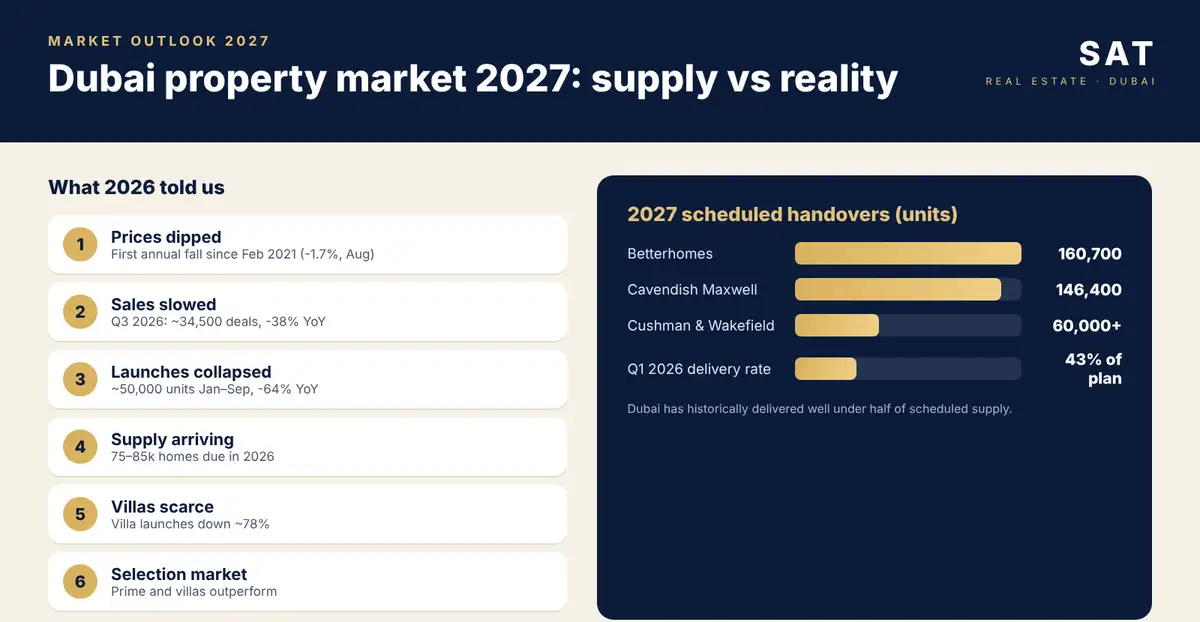
After capital values rose by roughly 60% between 2022 and early 2025, 2026 opened strongly and then cooled. According to ValuStrat, citywide capital values fell about 10% between February and August 2026, leaving them around 3% lower than a year earlier. Cavendish Maxwell reported that average residential prices in August were about 1.7% lower than in August 2025, the first annual decline since February 2021.
Volumes cooled faster than prices. Savills recorded about 34,500 residential sales in Q3 2026, 38% fewer than in Q3 2025. Earlier in the year, Betterhomes reported that secondary (ready) sales collapsed by around 59% in Q2 while off-plan sales fell only 12%. Off-plan still makes up around three quarters of all residential deals.
The important point is the split between segments:
| Segment | 2026 direction | Why |
|---|---|---|
| Mid-market apartments (JVC, Arjan, Dubai South, Business Bay) | Prices and rents softening | Most new supply is apartments in these areas |
| Prime apartments (Downtown, Marina) | Prices broadly stable, rents down | Listings rising faster than tenant demand |
| Villas and townhouses | Small decline after years of gains | Villa launches fell about 78%; stock stays scarce |
| Ultra-prime (Palm Jumeirah, Emirates Hills, Jumeirah Bay) | Fewer deals, values resilient | Thin supply, global buyer base |
Rents told the same story. Savills found apartment rents in Dubai Marina, Business Bay and JVC fell by roughly 10–13% year-on-year in Q3 2026, even as the total number of rental contracts held level with 2025. Tenants are still arriving; they simply have more choice.
Why are Dubai property prices falling in 2026?
Three forces explain most of the change.
1. Supply finally arriving. Around 26,500 homes were handed over in H1 2026, about 85% of them apartments, and Savills expects 75,000–85,000 for the full year. That is the highest annual delivery in nearly two decades. New stock gives tenants and resale buyers options they did not have in 2023–2024.
2. Slower buyer enquiry. Betterhomes reported buyer enquiries down about a third year-on-year in Q2, with apartment enquiries falling most. Regional uncertainty earlier in the year and higher entry prices both made buyers more patient.
3. Investors re-pricing yield. When rents soften, the price an investor will pay for a given unit falls. Gross yields have compressed across studios, one-bedroom and two-bedroom units, so buyers are negotiating harder in rental-led communities.
What has not changed is the demand base. Dubai’s population is projected to reach around 4.7 million by the end of 2026, the economy is forecast to grow about 5%, and the office market hit record values in 2026. These are the conditions of a maturing market, not a crash.
How much new supply is coming in 2027?
This is where most headlines mislead. Published schedules look alarming:
| Source | 2026 scheduled | 2027 scheduled |
|---|---|---|
| Cavendish Maxwell / Property Monitor | ~77,500 | ~146,400 |
| Betterhomes | ~74,100 | ~160,700 |
| Cushman & Wakefield (expected) | Highest since 2008 | 60,000+ |
But Dubai has a long record of delivering well below schedule. In Q1 2026 only about 43% of scheduled units were actually handed over. ValuStrat noted that just 20,000 homes were completed in H1 2026 against a preliminary target of more than 129,000. Contractor capacity, supply-chain delays and developers’ own pacing all stretch timelines.
Just as important, the launch pipeline has collapsed. Only about 50,000 units were launched in the first nine months of 2026, around 64% fewer than in the same period of 2025. That is what drives deliveries in 2029–2030. A smaller pipeline today means less pressure on prices later.
Our working view for 2027 is that realistic deliveries will be heavy but staggered, concentrated in mid-market apartment communities, and that villa and prime supply will remain tight.
Dubai property prices 2027: three scenarios
Nobody can forecast a single number with confidence, so we plan around scenarios.
| Scenario | What happens | Citywide price effect | Who it hurts most |
|---|---|---|---|
| Soft landing (base case) | Deliveries slip, demand stays steady, rates ease | Flat to -5% for apartments; villas flat to modest growth | Over-leveraged flippers in high-supply areas |
| Deeper correction | Deliveries arrive on schedule, enquiry stays weak | -10% to -15% in mid-market apartments | Buyers of generic stock with no rental edge |
| Early recovery | Lower rates and new residents absorb supply fast | Prime +5–8%, mid-market flat | Buyers who waited too long for “the bottom” |
Fitch Ratings had already flagged a “moderate correction” of around 10–15% when supply peaked, and the 2026 data so far sits at the milder end of that range. In every scenario the gap between prime and average stock widens. That is the most useful single idea for 2027.
Where to invest in Dubai in 2027
In a selection market, location and product type matter more than the headline. Here is how we would rank segments for the year ahead.
Hold or buy with conviction
- Villas and townhouses in established communities such as Dubai Hills Estate, Arabian Ranches and Tilal Al Ghaf. Villa launches have fallen hardest, and family demand is long-term. See our luxury villas in Dubai.
- Prime waterfront such as Palm Jumeirah and, for longer horizons, Palm Jebel Ali. Scarcity protects value.
- Ready units with proven rental evidence in buildings with low vacancy and reasonable service charges.
Buy selectively, only at the right price
- Downtown and Dubai Marina apartments. Values are holding but rents have fallen, so pay for yield, not the address.
- Growth corridors such as Dubai South, where infrastructure (Al Maktoum Airport, the Blue Line) supports a five-to-ten-year view, but near-term supply is heavy.
Approach with caution
- Generic studios and one-bedroom units in high-supply mid-market areas, especially off-plan bought purely to flip before handover.
Should you buy now or wait until 2027?
Waiting for a “bottom” sounds sensible but rarely works in practice. Three reasons to act selectively now:
- Negotiating power is with buyers. Ready-market volumes are down sharply, so motivated sellers accept below-asking offers. Developers are again offering longer post-handover payment plans and fee waivers.
- Residency rules have improved. Since 2026, sole owners of ready property qualify for the two-year investor visa with no minimum value, and the AED 2 million Golden Visa no longer needs a large upfront payment.
- Prime stock does not wait. Scarce villas and waterfront units rarely become cheaper just because mid-market apartments do.
Reasons to wait: if your budget only reaches high-supply apartment communities, or you rely on a quick flip, patience and a lower entry price will serve you better.
What should existing owners do in 2027?
If you already own in Dubai, 2027 is the year to review rather than react.
- Re-test your rent. Compare your rent with recent Ejari contracts in the same building, not with 2024 levels. A month of vacancy costs about 8% of annual income.
- Check your exit depth. If your unit is one of hundreds of identical units handing over nearby, consider whether to sell before or after that wave. Our sell, hold or reinvest review is designed for exactly this decision.
- Off-plan holders: decide early whether to assign before handover or complete. Read how to sell off-plan property before handover.
- Rebalance. Many portfolios built in 2022–2024 are concentrated in one-bedroom apartments. Swapping two units for one villa or one prime unit can reduce risk. Our portfolio advisory team can model this.
Is the Dubai property market outlook 2027 positive?
Yes, for disciplined investors. The Dubai property market outlook 2027 is not a boom and not a crash. It is a market where supply is finally catching up in the apartment segment while villas and prime stock remain scarce, population and the economy keep growing, and the launch pipeline has already corrected itself. Prices in high-supply areas may soften further, but entry prices, payment terms and residency rules are now more favourable than at any point since 2021.
The investors who do well in 2027 will buy on evidence: rental data from Ejari, realistic service charges, honest exit analysis and the right entry price. SAT has advised investors in Dubai since 2013 across three market cycles. Book a private investment consultation and we will review your target areas, your existing holdings and the numbers before you commit, or explore our latest Dubai market reports.
Related reading
- Buying off-plan property in Dubai: a step-by-step guide
- Off-plan vs ready property in Dubai
- Selling off-plan property before handover
- Post-handover payment plans in Dubai
- Dubai rental market 2026: why rents are falling and what landlords should do
- Dubai Golden Visa through property in 2026
- Best areas to invest in Dubai real estate (2026 guide)
Frequently asked questions
1. Will Dubai property prices fall in 2027?
Prices in high-supply apartment communities may soften further in 2027, while villas and prime waterfront stock are expected to hold value. Our base case is flat to slightly lower citywide apartment prices rather than a sharp fall.
2. Is Dubai real estate in a crash?
No. Prices fell only about 1.7% year-on-year by August 2026 after a rise of roughly 60% since 2022. Volumes have dropped more than prices, which is typical of a cooling rather than a crash.
3. How many homes will be delivered in Dubai in 2027?
Published schedules range from about 60,000 to more than 160,000 units. In practice Dubai has delivered well under half of scheduled supply, so real 2027 handovers are likely to be lower and spread over time.
4. Is 2027 a good time to buy property in Dubai?
It can be, if you buy selectively. Buyers have more negotiating power, payment plans are generous and visa rules have improved, but generic apartments in high-supply areas need a lower entry price.
5. Which areas in Dubai are safest for 2027?
Established villa communities such as Dubai Hills Estate and Arabian Ranches, and prime waterfront such as Palm Jumeirah, have the most resilient values. Areas with heavy apartment handovers, such as JVC and parts of Dubai South, face more short-term pressure.
6. Should I sell my Dubai apartment before 2027?
It depends on how many similar units are handing over near yours and on your rental income. If a large wave of identical stock is due, selling before it arrives can protect your price; a sell, hold or reinvest review will show the numbers.
7. Are off-plan properties still a good investment in Dubai?
Off-plan can still work when bought from a strong developer, in a location with limited competing supply, at a fair price with a long payment plan. Buying off-plan purely to flip before handover is riskier in 2027 than it was in 2023–2024.
8. What will happen to Dubai rents in 2027?
Apartment rents in high-supply areas are likely to stay under pressure as new stock completes, while villa rents should be steadier. Landlords should price against recent Ejari contracts and focus on keeping tenants.
9. How do interest rates affect Dubai property in 2027?
The UAE dirham is pegged to the US dollar, so UAE mortgage rates follow US rate moves. Lower rates in 2027 would improve affordability for mortgage buyers and support demand.
10. How can SAT help me plan for 2027?
SAT reviews your objectives, existing holdings and target areas using DLD transaction data, Ejari rental evidence and supply analysis. You can book a private investment consultation to get a clear buy, hold or sell view.