
A post-handover payment plan in Dubai lets you take the keys to a new home while still owing part of the price, often 30–60%, paid over one to five years after completion. For investors, the appeal is obvious: you can lease the unit and let rent help cover the remaining instalments. But these plans are not free money. The convenience is usually priced in, and the terms can limit how and when you sell.
This guide explains how post-handover plans work, what they really cost, how to test whether the rent will cover the payments and the questions to ask a developer before you commit.
Key takeaways
- A post-handover plan splits the price into pre-handover and post-handover instalments, with the second part paid directly to the developer after completion.
- Rent rarely covers the full post-handover instalment. Run a rent coverage test before you buy.
- The flexibility is often reflected in a higher price than a cash or shorter-plan deal. Compare the effective cost.
- Check when the title deed is issued, whether you can resell or lease freely and what happens if you miss a payment.
In this guide
- What Is a Post-Handover Payment Plan?
- How a Post-Handover Plan Works in Practice
- The Pros of Post-Handover Payment Plans
- The Cons and Hidden Costs
- Rent Coverage: Will Rent Pay the Instalments?
- How to Compare the True Cost of a Plan
- Questions to Ask Before You Sign
- Who Should Consider a Post-Handover Plan?
- Is a Post-Handover Payment Plan in Dubai Worth It?
- Frequently Asked Questions About Post-Handover Payment Plans in Dubai
What Is a Post-Handover Payment Plan?
In a standard off-plan purchase, most or all of the price is paid by the time you collect the keys. A post-handover payment plan shifts a share of the price beyond completion. Typical structures include:
| Structure | Before handover | After handover |
|---|---|---|
| 60/40 | 60% during construction and at handover | 40% over two to three years |
| 50/50 | 50% during construction and at handover | 50% over three to five years |
| 1% monthly | 1% a month during construction | 1% a month after handover until paid |
| 70/30 | 70% before completion | 30% over one to two years |
The post-handover share is effectively developer financing. It is usually interest-free on paper, but it is built into the overall pricing. Like every off-plan purchase, the sale is registered on the Dubai Land Department (DLD) Oqood register and pre-handover payments go into the project escrow account. You can verify a project’s registration through the Dubai Land Department before you pay.
How a Post-Handover Plan Works in Practice
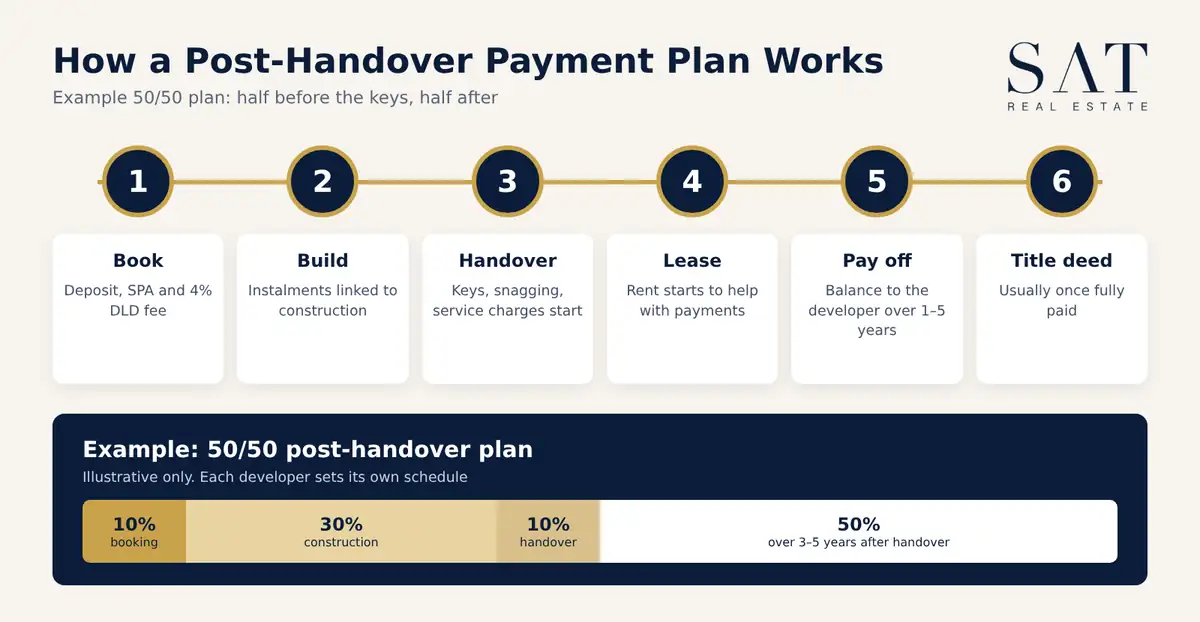
- Booking and SPA. You pay the booking deposit, sign the Sales and Purchase Agreement (SPA) and pay the 4% DLD fee on the full price.
- Construction instalments. You pay the pre-handover share in stages linked to milestones.
- Handover. You pay any handover instalment, complete snagging and receive the keys.
- Leasing. You can usually lease the unit and start collecting rent, subject to the SPA.
- Post-handover instalments. You pay the remaining balance to the developer, monthly or quarterly, until fully settled.
- Title deed. The final title deed is commonly issued only once the price is fully paid, or with the developer’s interest registered against the unit until then. Check the SPA.
The Pros of Post-Handover Payment Plans
- Less capital before income. You commit less money before the unit can earn rent.
- Rent helps pay the balance. Rental income can cover part of each instalment.
- No bank approval needed. The post-handover share is developer credit, which helps buyers who cannot easily get a UAE mortgage, including many non-residents.
- Interest-free on paper. There is usually no stated interest rate, though the cost may be in the price.
- Leverage on growth. If values rise, your gain is earned on the full unit while part of the price is still unpaid.
The Cons and Hidden Costs
- Price premium. Projects with long post-handover plans can be priced above comparable units sold on shorter plans or for cash. Ask for the cash price and compare.
- Rent shortfall. Gross rent often covers only a part of the instalment, so you must fund the gap from savings or income.
- Service charges start at handover. These come on top of instalments, so budget for them from day one.
- Resale restrictions. Selling before the balance is paid usually needs a developer NOC and may require the buyer to take over or settle the remaining instalments.
- Default terms. Missed payments can trigger penalties under the SPA, and the developer may retain amounts paid.
- No refinancing at will. Moving the post-handover balance to a bank mortgage is possible only if a lender accepts the property and you meet its criteria.
Rent Coverage: Will Rent Pay the Instalments?
The most important test is simple: how much of each post-handover payment will rent cover? The example below is illustrative only.
| Assumption | Value |
|---|---|
| Purchase price | AED 1,500,000 |
| Plan | 50% before handover, 50% over 3 years after |
| Post-handover balance | AED 750,000 |
| Annual post-handover payment | AED 250,000 |
| Gross rent at 7% of price | AED 105,000 a year |
| Service charges (example) | AED 15,000 a year |
| Net rent | AED 90,000 a year |
| Rent coverage | About 36% of each year’s instalment |
| Annual shortfall to fund | About AED 160,000 |
In this case, the investor still needs about AED 13,000 a month from other sources for three years. A longer plan lowers the annual payment and raises coverage. A five-year plan on the same balance means AED 150,000 a year, and net rent would cover about 60%. Always run this test with real rents for comparable completed units. Our yield and price guides explain how SAT sources rental evidence.
How to Compare the True Cost of a Plan
A plan is only good value if the total price is fair. Use three checks:
- Cash price vs plan price. Ask the developer, or the market, what the same unit sells for with a shorter plan. The difference is the cost of the credit.
- Effective interest rate. Treat the price premium as interest on the post-handover balance. If it works out higher than a mortgage you could obtain, the plan is expensive. Our mortgage and specialist coordination team can compare bank options.
- Price vs ready stock nearby. If the full plan price is close to or above finished homes in the same area, much of your upside has already been paid away.
The costs and financing chapter of our Dubai Real Estate Investment Guide explains how to calculate total capital exposure across a payment schedule.
Questions to Ask Before You Sign
- When is the title deed issued, and is the developer’s interest registered against the unit?
- Can I lease the property from handover, including as a holiday home?
- Can I resell before the balance is paid, and what NOC conditions apply?
- What penalties apply to late payments, and what is the grace period?
- Can I settle early, and is there a discount for doing so?
- Who pays service charges during the post-handover period? (Almost always you.)
Our off-plan investment advisory team reviews these terms, the developer’s delivery record and the true price before you commit.
Who Should Consider a Post-Handover Plan?
A post-handover plan can suit you if:
- You have steady income to cover the shortfall between rent and instalments
- You prefer developer credit to a bank mortgage, or cannot easily access one
- You plan to hold the unit for the full plan period or longer
- The plan price is still competitive against comparable stock
It is less suitable if you need positive cash flow from day one, intend to sell quickly or are relying entirely on rent to pay the balance. If you do go ahead, SAT’s property management and rental supervision services help keep the unit let and the rent flowing.
Is a Post-Handover Payment Plan in Dubai Worth It?
A post-handover payment plan in Dubai can be a useful tool: it reduces the capital you commit before income starts and gives access to developer credit without a bank. Its value depends on the price you pay for that flexibility and on realistic rent assumptions. Test the effective cost, run the rent coverage numbers and read the SPA closely before you commit.
Browse current off-plan properties in Dubai, including projects in growth areas such as Dubai South and Dubai Islands, or ask an adviser to model a plan for you.
Book a private investment consultation
Related reading
- Buying Off-Plan Property in Dubai: The Complete 2026 Investor Guide
- Off-Plan vs Ready Property in Dubai: Which Delivers Better Returns?
- How to Sell Off-Plan Property Before Handover in Dubai
- Best Places to Invest in Rental Property in Dubai
- Best Areas to Invest in Dubai Real Estate (2026 Guide)
Frequently Asked Questions About Post-Handover Payment Plans in Dubai
1. What is a post-handover payment plan in Dubai?
It is an off-plan payment structure where part of the price, often 30–60%, is paid to the developer over one to five years after you receive the keys, rather than before handover.
2. Do post-handover payment plans charge interest?
Most have no stated interest rate, but the cost of the credit is often built into a higher purchase price. Compare the plan price with a cash or shorter-plan price to see the real cost.
3. Can I rent out my property during a post-handover plan?
Usually yes, from handover, which is the main appeal. Check the SPA for any leasing restrictions, especially for short-term or holiday home lets.
4. Will rent cover my post-handover instalments?
Rarely in full. On a typical three-year plan, net rent may cover around a third of the annual instalment. Longer plans improve coverage, so always run the numbers with real rents.
5. When do I get the title deed on a post-handover plan?
Commonly once the full price is paid, or with the developer’s interest registered against the unit until then. The SPA sets the exact terms.
6. Can I sell a property that is still on a post-handover plan?
Often yes, with a developer NOC. The buyer may need to take over the remaining instalments or the balance may need to be settled at transfer.
7. What happens if I miss a post-handover payment?
Late-payment penalties set in the SPA can apply, and persistent default can lead to cancellation, with the developer retaining amounts allowed under Dubai law. Speak to the developer early if you expect difficulty.
8. Can I switch a post-handover balance to a bank mortgage?
Sometimes. A bank must accept the property and you must meet its criteria. The developer will also need to agree to release its interest when the bank pays off the balance.
9. Do I pay service charges during the post-handover period?
Yes. Service charges start from handover and are paid by the owner, on top of the post-handover instalments.
10. Are post-handover payment plans good for non-residents?
They can be, because they offer credit without a UAE bank mortgage. Non-residents should still check the rent coverage, the developer’s track record and the resale terms carefully.