
Escrow accounts in Dubai are the main reason off-plan buying is far safer today than it was before 2007. Every registered off-plan project must have its own escrow account with a bank approved by the Dubai Land Department, and the developer can only draw on buyers’ money as construction progresses. If you understand how this works, you can check in minutes whether your payments are protected.
This guide explains how off-plan escrow accounts work, the law behind them, when developers can access the money, the 5% retention after completion, what happens if a project is delayed or cancelled, and the simple checks every buyer should make before paying a deposit.
Key takeaways
- Under Dubai Law No. 8 of 2007, every off-plan project must have a dedicated escrow account with a DLD-approved bank.
- Developers can withdraw funds only against certified construction progress, not for other projects or marketing.
- 5% of the account is retained after completion and released one year after units are registered to buyers.
- Always pay directly into the project escrow account, never to a broker or a personal account.
In this guide
- What an off-plan escrow account is
- How the escrow process works
- When developers can access escrow funds
- The 5% retention after completion
- What happens if a project is delayed or cancelled
- How to check a project’s escrow account
- Escrow vs other buyer protections
- Common escrow mistakes buyers make
- Questions to ask the developer before you pay
- Are escrow accounts in Dubai enough to protect off-plan buyers?
What an off-plan escrow account is
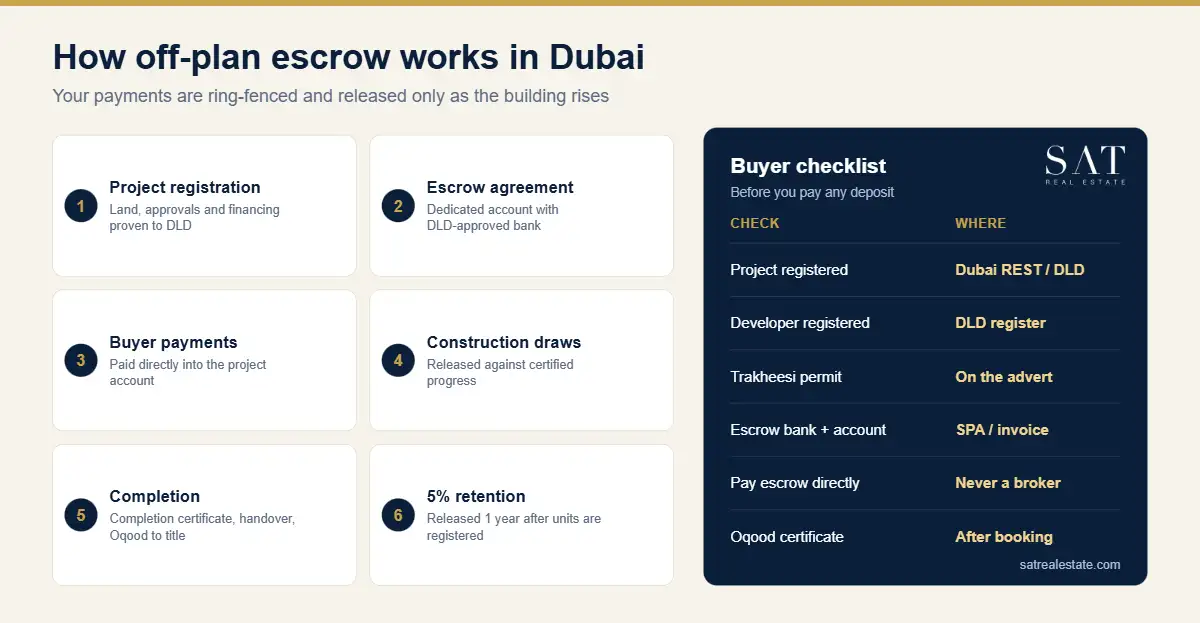
An escrow account is a ring-fenced bank account opened in the name of a single real estate project. Buyers’ instalments and any project financing go into it, and the money can only be used to build that project. It is controlled by an escrow agent, a bank accredited by the DLD, rather than by the developer alone.
Before 2007, buyers in some projects paid developers directly, and when projects stalled their money had often been spent elsewhere. Law No. 8 of 2007 concerning escrow accounts for real estate development changed that. It made escrow mandatory for every developer selling off-plan in Dubai and gave the DLD and RERA powers to supervise the accounts.
How the escrow process works
The process follows a clear sequence:
| Stage | What happens |
|---|---|
| 1. Project registration | Developer registers the project with the DLD, proving land ownership, approvals and financing |
| 2. Escrow agreement | Developer signs an agreement with a DLD-approved bank; the DLD receives a copy |
| 3. Sales permission | DLD approves advertising and sales; listings carry a Trakheesi permit |
| 4. Buyer payments | Buyers pay instalments directly into the project escrow account |
| 5. Construction draws | The bank releases funds to contractors as progress is certified and verified by RERA |
| 6. Completion | Completion certificate issued; units handed over and registered |
| 7. Retention release | 5% retention released one year after units are registered to buyers |
Each project has its own account number. Money from one project cannot be moved to fund another, and developers cannot use it for land purchases elsewhere, marketing or profit before the work is done.
When developers can access escrow funds
Withdrawals are tied to construction. The project consultant certifies the work completed, RERA reviews progress, and the escrow bank then pays contractors, consultants and other approved project costs. This means the amount released broadly matches the value of what has actually been built.
Developers usually also have to show they can fund part of the build themselves, and in many cases the first instalments are linked to construction milestones rather than the calendar. This is one reason payment plans are expressed as percentages tied to construction stages.
Brokers are bound by the same rules. Under the implementing regulations, brokers must deposit off-plan sale proceeds into the project escrow account and may not deduct their commission first.
The 5% retention after completion
Once the building receives its completion certificate, the escrow agent keeps back 5% of the total value of the account. This retention is released to the developer one year after the units are registered in buyers’ names.
The retention gives buyers leverage during the first year after handover. It sits alongside the developer’s liability for defects: one year for non-structural items such as fittings and finishes, and ten years for structural defects. If you find snags at handover, report them in writing promptly. Our guide to property snagging in Dubai covers what to check.
What happens if a project is delayed or cancelled
Escrow does not guarantee a project will finish on time, but it protects the money you paid.
- Delays: if construction slows, the money already in escrow is still held for the project. Your rights under the sale and purchase agreement and Dubai law apply. Read our guide to an off-plan project delayed in Dubai.
- Stalled projects: if a project is not completed, the escrow agent, working with the DLD, must either ensure completion, for example through a replacement developer, or refund depositors from the account.
- Cancelled projects: where the DLD and RERA cancel a project, buyers’ funds held in escrow are returned through the official process, with disputes handled by the dedicated committee for stalled and cancelled projects.
- Developer penalties: developers who break escrow rules face fines of at least AED 100,000, possible imprisonment and removal from the developer register.
How to check a project’s escrow account
You can confirm the essentials yourself before paying anything:
- Check the project on the DLD: search the project on the Dubai REST app or DLD website and confirm it is registered and active.
- Confirm the developer: make sure the developer is on the DLD developer register.
- Check the advert: genuine listings show a Trakheesi permit number and QR code.
- Get the escrow details in writing: the SPA and payment instructions should name the escrow bank and the project account number.
- Pay the escrow account directly: transfer only to the account in the developer’s official name at the escrow bank. Never pay a broker, a personal account or a different company.
- Register the sale on Oqood: your purchase should be recorded on the DLD’s interim register, and you should receive the Oqood certificate.
See the Dubai Land Department for official project and developer searches.
Escrow vs other buyer protections
Escrow is one layer of protection. Others include:
- Oqood registration, which records your purchase with the DLD before handover
- The SPA, which sets the completion date, specifications and remedies
- RERA supervision of developers, brokers and advertising
- Defect liability of one year for non-structural and ten years for structural defects
- Trustee offices that handle registration and payments on resales
Together they make Dubai’s off-plan framework one of the more robust in the region, but they only help buyers who use them. Most problems arise when buyers pay outside the system or buy from unregistered sellers.
Common escrow mistakes buyers make
Most escrow problems come from avoidable errors:
- Paying a booking fee to a broker instead of the developer’s escrow account, then struggling to get it back when the deal changes
- Transferring to an account in a similar but different company name, a common sign of fraud
- Buying before the project is registered on the DLD, when sales are not valid
- Accepting an assignment without a developer NOC, so the transfer is not recorded properly
- Not keeping receipts and bank confirmations for each instalment
Keep a simple file with your SPA, Oqood certificate, payment receipts and escrow account details. If anything goes wrong, those documents prove what you paid and where.
Questions to ask the developer before you pay
Before signing a reservation form or paying a booking amount, ask the developer or their sales team:
- What is the DLD project number, and is the project registered and active?
- Which bank is the escrow agent, and what is the escrow account number?
- What percentage of construction is complete, and when was it last certified?
- Is the payment plan linked to construction milestones or fixed dates?
- What is the anticipated completion date in the SPA, and what grace period applies?
- What are the developer’s obligations and your remedies if completion is late?
- What are the fees and conditions for reselling before handover, including the developer NOC?
A professional developer will answer these quickly and in writing. Hesitation or vague answers, especially about the escrow account, are a reason to pause. It is also worth checking the developer’s record on previous projects: how close to schedule they delivered, the build quality at handover and how their completed buildings have held their value on resale.
Are escrow accounts in Dubai enough to protect off-plan buyers?
They are a strong foundation. Escrow accounts in Dubai ensure your money goes into a ring-fenced account and is released only as the building rises. Combined with Oqood registration and a careful choice of developer, they reduce off-plan risk substantially. The remaining risks, such as delays, specification changes or weaker resale demand, are best managed by choosing experienced developers and reading the SPA closely.
SAT Real Estate checks project registration, escrow details and developer track record before recommending any off-plan purchase. Book a private investment consultation or see our off-plan investment advisory service.
Related reading
- Rental Yield in Dubai: How to Calculate Gross and Net ROI
- UAE Corporate Tax on Real Estate
- Buying Off-Plan Property in Dubai: The Complete 2026 Investor Guide
- Off-Plan Project Delayed in Dubai? Your Rights
- Post-Handover Payment Plans in Dubai
- How to Sell Off-Plan Property Before Handover
- Cost of Buying Property in Dubai
Frequently asked questions
1. What is an escrow account in Dubai real estate?
It is a ring-fenced bank account for a single off-plan project. Buyers’ payments go into it and can only be used to build that project under DLD and RERA supervision.
2. Is an escrow account mandatory for off-plan projects in Dubai?
Yes. Law No. 8 of 2007 requires every developer selling off-plan in Dubai to open a dedicated escrow account with a DLD-approved bank.
3. When can a developer withdraw money from escrow?
Only against construction progress certified by the project consultant and verified by RERA, with payments made to contractors and approved project costs.
4. What is the 5% escrow retention?
After completion, 5% of the account is held back and released to the developer one year after the units are registered in buyers’ names.
5. What happens to my money if an off-plan project is cancelled?
Funds held in escrow are protected. The escrow agent and DLD either arrange completion or refund buyers through the official process for cancelled projects.
6. How do I find a project’s escrow account?
The escrow bank and account number should be in your SPA and payment instructions. You can confirm the project’s registration on the Dubai REST app or DLD website.
7. Can I pay my off-plan deposit to a broker?
You should not. Payments should go directly into the project escrow account. Brokers must not hold buyer funds or deduct commission from them.
8. Does escrow protect against construction delays?
It protects the money you paid, but not the timeline. Delays are governed by your SPA and Dubai law, and the funds stay ring-fenced for the project.
9. Is Oqood the same as escrow?
No. Escrow protects your payments; Oqood registers your purchase on the DLD’s interim register before handover. You need both.
10. Are resale off-plan payments also made into escrow?
Instalments still due to the developer go into the project escrow account. Payments between seller and buyer on a resale are handled through the developer and a trustee or conveyancer.