
Ejari registration in Dubai is the official step that records a tenancy contract with the Dubai Land Department (DLD) and the Real Estate Regulatory Agency (RERA). Once a lease is registered, it becomes part of the government record, which protects both landlord and tenant if a dispute ever arises.
For tenants, Ejari is needed to connect DEWA and for many residency processes. For landlords, it is the proof that a lease exists on the terms both sides agreed. This guide explains who registers, the documents and fees, the online steps, renewals and the common mistakes to avoid.
Key takeaways
- Ejari is the official DLD and RERA system for registering tenancy contracts in Dubai.
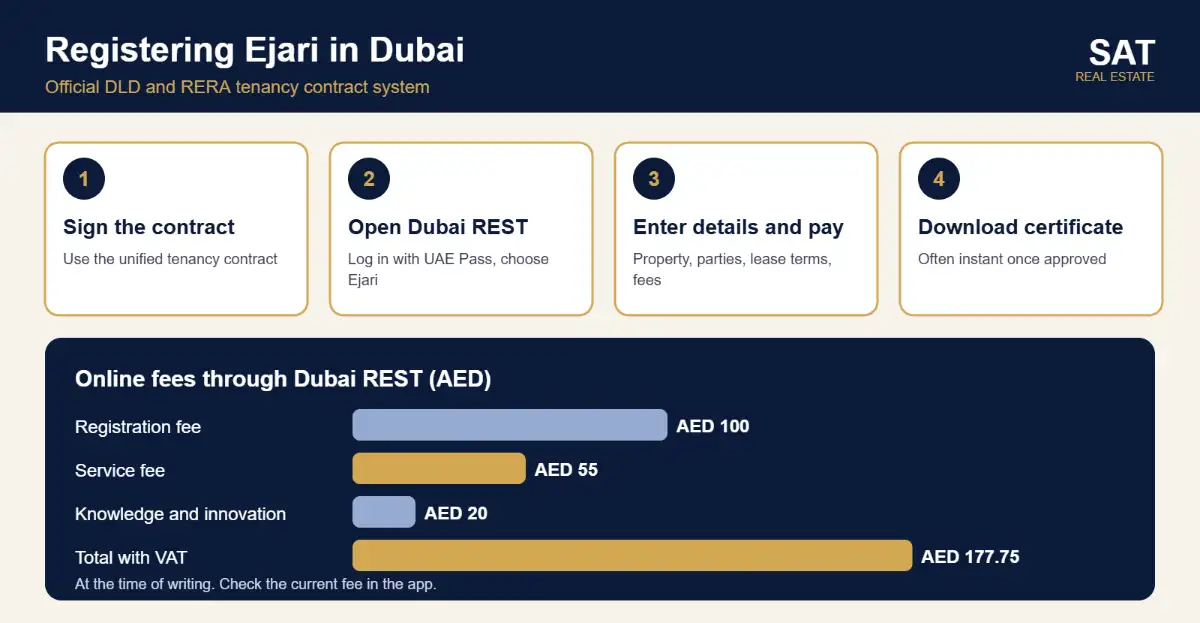
- Online registration through Dubai REST costs about AED 177.75 in total and is usually instant.
- A registered Ejari is needed for DEWA connection, residency processes and legal protection in disputes.
- Every new or renewed lease needs its own registration, so build it into your renewal routine.
In this guide
- What is Ejari?
- Why Ejari matters
- Who is responsible for registering?
- Documents you need
- How to register Ejari online, step by step
- Ejari fees
- Renewals, changes and cancellation
- What landlords should know
- What tenants should know
- Ejari for different situations
- What happens if a lease is not registered?
- Common mistakes to avoid
- Is Ejari registration in Dubai worth doing promptly?
What is Ejari?
Ejari, which means “my rent” in Arabic, is the DLD system for registering residential and commercial tenancy contracts. The registered contract follows a standard format, known as the unified tenancy contract, and records the parties, the property, the rent and the lease period.
The aim is transparency. With every lease on one official system, the authorities can track rental activity, and landlords and tenants have a clear record to rely on.
Why Ejari matters
A registered Ejari has practical uses for both sides.
- DEWA connection. Tenants usually need Ejari to activate electricity and water in their name.
- Residency and family visas. Many visa and residency applications ask for a registered tenancy contract.
- Disputes. If there is a disagreement over rent, deposits or eviction, a registered contract is the basis of any case. Our guide on what to do when a tenant is not paying rent shows why paperwork matters.
- Rent rules. A registered lease gives both sides a clear starting point for future rent reviews.
Skipping Ejari may seem like a time saver, but it can cause real problems later.
Who is responsible for registering?
In practice, either party, or an agent or property manager acting for them, can complete the registration. Many landlords leave it to the tenant, while professional landlords and managers often register leases themselves so they control the record.
Whoever registers, both sides should agree the contract details first and keep a copy of the final certificate. The landlord must be the owner or an authorised representative, and companies need the right licence to register through the online system.
Documents you need
The exact list depends on the channel you use, but have these ready:
- A copy of the signed unified tenancy contract.
- Emirates ID or passport copies for the tenant and landlord.
- Title deed details for the property.
- A recent DEWA premise number for the unit.
- A power of attorney, if someone is registering on another person’s behalf.
- For company tenants or landlords, the trade licence.
Check that names, unit number and dates match across all documents. Small mismatches are the most common reason a registration is rejected.
How to register Ejari online, step by step
Online registration through the Dubai REST app is the quickest route.
- Agree and sign the contract. Use the standard unified tenancy contract and confirm rent, dates and payment terms.
- Open Dubai REST. Log in with UAE Pass and choose the Ejari service.
- Enter the contract details. Add the property, the parties and the lease terms, then upload the contract.
- Pay the fees. Pay online by card.
- Download the certificate. Once approved, the Ejari certificate is available to download, often straight away.
You can also register at a real estate trustee centre if you prefer to do it in person or if your case needs extra checks.
Ejari fees
At the time of writing, online fees through Dubai REST are:
| Item | Amount (AED) |
|---|---|
| Registration fee | 100 |
| Knowledge fee | 10 |
| Innovation fee | 10 |
| Service fee | 55 |
| VAT on service fee | 2.75 |
| Total online | 177.75 |
Registering at a trustee centre usually costs a little more, at around AED 220. Fees can change, so check the current amount on the app before you pay.
Renewals, changes and cancellation
Ejari follows the lease, so:
- Renewals. When a lease is renewed, the new contract needs its own registration.
- Changes. If key terms change, such as rent or parties, the record should be updated.
- Moving out. When a lease ends early or the tenant leaves, the old Ejari should be cancelled so the unit can be registered to a new tenant.
Landlords with several units should keep a simple calendar of lease end dates so renewals and cancellations are not missed. If you would rather not manage this yourself, our rental supervision service can handle it.
What landlords should know
For landlords, Ejari is part of good practice, not just tenant admin.
- Register promptly. A registered lease protects your position from day one.
- Keep copies. Store the contract, certificate and payment records together.
- Use the right contract. Add any special terms as an addendum, not loose side agreements.
- Plan for renewals. Ejari renewals line up with rent reviews, so plan both at the same time.
Ejari is also one of the documents required for a holiday home permit in Dubai, so keep it current even if you switch between long-term and short-term letting. For a wider view of rents and tenant demand, see our post on the Dubai rental market for landlords.
What tenants should know
- Ask who will register before you sign.
- Get the certificate and keep it with your lease.
- Check the details: names, unit, rent and dates must be correct.
- Cancel when you leave, or ask the landlord to do so, especially if you need Ejari for a new home.
A registered lease is also useful if you share a home. Our post on the Dubai shared housing law explains the rules on occupancy.
Ejari for different situations
The basic process is the same, but a few situations need extra care.
- Furnished apartments. Record furniture and condition in an inventory attached to the contract, so the deposit discussion at the end of the lease is clear.
- Villas and townhouses. Check that the right unit and plot details are used, especially in communities with similar unit numbers.
- Company leases. When a company rents a home for an employee, the company is the tenant, and its trade licence details are needed.
- New handovers. If you have just received keys from a developer, make sure the title deed or handover documents are issued before you try to register a lease. Some developers help with this as part of handover.
- Owners abroad. If you live outside the UAE, a property manager or a representative with a valid power of attorney can register for you.
What happens if a lease is not registered?
An unregistered lease leaves both sides exposed. The tenant may struggle to connect utilities or complete residency paperwork. The landlord may find it harder to rely on the agreed terms if there is a disagreement, because there is no official record of the contract. In a rental dispute, the registered contract is usually the first document requested.
Registering also avoids awkward delays. A tenant who cannot connect DEWA on move-in day will not be a happy tenant, and that can sour the relationship from the start. Treat Ejari as part of the handover checklist, alongside keys, access cards and the inventory.
Common mistakes to avoid
- Spelling names differently from the Emirates ID or passport.
- Using a non-standard contract that the system will not accept.
- Forgetting to cancel the old Ejari before a new tenant moves in.
- Letting the lease renew without registering the new contract.
- Not keeping a copy of the certificate.
Each of these is easy to fix early and frustrating to fix later. A quick check of the contract against the ID documents before you submit saves most of the trouble, and keeping a digital folder for each property makes renewals far simpler.
Is Ejari registration in Dubai worth doing promptly?
Ejari registration in Dubai is quick, low-cost and protects both sides, so it is always worth doing as soon as a lease is signed. For about AED 178 online, landlords get a clear legal record and tenants get access to utilities and residency services.
If you own rental property and want leases, renewals and Ejari handled for you, our property management in Dubai team can help. For advice on growing your portfolio, book a private investment consultation.
Related reading
- Holiday home permit in Dubai
- What to do when a tenant is not paying rent
- Dubai rental market for landlords
- Dubai shared housing law
- Investing in JVC Dubai
Frequently asked questions
1. What is Ejari in Dubai?
It is the official Dubai Land Department and RERA system for registering tenancy contracts.
2. Is Ejari registration mandatory?
Tenancy contracts in Dubai are expected to be registered, and you will need Ejari for DEWA, many residency processes and any rental dispute.
3. Who should register Ejari, the landlord or the tenant?
Either party, or their agent or property manager, can register. Agree who will do it before signing.
4. How much does Ejari cost?
Online through Dubai REST, the total is about AED 177.75. Trustee centres usually charge a little more.
5. How long does Ejari registration take?
Online registration is often instant once the details and payment are complete.
6. Can I register Ejari online?
Yes. Use the Dubai REST app with UAE Pass, enter the contract details and pay online.
7. What documents do I need?
The signed tenancy contract, Emirates ID or passport copies, property details and a power of attorney if someone registers for you.
8. Do I need a new Ejari when I renew my lease?
Yes. Each new or renewed contract needs its own registration.
9. How do I cancel Ejari?
Request cancellation when the lease ends or the tenant moves out, so the unit can be registered to the next tenant.
10. Is Ejari needed for a holiday home permit?
Yes. Ejari is one of the documents listed for a holiday home permit application.