
The Dubai shared housing law, Law No. 4 of 2026, is now in force, and it changes the rules for every landlord whose property is occupied by more than one household or group of sharers. Since 26 August 2026, any home in Dubai let as shared accommodation needs a permit, only owners and licensed operators may let it, and tenants can no longer sublet rooms or bed spaces.
The law follows a long crackdown on illegal partitions and overcrowded flats, and the fines are serious: up to AED 500,000 for a single offence and up to AED 1 million for a repeat. Existing owners and operators have until August 2027 to comply. This guide explains what counts as shared housing, who needs a permit, what landlords and tenants should do now and how the law is likely to affect rents.
Key takeaways
- Law No. 4 of 2026 took effect on 26 August 2026 and applies across Dubai, including free zones.
- Shared housing needs a Dubai Municipality permit, valid for one year and renewable; only owners or licensed operators may let it.
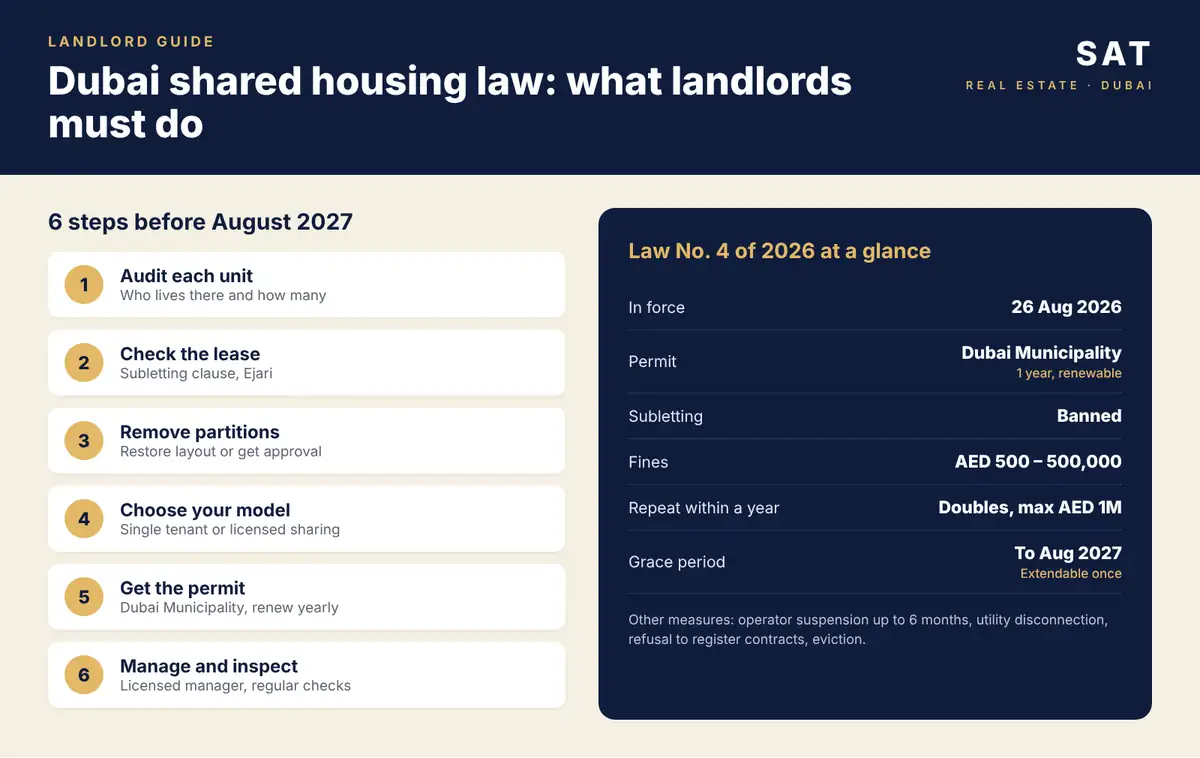
- Subletting rooms or bed spaces by tenants is banned; fines run from AED 500 to AED 500,000, doubling to AED 1 million for repeats.
- Existing owners and operators have a one-year grace period to comply, to August 2027.
In this guide
- What is the Dubai shared housing law?
- What counts as shared housing in Dubai?
- Who needs a shared housing permit?
- What are the occupancy and safety standards?
- Is subletting allowed under the new law?
- Fines and penalties under Law No. 4 of 2026
- What landlords should do before August 2027
- What tenants and flat-sharers should check
- How will the law affect Dubai rents and investors?
- Is the Dubai shared housing law good for landlords?
- Frequently asked questions
What is the Dubai shared housing law?
Law No. 4 of 2026 regulating shared housing in the Emirate of Dubai was issued by His Highness Sheikh Mohammed bin Rashid Al Maktoum earlier this year and came into force on 26 August 2026, 180 days after it was published in the Official Gazette. It applies to all real estate in Dubai, including special development zones and free zones. Collective labour accommodation remains covered by separate legislation.
The law has three aims: to raise health and safety standards, to stop overcrowding in homes that were never designed for it, and to give landlords and residents a clear legal framework. It follows the June 2025 fire in a Dubai Marina tower that housed more than 3,800 people and exposed the risks of illegally partitioned flats, and a city-wide crackdown on partitions and illegal subletting that followed.
Dubai Municipality is the competent authority for permits and standards, working with the Dubai Land Department on tenancy registration.
What counts as shared housing in Dubai?
Under the law, shared housing is accommodation where individuals or families occupy their own space within a property while sharing facilities such as the kitchen, dining area, bathrooms or outdoor areas.
In practice, the law covers:
- A villa or apartment let room by room to several unrelated people.
- Bed-space and partition arrangements, where several people rent a bed in the same room.
- Homes let to a company or institution to house its staff or students.
- Co-living and room-share products run by operators.
It applies to apartments, villas, townhouses, residential complexes, mixed-use and multi-storey buildings. Permitted residents include families, men, women, male and female students, government employees and private-sector workers, provided the property is licensed and meets the approved standards.
A standard tenancy, where one tenant or one family rents the whole home under one Ejari contract, is not shared housing.
Who needs a shared housing permit?
Anyone who wants to use a property for shared housing needs a permit before doing so. The law allows three ways to run it:
| Model | Who holds the permit | How it works |
|---|---|---|
| Owner lets directly | Property owner | Owner leases rooms or spaces directly to residents |
| Owner appoints a manager | Owner, with a licensed establishment | Licensed company manages and leases on the owner’s behalf |
| Operator leases the property | Licensed establishment | Operator rents the property from the owner and lets spaces to residents |
Permits are generally issued for one year and are renewable, with renewal applications due at least 30 days before expiry; owners can request a longer term. Government entities, private companies and educational institutions housing their own staff or students also need permits and must meet the same standards.
Without a permit, tenancy and management contracts for the unit can be refused registration, which leaves both landlord and residents without legal protection.
What are the occupancy and safety standards?
Dubai Municipality sets the technical standards that permitted shared housing must meet. These cover:
- Maximum occupants for each property and room.
- Minimum space per resident. Existing Dubai rules already require at least about 5 square metres of living space per person.
- Shared facilities such as bathrooms and kitchens in proportion to the number of residents.
- Fire and life safety, including escape routes, alarms and ventilation.
- No unapproved partitions. Dividing bedrooms, living rooms or balconies with wooden or non-fire-rated gypsum boards without a municipality permit is illegal.
Expect inspections. The authorities can enter, inspect and verify permits, and investigate complaints from neighbours, building managers and residents.
Is subletting allowed under the new law?
No. Residents of shared housing, and any other party without a permit, are prohibited from subletting their accommodation or any part of it. A tenant who rents a flat and then advertises rooms or bed spaces on social media or WhatsApp is now breaking the law, even if the landlord is unaware.
This matters for landlords as much as tenants. If your tenant is subletting, your property can be inspected, fined, cut off from utilities or ordered to be vacated. Most Dubai tenancy contracts already forbid subletting without the landlord’s written consent, so landlords have both a contractual and a legal basis to act.
Fines and penalties under Law No. 4 of 2026
The penalties are designed to make illegal shared housing uneconomic.
| Measure | Detail |
|---|---|
| Fines | AED 500 to AED 500,000 per violation |
| Repeat offence within a year | Fine doubles, up to AED 1,000,000 |
| Operator suspension | Up to six months |
| Permit and licence action | Revocation of permits; coordination to cancel a company’s trade licence |
| Utilities | Disconnection until violations are fixed |
| Contracts | Refusal to register tenancy or management contracts for the unit |
| Eviction | Evacuation of non-compliant properties by order of an execution judge |
Where a permit is suspended or cancelled, residents may be given a set period to stay before they must move out.
What landlords should do before August 2027
Existing owners and businesses have one year from 26 August 2026 to bring properties into line, and the municipality’s director-general can extend this once. Here is how we recommend landlords use that time.
1. Audit how each unit is used. Confirm who actually lives in your property and how many people. Many landlords do not know their tenant is renting out rooms.
2. Check the tenancy contract and Ejari. Make sure the contract prohibits subletting and names the permitted occupants. Update the clause at renewal if it is vague.
3. Remove illegal partitions. Restore the original layout, or obtain Dubai Municipality approval for any change. Partitions are the fastest way to attract fines and safety risks.
4. Choose your model. Decide whether to let the home to a single tenant or family, or to run it as permitted shared housing with the extra licensing, standards and management that involves.
5. Apply for the permit if you share. If you will operate shared housing, apply through Dubai Municipality and diarise the renewal at least 30 days before expiry.
6. Use a licensed manager and inspect regularly. A professional manager checks occupancy, handles complaints and keeps documents ready for inspection. See our property management in Dubai and rental supervision services.
If a tenant refuses to stop subletting, the remedy runs through the Rental Dispute Center, in the same way as unpaid rent; our guide on a tenant not paying rent in Dubai explains notices and RDC procedure.
What tenants and flat-sharers should check
If you rent a room or bed space, protect yourself before paying a deposit:
- Ask who owns the property and who legally manages the shared accommodation.
- Ask to see the shared housing permit and how many residents it allows.
- Check for partitions or blocked escape routes.
- Pay rent only to the owner or the licensed operator, and get receipts.
- Insist on a written agreement that can be registered.
If you are the main tenant and have been renting out rooms, stop and speak to your landlord. You may be able to move to a lease that matches how the home is used, or find a smaller unit for yourself.
How will the law affect Dubai rents and investors?
The law does not set rents, but it will change demand in parts of the market. Bed spaces and partitioned rooms have been the cheapest housing in many older and central communities, and in some high-rise areas close to jobs and the Metro. As illegal arrangements are removed, some of those residents will move into legal shared housing run by licensed operators, and others will look for affordable studios and one-bedroom flats.
For investors, that is likely to support demand for well-managed studios and small apartments in affordable communities, and to create an opportunity for licensed co-living operators. Owners who relied on high income from overcrowded sharing will lose it. Compare current rents and yields in our yield and price guides and in our Dubai rental market 2026 guide.
The law also makes building records cleaner. Ejari registration is the backbone of the system; the Dubai Land Department explains tenancy registration and the official rental index.
Is the Dubai shared housing law good for landlords?
For responsible landlords, yes. The Dubai shared housing law removes unlicensed competition, protects properties from damage and fire risk, and gives owners a clear legal basis to stop tenants subletting. The cost falls on owners and tenants who relied on overcrowding and on landlords who did not know how their homes were being used.
The sensible step now is an audit of every unit you own, well before the August 2027 deadline. SAT can review your tenancies, check occupancy and manage your property under the new rules. Book a private investment consultation or speak to our property management team to get started.
Related reading
- Tenant not paying rent in Dubai: a landlord’s guide
- Dubai rental market 2026: why rents are falling
- Off-plan project delayed in Dubai: your rights
- Dubai mortgage rates 2026
- Etihad Rail and Dubai property
- Dubai property market outlook 2027
- Top property management company in Dubai in 2026
- Best places to invest in rental property in Dubai
- Properties for rent in Dubai
Frequently asked questions
1. What is the Dubai shared housing law?
It is Law No. 4 of 2026, which regulates homes where individuals or families occupy their own space and share facilities. It requires a permit, sets occupancy and safety standards, bans subletting and introduces fines of up to AED 1 million for repeat offences.
2. When did the Dubai shared housing law come into force?
It took effect on 26 August 2026, 180 days after publication in the Official Gazette. Existing owners and operators have one year from that date to comply, which the municipality can extend once.
3. Do I need a permit to share my apartment in Dubai?
If the home is let as shared accommodation to several individuals or households, yes. A normal lease of the whole home to one tenant or one family under a single Ejari contract does not need a shared housing permit.
4. Who issues shared housing permits in Dubai?
Dubai Municipality is the competent authority, working with the Dubai Land Department. Permits are generally valid for one year and must be renewed at least 30 days before expiry.
5. Is subletting a room allowed in Dubai?
No. Under the new law, residents and anyone else without a permit cannot sublet their accommodation or any part of it. Only owners and licensed operators may let shared housing.
6. What are the fines for illegal shared housing in Dubai?
Fines range from AED 500 to AED 500,000 per violation, and double for a repeat offence within a year, up to AED 1 million. Authorities can also suspend operators, disconnect utilities and order eviction.
7. Are partitions allowed in Dubai apartments?
Not without Dubai Municipality approval. Partitioning bedrooms, living rooms or balconies to fit more occupants is illegal and a common cause of fines and fire risk.
8. Does the law apply in free zones and JLT?
Yes. The law applies to all real estate in Dubai, including special development zones and free zones. Only collective labour accommodation is covered by separate rules.
9. Will the shared housing law push up rents in Dubai?
It may increase demand for affordable studios and small apartments as illegal bed spaces disappear, but rents in 2026 are also shaped by large new supply, so the effect will vary by community.
10. How can SAT help landlords comply with the new law?
SAT audits occupancy, updates tenancy contracts and Ejari, coordinates with licensed operators and manages properties under the new rules. Book a private investment consultation for a review of your units.