
A mortgage for non-residents in Dubai lets overseas investors buy property in the city without paying the full price in cash. Several UAE banks lend to buyers who live abroad, but the rules are stricter than for UAE residents: you need a bigger deposit, stronger paperwork and a clear picture of the extra costs before you commit to a purchase.
This guide explains how much non-residents can borrow, who qualifies, the documents banks ask for, the fees involved, how off-plan purchases are treated and the steps from pre-approval to title deed. It is written for investors who want to use leverage sensibly rather than stretch to the limit.
Key takeaways
- Non-residents can usually borrow 50% to 60% of the property value, so plan for a 40% to 50% deposit.
- Your total monthly debt repayments must stay below 50% of your income under UAE Central Bank rules.
- Budget around 7% to 8% of the price on top of the deposit for DLD, mortgage and agency costs.
- Most banks lend on ready property; off-plan finance is limited and usually starts near handover.
In this guide
- How non-resident mortgages work in Dubai
- How much can non-residents borrow?
- Who qualifies?
- Documents you will need
- The costs of a non-resident mortgage
- Can non-residents get a mortgage on off-plan property?
- Step-by-step: from pre-approval to title deed
- How to improve your chances of approval
- Is a mortgage for non-residents in Dubai worth it?
How non-resident mortgages work in Dubai
Foreign nationals can buy freehold property in designated areas of Dubai, and they can finance that purchase with a UAE bank whether or not they live in the country. The loan is secured on the Dubai property and registered with the Dubai Land Department (DLD), exactly as it would be for a resident.
The difference is risk. A bank lending to someone who earns abroad cannot easily check income, pursue the borrower or verify credit history through the Al Etihad Credit Bureau. To compensate, banks ask for a larger deposit, more documents and sometimes a slightly higher rate.
How much can non-residents borrow?
The UAE Central Bank sets maximum loan-to-value (LTV) limits for all mortgages. Banks then apply their own, usually tighter, limits for non-residents.
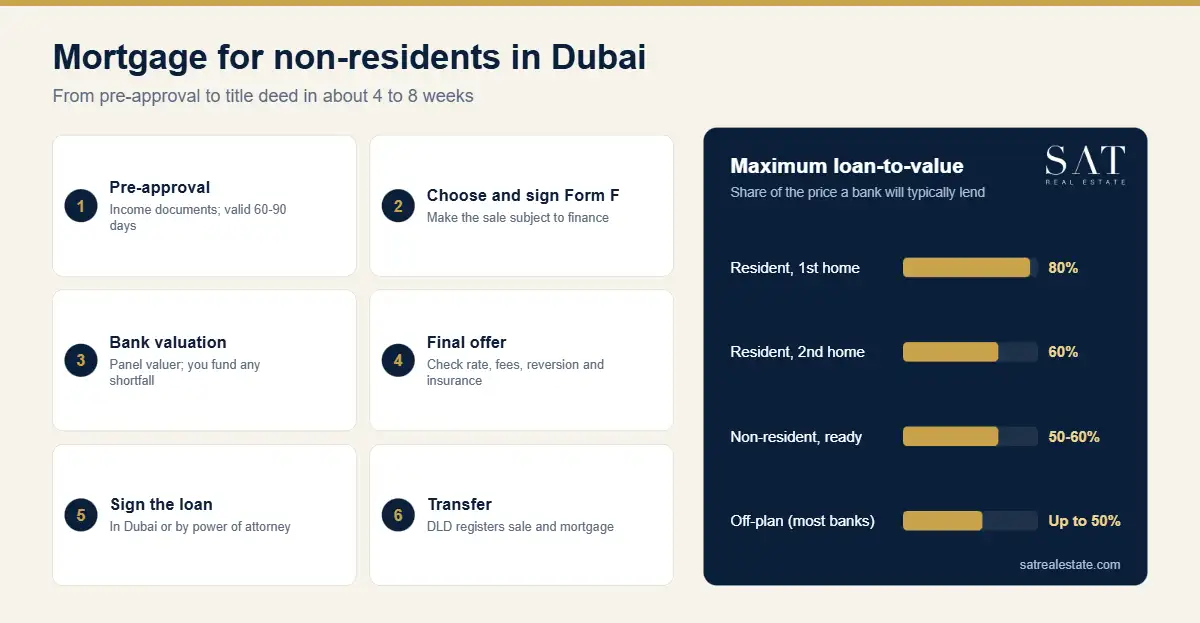
| Buyer and property | Maximum LTV | Minimum deposit |
|---|---|---|
| Resident expat, first home up to AED 5M | 80% | 20% |
| Resident expat, first home above AED 5M | Around 65–70% | 30–35% |
| Resident expat, second or investment property | 60% | 40% |
| Non-resident, ready property (bank policy) | 50–60% | 40–50% |
| Off-plan property (most banks) | Up to 50% | 50% |
Banks also limit how much your repayments can be. Under the Central Bank’s debt burden ratio, all your monthly loan repayments, including car loans, credit cards and loans in your home country, must not exceed 50% of your gross monthly income. Many banks apply a lower threshold to non-residents.
The maximum term is usually 25 years, and the loan must end before you reach the bank’s age limit, commonly 65 for salaried borrowers and 70 for self-employed borrowers.
Who qualifies?
Each bank sets its own criteria, but most look for:
- Nationality: your country must be on the bank’s approved list; some nationalities are excluded or need extra checks
- Income: a stable, provable income, often a minimum of around AED 25,000 to AED 50,000 a month equivalent for non-residents
- Employment: at least one to two years with your current employer, or two to three years of trading for self-employed applicants
- Credit history: a clean record in your home country, often supported by a credit report
- Property: a ready unit in an approved project, valued by the bank’s panel valuer
Banks such as Emirates NBD, Mashreq, ADCB, HSBC and FAB have offered non-resident products, though criteria and appetite change through the year. A mortgage broker or advisor who works with several banks can save weeks of applications.
Documents you will need
Prepare these before you apply. Missing or unclear documents are the main cause of delay for overseas buyers.
Salaried applicants
- Passport copy and, if you have one, a UAE visa
- Salary certificate and recent payslips (usually three to six months)
- Personal bank statements for six months showing salary credits
- Credit report from your home country
- Proof of address abroad
Self-employed applicants
- Trade licence or company registration documents
- Audited financial statements, typically for two years
- Company and personal bank statements for six to twelve months
- Tax returns, where applicable
You will also need the property details: the signed Form F or reservation agreement, and the seller’s title deed copy for a resale.
The costs of a non-resident mortgage
On top of your deposit, budget for purchase and loan costs. These are typical 2026 figures.
| Cost | Typical amount |
|---|---|
| DLD transfer fee | 4% of the price + admin fee |
| DLD mortgage registration | 0.25% of the loan + AED 290 |
| Bank arrangement fee | Up to 1% of the loan + VAT |
| Property valuation | About AED 2,500–3,500 + VAT |
| Trustee office fee | AED 4,000 + VAT |
| Agency commission | 2% of the price + VAT |
| Life and property insurance | Annual premium, set by the bank |
On a AED 2 million apartment with a 50% loan, that adds up to roughly AED 140,000 to AED 150,000, or around 7% to 7.5% of the price, before furnishing or service charges. Some banks waive the arrangement fee as a promotion, so it pays to compare offers. Our guide to the cost of buying property in Dubai breaks these fees down in more detail.
Interest rates for non-residents are usually a little higher than for residents. Most loans offer a fixed rate for one to five years and then move to a variable rate linked to EIBOR. Read the reversion rate carefully, because that is what you will pay for most of the loan. For the latest market picture, see our analysis of Dubai mortgage rates in 2026.
Can non-residents get a mortgage on off-plan property?
It is harder. Few banks lend on off-plan property during construction, and those that do usually cap the loan at 50% and only for projects by approved developers with a strong delivery record.
Most off-plan investors therefore pay the construction instalments from their own funds, using the developer’s payment plan, and take a mortgage at or near handover to cover the final payment. If you plan to do this, check with a bank before you buy that it will lend on the project and that your income will support the loan at handover. A post-handover payment plan is another option, but it is a developer instalment scheme, not a bank mortgage.
Step-by-step: from pre-approval to title deed
- Speak to a broker or bank and get a pre-approval based on your income and documents. Pre-approvals are usually valid for 60 to 90 days.
- Choose the property and sign Form F with a deposit, making the sale subject to mortgage approval where possible.
- Bank valuation: the bank’s panel valuer inspects the unit. If the valuation is below the price, the loan is based on the lower figure and you fund the gap.
- Final offer letter: the bank issues the formal offer; read the rate, fees, early settlement terms and insurance requirements.
- Sign the loan agreement in Dubai or through a power of attorney.
- Transfer at the trustee office: the bank issues a manager’s cheque to the seller, the DLD registers the sale and the mortgage, and the title deed is issued in your name with the bank’s mortgage noted.
The whole process typically takes four to eight weeks for a non-resident, compared with three to five weeks for a resident with straightforward paperwork.
How to improve your chances of approval
Non-resident applications are declined more often than resident ones, usually for avoidable reasons. These steps help:
- Clear small debts first. Closing a car loan or credit card balance can bring your debt burden ratio within the bank’s limit.
- Show consistent income. Banks prefer the same salary credited to the same account every month. Avoid moving money between accounts before you apply.
- Get your credit report early. Correct any errors in your home-country report before the bank sees it.
- Choose an approved project. Banks lend more readily on buildings they already know, by developers with a strong delivery record.
- Keep extra cash in reserve. If the valuation comes in below the price, you will need to fund the gap quickly.
- Use one broker, not five banks. Multiple applications at once can slow things down and raise questions.
A clean, complete file usually gets a decision within one to two weeks of submission.
Is a mortgage for non-residents in Dubai worth it?
It can be, if the numbers work at today’s rates. Leverage lets you keep capital free, buy a better unit or spread risk across two properties instead of one. But borrowing costs reduce your net yield, and currency movements between your income and the dirham add risk. A mortgage for non-residents in Dubai makes most sense when the rental income comfortably covers the repayments and service charges with a buffer for void periods.
SAT Real Estate models net yield with and without finance and coordinates with mortgage specialists for overseas clients. Book a private investment consultation or see our mortgage and specialist coordination service.
Related reading
- How to Sell Property in Dubai: Steps, Fees and Documents
- Service Charges in Dubai: What Owners Pay
- Dubai Property Inheritance: Protect Your Property With a Will
- Buying Off-Plan Property in Dubai: The Complete 2026 Investor Guide
- Off-Plan vs Ready Property in Dubai
- Post-Handover Payment Plans in Dubai
- Dubai Golden Visa Through Property in 2026
- Dubai Property Market Outlook 2027
Frequently asked questions
1. Can non-residents get a mortgage in Dubai?
Yes. Several UAE banks lend to non-residents buying freehold property in Dubai, usually up to 50% to 60% of the value, subject to income, nationality and documents.
2. How much deposit does a non-resident need in Dubai?
Plan for a deposit of 40% to 50% of the price, plus around 7% to 8% for DLD, mortgage, valuation and agency costs.
3. What is the maximum mortgage term for non-residents?
Usually 25 years, provided the loan ends before the bank’s age limit, commonly 65 for salaried and 70 for self-employed borrowers.
4. What is the minimum income for a non-resident mortgage in Dubai?
It varies by bank, but many look for the equivalent of around AED 25,000 to AED 50,000 a month, supported by bank statements and payslips.
5. Can I get a mortgage on off-plan property as a non-resident?
It is limited. Few banks lend during construction, and those that do usually cap the loan at 50%. Most investors finance at handover instead.
6. Are interest rates higher for non-residents?
Often slightly. Non-resident loans can carry a higher margin than resident loans because the bank takes more risk. Compare fixed and reversion rates across banks.
7. What is the DLD mortgage registration fee?
The DLD charges 0.25% of the loan amount plus an AED 290 admin fee to register a mortgage on the title deed.
8. Do I need to visit Dubai to get a mortgage?
Not always. Many steps can be done remotely, and you can sign loan and transfer documents through a properly drafted power of attorney.
9. Does a mortgage affect the Dubai Golden Visa?
Mortgaged property can qualify, subject to the current Golden Visa rules and a bank letter confirming the amount paid. Check the latest criteria before you buy.
10. How long does a non-resident mortgage take in Dubai?
Typically four to eight weeks from pre-approval to title transfer, depending on the bank, the valuation and how quickly you supply documents.