
Knowing how to sell property in Dubai before you list saves weeks of delay and thousands of dirhams in avoidable costs. The process is well regulated: every sale runs through the Dubai Land Department (DLD), a set of standard RERA forms and a registered trustee office, so the steps are the same whether you own a studio in JVC or a villa on Palm Jumeirah.
This guide walks through each stage of a ready-property sale, from checking your title deed to handing over the keys. It covers the documents you need, the fees each side usually pays, what changes when the property still has a mortgage, and how long a typical sale takes in 2026.
Key takeaways
- Most ready-property sales in Dubai complete in 30 to 60 days from signed Form F to title transfer.
- The DLD transfer fee is 4% of the sale price, customarily paid by the buyer, plus trustee and admin fees.
- A developer NOC confirming no service charge arrears is mandatory before transfer.
- With a mortgage, you need a liability letter and a bank clearance before the DLD will register the sale.
In this guide
- The selling process at a glance
- Step 1: Prepare your property and documents
- Step 2: Appoint an agent and sign Form A
- Step 3: Agree the offer and sign Form F
- Step 4: Get the developer NOC
- Step 5: Clear the mortgage, if you have one
- Step 6: Transfer at a trustee office
- Selling fees and who pays them
- How long does a sale take?
- Selling from abroad
- Should you sell or hold?
- Is now the right time to sell property in Dubai?
The selling process at a glance
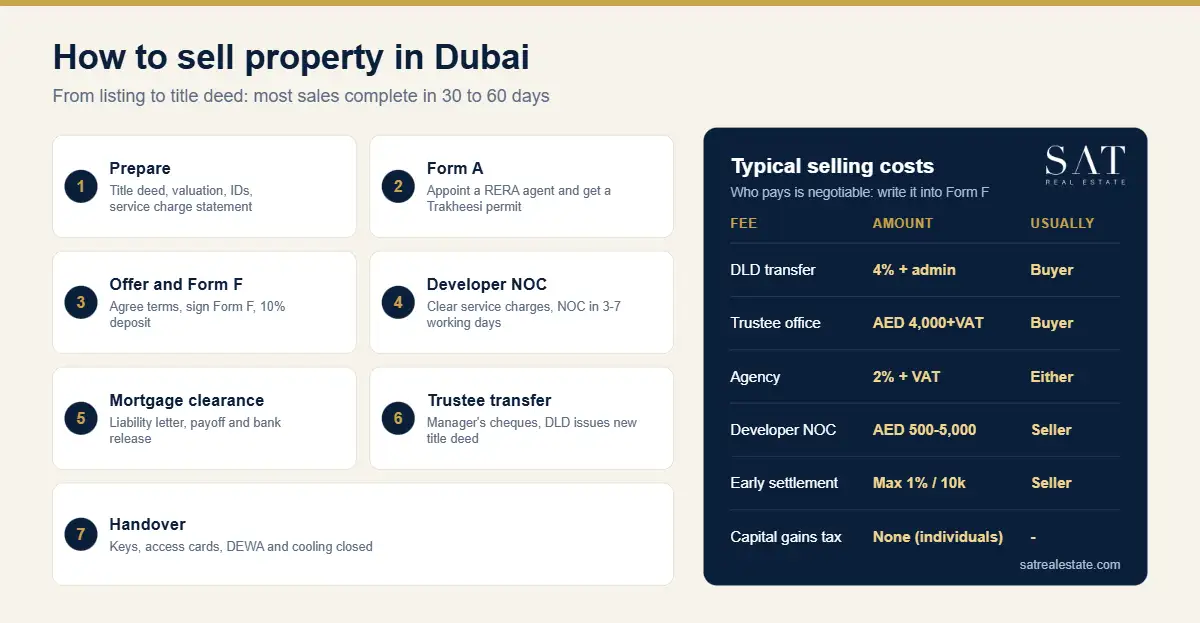
Every resale in Dubai follows the same broad sequence. You appoint an agent on Form A, agree a price with a buyer, sign the Form F sale contract, obtain the developer’s no-objection certificate (NOC), clear any mortgage, and meet at a trustee office where the DLD issues a new title deed in the buyer’s name.
| Stage | What happens | Typical time |
|---|---|---|
| 1. Preparation | Title deed check, valuation, documents | 1–7 days |
| 2. Listing | Form A signed, Trakheesi permit, marketing | 1–4 weeks |
| 3. Offer | Price agreed, deposit paid | 1–7 days |
| 4. Form F | Sale contract signed and registered | 1–2 days |
| 5. NOC | Developer confirms no dues | 3–7 working days |
| 6. Mortgage | Liability letter, payoff and clearance | 7–14 working days |
| 7. Transfer | Trustee office, manager’s cheques, new title deed | 1 day |
The order of steps 5 and 6 can overlap. A good agent books the NOC appointment as soon as Form F is signed, so the paperwork runs in parallel rather than one after another.
Step 1: Prepare your property and documents
Start by checking your title deed on the Dubai REST app. The owner names, unit number, plot and size must match your passport and the listing. If the property is held jointly, every owner must sign the sale documents or give a notarised power of attorney.
Get a realistic price before you list. Look at recent DLD transactions in your building, not asking prices on portals, and consider an independent valuation if the unit is unusual. Overpricing is the most common reason Dubai listings sit for months.
Gather these documents early:
- Original title deed (or Oqood for an off-plan unit)
- Passport and Emirates ID copies for every owner
- Latest service charge statement from the developer or owners association
- Current tenancy contract and Ejari certificate, if the unit is let
- Mortgage account details, if any
- Power of attorney, if you will not attend in person
If the property is tenanted, read the lease first. A sale does not end a tenancy in Dubai: the buyer inherits the tenant on the same terms. If your buyer wants vacant possession, you must give the tenant 12 months’ written notice by notary public or registered mail, and only for the reasons the law allows.
Step 2: Appoint an agent and sign Form A
Form A is the RERA listing agreement between you and your agent. It records the asking price, the commission, whether the listing is exclusive and how long it lasts. Your agent then applies for a Trakheesi advertising permit, which every property listing in Dubai must display.
Use a RERA-licensed brokerage and check the agent’s BRN on the DLD app. An exclusive agreement for 30 to 90 days usually gets better marketing effort than listing with several agents at once, because one agent controls the price and the presentation.
Commission is negotiable. The market norm is 2% of the sale price plus 5% VAT, often paid by the buyer, but some sellers agree to pay their own agent separately. Make sure Form A states clearly who pays what.
Step 3: Agree the offer and sign Form F
When a buyer makes an offer, negotiate price, payment method and the target transfer date together. Cash and mortgage buyers move at different speeds, so the transfer date should reflect how the buyer is paying.
Once terms are agreed, both sides sign Form F, the memorandum of understanding that DLD recognises as the sale contract. It sets the price, the deposit, the deadline for transfer and the penalties if either party walks away. The buyer normally pays a security deposit of 10% of the price, held by the brokerage or a conveyancer until transfer.
If the buyer fails to complete without good reason, the seller can usually keep the deposit. If the seller backs out, they normally return the deposit and pay an equal penalty. Read the clauses carefully, because Form F is enforceable.
Step 4: Get the developer NOC
The no-objection certificate confirms the developer or master community has no objection to the sale and that all service charges are paid. Without it, the trustee office cannot complete the transfer.
Both parties, or their agents, apply through the developer’s portal or office. Fees vary by developer, typically AED 500 to AED 5,000 plus VAT, and the certificate usually takes three to seven working days. Most NOCs are valid for a limited period, often 30 days, so time the application close to your transfer date.
Clear any service charge arrears before you apply. Developers will not issue an NOC while the account shows money owed, and arrears are the most common cause of last-minute delays.
Step 5: Clear the mortgage, if you have one
Selling a mortgaged property in Dubai is routine, but it adds a step. Ask your bank for a liability letter showing the exact amount needed to settle the loan, including any early settlement fee. UAE Central Bank rules cap that fee at 1% of the outstanding balance or AED 10,000, whichever is lower.
On a cash sale, the buyer usually pays the outstanding loan directly to your bank with a manager’s cheque before the transfer. The bank then issues a clearance letter and releases the original title deed. On a sale to a mortgage buyer, the buyer’s bank often pays off your loan on the transfer day.
Allow seven to 14 working days for the bank paperwork. If your loan is larger than the buyer’s deposit, discuss bridging arrangements with your agent early.
Step 6: Transfer at a trustee office
The transfer takes place at a DLD-registered real estate trustee office. Buyer and seller (or their attorneys) attend with original IDs, the NOC, the Form F and manager’s cheques made out to each party: the seller, the DLD, the bank if there is a mortgage, and the trustee.
The trustee checks the documents, collects the fees and submits the transaction to the DLD. The new title deed is issued to the buyer, usually electronically on the same day. You then hand over the keys, access cards, parking remotes and appliance manuals, and close or transfer your DEWA and district cooling accounts.
Selling fees and who pays them
Dubai has no capital gains tax for individual owners, so your main costs are fees. Customarily the buyer pays the DLD fee, but everything is negotiable and should be written into Form F.
| Fee | Typical amount | Usually paid by |
|---|---|---|
| DLD transfer fee | 4% of sale price + admin fee | Buyer |
| Trustee office fee | AED 4,000 + VAT (AED 2,000 + VAT under AED 500,000) | Buyer |
| Agency commission | 2% + VAT | Buyer or seller, per Form A/F |
| Developer NOC | AED 500–5,000 + VAT | Seller |
| Mortgage early settlement | Up to 1% or AED 10,000 | Seller |
| Service charge arrears | Whatever is owed | Seller |
If you hold the property through a company, corporate tax may apply to the gain. Speak to a tax adviser before you sign, because the structure affects your net proceeds. See the DLD’s official transfer service guidance for the current fee schedule.
How long does a sale take?
A straightforward cash sale with no mortgage can complete in two to three weeks after Form F. A sale involving a seller’s mortgage, a mortgage buyer, or both usually takes 30 to 60 days, because two banks need to issue letters and valuations.
The biggest delays come from:
- Service charge arrears holding up the NOC
- Missing owners or unregistered powers of attorney
- Buyer mortgage valuations coming in below the agreed price
- Tenants who do not allow viewings
Sorting these out before you list keeps the timeline close to the minimum.
Selling from abroad
You do not need to be in Dubai to sell. Many overseas owners sign a specific power of attorney for the sale, either at a UAE notary or at a UAE embassy, legalised and translated into Arabic if signed outside the country. The attorney can then sign Form F, collect the NOC and attend the trustee office for you.
Keep the POA specific to the property and the sale. Your agent and conveyancer should check the wording against DLD requirements before you sign it, because a rejected POA can delay the transfer by weeks.
Should you sell or hold?
Selling makes sense when the property no longer fits your goals, the yield has fallen below what the capital could earn elsewhere, or a major cost such as a mortgage reset or large service charge increase is coming. Holding can make sense in an area where new infrastructure or limited supply still supports prices.
Is now the right time to sell property in Dubai?
Learning how to sell property in Dubai is the easy part; the harder question is timing and price. Look at recent transaction data in your building, the rental income you would give up and what you would do with the proceeds. A clear plan for the capital often matters more than squeezing the last few dirhams from the sale price.
SAT Real Estate advises owners on exit timing, pricing and reinvestment. Book a private investment consultation or see our sell a property and real estate trading and exit services.
Related reading
- How to Sell Off-Plan Property Before Handover in Dubai
- Off-Plan vs Ready Property in Dubai
- Cost of Buying Property in Dubai: DLD Fees, Oqood and Hidden Costs
- Dubai Mortgage Rates 2026
- Dubai Property Market Outlook 2027
Frequently asked questions
1. What is Form F in Dubai?
Form F is the RERA memorandum of understanding between buyer and seller. It records the price, deposit, transfer date and penalties, and the DLD treats it as the sale contract.
2. Who pays the 4% DLD fee when selling property in Dubai?
By market custom the buyer pays the 4% DLD transfer fee. It can be split or shifted by agreement, and whatever is agreed should be written into Form F.
3. Do I need a developer NOC to sell my property?
Yes. The developer or master community must issue a no-objection certificate confirming there are no unpaid service charges before the trustee office can complete the transfer.
4. Can I sell my Dubai property if it still has a mortgage?
Yes. Your bank issues a liability letter, the loan is settled from the sale proceeds or by the buyer, and the bank then issues a clearance so the DLD can transfer the title.
5. How long does it take to sell property in Dubai?
Most sales complete in 30 to 60 days after Form F is signed. Simple cash sales with no mortgage can finish in two to three weeks.
6. Is there capital gains tax on property sales in Dubai?
Individuals pay no capital gains tax on Dubai property. Property held through a company may fall under UAE corporate tax, so take tax advice first.
7. What commission do agents charge to sell property in Dubai?
The usual commission is 2% of the sale price plus 5% VAT. Who pays it, and how much, is negotiable and should be set out in Form A.
8. Can I sell a tenanted property in Dubai?
Yes. The tenancy continues with the new owner on the same terms. Vacant possession requires 12 months’ notice served by notary or registered mail for a legally permitted reason.
9. Can I sell my Dubai property from overseas?
Yes. You can appoint someone under a specific power of attorney, notarised and, if signed abroad, legalised and translated into Arabic, to sign and attend the transfer for you.
10. What documents do I need to sell property in Dubai?
You need the title deed, passport and Emirates ID copies, Form A, Form F, the developer NOC, a mortgage clearance letter if applicable, and manager’s cheques for the transfer.