
Dubai rent increase rules decide whether a landlord can raise the rent at renewal, by how much, and how much notice the tenant must get. The limits are set by Decree No. 43 of 2013 and tied to the official rental index published by the Dubai Land Department (DLD), often called the RERA rental index.
For landlords, the rules shape renewal income and how you plan your yield. For tenants, they set a clear ceiling on what can be asked. This guide explains the increase bands, the 90-day notice rule, the Smart Rental Index, how to check a renewal, and what to do if the two sides disagree.
Key takeaways
- Rent can only rise at renewal if the current rent is more than 10% below the index average for similar homes.
- The maximum increase runs in bands from 0% to 20%, depending on how far below the average the rent sits.
- Landlords must give at least 90 days’ notice before the contract ends to change the rent or terms.
- The DLD’s Smart Rental Index, launched in 2025, makes valuations more specific to each building.
In this guide
- Which laws set the rules?
- How the increase bands work
- The 90-day notice rule
- The Smart Rental Index
- How to check what increase is allowed
- Worked examples
- What landlords should know
- What tenants should know
- When the two sides disagree
- Renewal timeline for landlords
- Common mistakes to avoid
- How rent rules affect your investment
- Do the Dubai rent increase rules favour landlords or tenants?
Which laws set the rules?
Two pieces of legislation matter most.
- Law No. 33 of 2008, which amended Dubai’s tenancy law, sets the 90-day notice requirement for changing tenancy terms at renewal.
- Decree No. 43 of 2013 sets the maximum rent increase percentages, linked to the official rental index.
Together they mean an increase must be both allowed by the index and properly notified. One without the other is not enough.
How the increase bands work
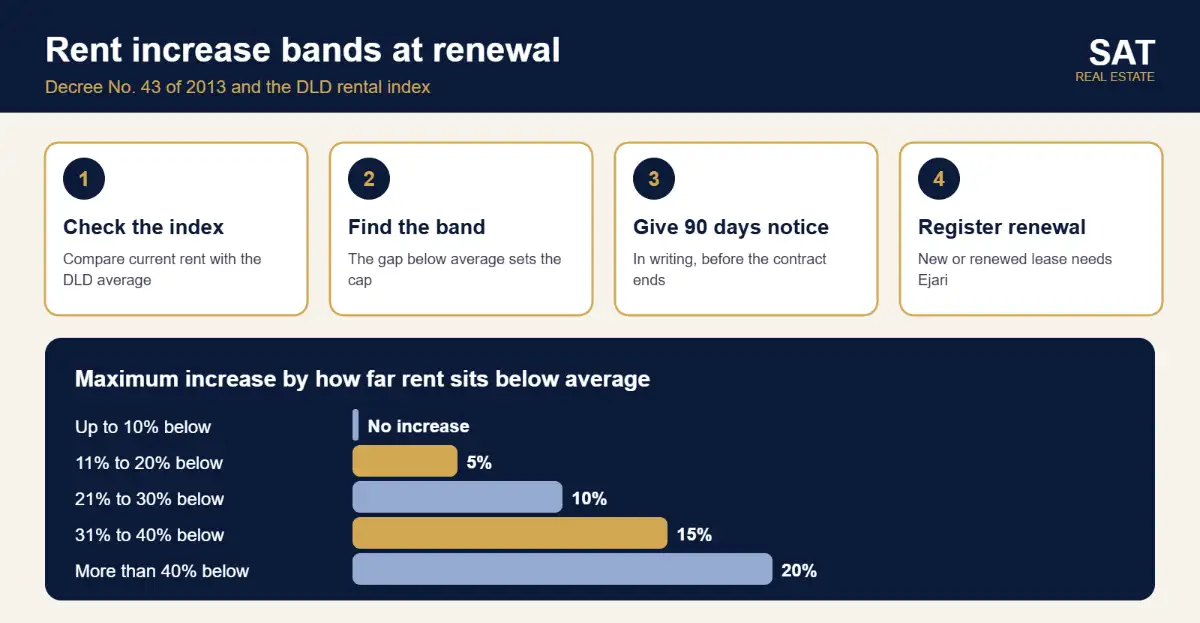
The key question is how far the current rent sits below the average rent for similar properties, according to the DLD’s rental index. The further below the average, the larger the increase allowed.
| Current rent below the index average | Maximum increase |
|---|---|
| Up to 10% | No increase |
| 11% to 20% | 5% |
| 21% to 30% | 10% |
| 31% to 40% | 15% |
| More than 40% | 20% |
The percentage applies to the current rent, not to the index average. So if a tenant pays AED 100,000 and the band allows 10%, the maximum new rent is AED 110,000, even if the average is higher.
If the current rent is already at or above the average, or within 10% of it, no increase is allowed at that renewal.
The 90-day notice rule
To change the rent or any other term at renewal, the landlord must notify the tenant at least 90 days before the contract ends, unless the contract states otherwise. Late notice means the increase cannot be applied at that renewal, even if the index would have allowed it.
Practical tips for landlords:
- Diarise expiry dates for every unit and set a reminder at least four months ahead.
- Send notice in writing, by a method you can prove, such as email or registered post.
- Include the figure and the basis, ideally with a screenshot of the index result.
Tenants should note when notice was received. If it arrived late, say so clearly and in writing.
The Smart Rental Index
In 2025 the DLD introduced the Smart Rental Index. It makes rental valuations more specific to each property by looking at building classification, including technical and structural features, finishes, maintenance, location, services and facilities, and by using artificial intelligence and current market data.
In practice, this means two buildings in the same area can now have different reference rents if one is better built, better kept or better located. Landlords who maintain their buildings well may see that reflected in the index, while tired buildings may score lower.
How to check what increase is allowed
The DLD rental index is available through the DLD website and supported government apps, including Dubai REST. You usually enter:
- The tenancy contract expiry date.
- The property type and area.
- The number of bedrooms.
- The current yearly rent.
The tool then shows the average rent for comparable properties and the maximum increase allowed, if any. Save a copy of the result, as it is the basis for any discussion.
Worked examples
Here is how the bands play out on a home where the index average is AED 120,000 a year.
| Current rent (AED) | Below average by | Maximum increase | Maximum new rent (AED) |
|---|---|---|---|
| 115,000 | About 4% | None | 115,000 |
| 104,000 | About 13% | 5% | 109,200 |
| 90,000 | 25% | 10% | 99,000 |
| 78,000 | 35% | 15% | 89,700 |
| 66,000 | 45% | 20% | 79,200 |
These are illustrative figures. Always run the real index for your unit before you send or respond to a notice.
What landlords should know
- Each renewal is a fresh check. Do not assume last year’s increase applies again.
- Notice and eligibility are separate. You need both.
- Keep the building in good condition. Under the Smart Rental Index, quality and upkeep can affect the reference rent.
- Think about vacancy. Pushing for the maximum may cost more if a good tenant leaves and the unit sits empty.
- Register the renewed lease. A new or renewed contract needs its own Ejari. Our guide to Ejari registration in Dubai explains how.
For a wider view of rents and demand, see our post on the Dubai rental market for landlords.
What tenants should know
- Check the index yourself as soon as you receive notice.
- Check the date the notice arrived against your contract end date.
- Reply in writing, attaching the index result if the increase is too high.
- Keep it factual. Most disagreements are settled once both sides look at the same index result.
If the landlord does not agree, the next step is a formal dispute, covered below.
When the two sides disagree
If a landlord and tenant cannot agree on a renewal, either side can take the matter to the Rental Dispute Settlement Centre, which handles tenancy disputes in Dubai. Bring the contract, the Ejari certificate, the notice, the index result and all written messages.
Landlords facing payment problems, rather than renewal disagreements, may find our guide on what to do when a tenant is not paying rent useful.
Renewal timeline for landlords
A simple timeline keeps renewals on track and avoids late notices.
- Four months before expiry. Check the current rent against the rental index and decide whether to propose a change.
- At least 90 days before expiry. Send written notice of any new rent or terms, with the index result attached.
- Two months before expiry. Confirm whether the tenant will renew, and start marketing the unit if not.
- At renewal. Sign the new contract and register it with Ejari.
Following the same routine for every unit makes renewals predictable and reduces the risk of disputes. If you own several properties, a shared calendar or a simple spreadsheet with each expiry date, current rent and index result is often enough to stay on top of every renewal.
Common mistakes to avoid
- Sending notice less than 90 days before the contract ends.
- Applying the percentage to the index average instead of the current rent.
- Assuming the same increase can be applied every year.
- Skipping the written record of the notice and the index result.
- Forgetting to register the renewed contract with Ejari.
Each one can turn a simple renewal into a dispute.
How rent rules affect your investment
For investors, rent caps mean income growth on an existing tenant can be slower than market growth. That matters when you model returns. If market rents rise sharply, a sitting tenant’s rent may lag behind, and the gap is often only closed when the unit is re-let to a new tenant at market rate.
When you buy a tenanted property, check the current rent against the index. A unit let well below the average may have room to rise at renewal, while one already at the average may not. Our yield and price guides give area benchmarks, and our property management in Dubai team can handle renewals and notices for you.
Do the Dubai rent increase rules favour landlords or tenants?
The Dubai rent increase rules aim to balance both sides. Tenants are protected from sudden large rises, and landlords can still move rents towards market levels in steps, as long as they follow the index and give 90 days’ notice. Landlords who plan renewals early and keep buildings in good condition tend to do best under the system.
If you own rental property and want help planning renewals or modelling returns, book a private investment consultation. For hands-off ownership, our rental supervision service can manage notices and renewals on your behalf.
Related reading
- Ejari registration in Dubai
- Dubai rental market for landlords
- What to do when a tenant is not paying rent
- Holiday home permit in Dubai
- Dubai shared housing law
Frequently asked questions
1. Can my landlord increase the rent every year in Dubai?
Only if the index allows it at that renewal and the landlord gives at least 90 days’ notice. An increase is not automatic.
2. What is the maximum rent increase in Dubai?
The maximum is 20%, and only when the current rent is more than 40% below the index average for similar homes.
3. When is no rent increase allowed?
When the current rent is no more than 10% below the index average, or is at or above it.
4. How much notice must a landlord give?
At least 90 days before the tenancy contract ends, unless the contract says otherwise.
5. What is the RERA rental index?
It is the DLD’s official reference for average rents, used to work out how much rent can rise at renewal.
6. What is the Smart Rental Index?
A DLD system launched in 2025 that makes rental valuations more specific to each building, using building classification and market data.
7. How do I check the allowed increase?
Use the DLD rental index on the DLD website or a supported app such as Dubai REST, entering the contract end date, property details and current rent.
8. Is the increase based on the average rent or my current rent?
The percentage applies to your current rent, not to the average.
9. What can a tenant do if the increase is too high?
Reply in writing with the index result. If the landlord does not agree, the dispute can go to the Rental Dispute Settlement Centre.
10. Does a renewed lease need a new Ejari?
Yes. Each new or renewed tenancy contract should be registered with Ejari.