
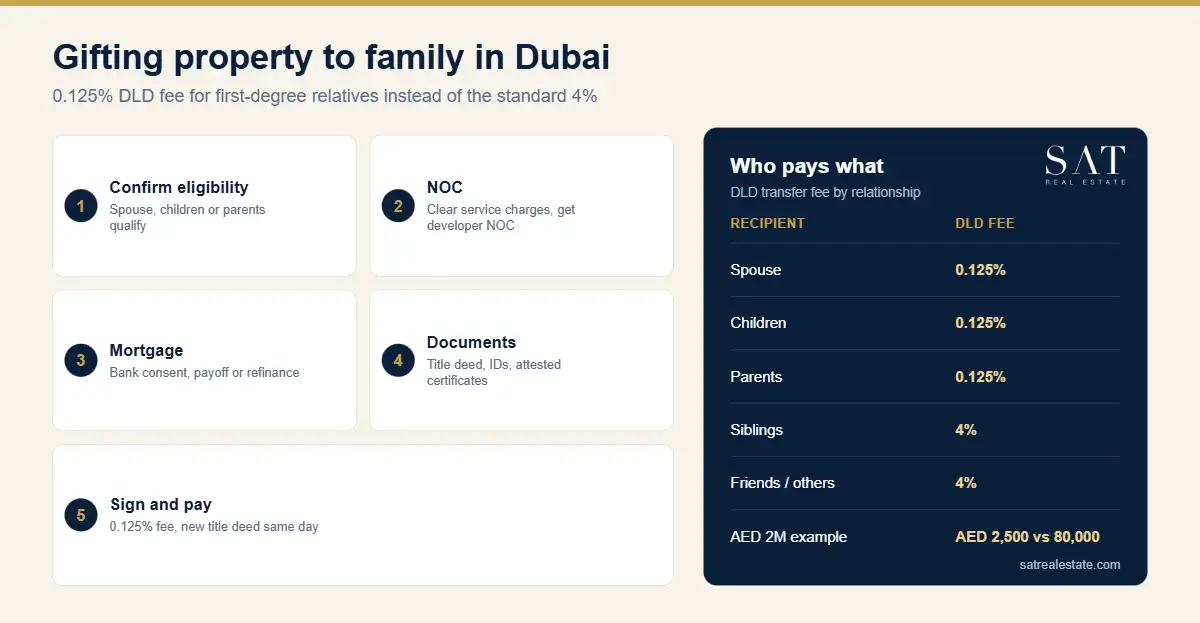
Gifting property in Dubai to a spouse, child or parent can cost a fraction of a normal sale. Instead of the standard 4% Dubai Land Department (DLD) transfer fee, gifts between first-degree relatives qualify for a reduced fee of 0.125% of the property value. On a AED 2 million apartment, that is AED 2,500 instead of AED 80,000.
This guide explains who qualifies for the reduced gift fee, the documents you need, the step-by-step process, what happens with mortgaged and off-plan property, and how gifting compares with leaving property in a will. It is written for owners planning family succession, adding a spouse to a title deed or helping children onto the property ladder.
Key takeaways
- Gifts to first-degree relatives (spouse, children, parents) attract a DLD fee of 0.125% instead of 4%.
- Gifts to siblings and other relatives do not qualify and usually pay the full 4%.
- A mortgaged property normally needs the bank’s consent or the loan cleared before a gift transfer.
- Relationship documents must be attested and translated into Arabic if issued outside the UAE.
In this guide
- What gifting property in Dubai means
- Who qualifies for the reduced gift fee
- How much gifting property costs
- Documents you will need
- Step-by-step gift transfer process
- Gifting a mortgaged property
- Gifting off-plan property
- Gifting vs leaving property in a will
- Tax and other considerations
- Gifting a share instead of the whole property
- Mistakes to avoid
- Is gifting property in Dubai the right choice for your family?
What gifting property in Dubai means
A property gift, sometimes called a hiba, is a transfer of ownership without payment. The donor transfers the title deed to the recipient, who becomes the registered owner. Once registered with the DLD, the gift is generally final, so it should be planned carefully.
People gift property in Dubai for several reasons:
- Succession planning: passing property to children during the owner’s lifetime
- Adding a spouse: transferring a full or partial share to a husband or wife
- Helping family: giving a child their first home or investment
- Restructuring: moving property into a company the owner controls, where permitted
Who qualifies for the reduced gift fee
The reduced fee applies to transfers between first-degree relatives:
| Relationship | Reduced 0.125% fee? |
|---|---|
| Spouse | Yes |
| Children | Yes |
| Parents | Yes |
| Grandchildren and grandparents | Usually no; check with the DLD |
| Siblings | No, standard 4% applies |
| Other relatives and friends | No, standard 4% applies |
The DLD has also applied a reduced rate to some transfers from an individual to a company in which the owner is a shareholder. Rules can change, so confirm the current fee with a trustee office or the DLD before you start.
How much gifting property costs
On top of the 0.125% gift fee, expect small administrative charges:
| Cost | Typical amount |
|---|---|
| DLD gift transfer fee | 0.125% of property value |
| Title deed issuance and admin fees | A few hundred dirhams |
| Trustee office fee (if used) | AED 2,000–4,000 + VAT |
| Developer NOC | AED 500–5,000 + VAT |
| Document attestation and translation | Varies by country |
| Mortgage release and re-registration (if any) | Bank and DLD fees |
On a AED 2,000,000 property, the gift fee is AED 2,500, compared with AED 80,000 for a standard transfer. The saving is the main reason families use the gift route.
Documents you will need
The DLD needs to see proof of ownership, identity and the family relationship:
- Title deed for the property
- Passports and Emirates IDs of donor and recipient
- Proof of relationship: marriage certificate for spouses, birth certificates for children and parents
- Developer NOC confirming service charges are paid
- Bank consent or clearance letter if the property is mortgaged
- Power of attorney if either party will not attend in person
Certificates issued outside the UAE must normally be legalised in the issuing country, attested by the UAE embassy, legalised by the UAE Ministry of Foreign Affairs and translated into Arabic by a licensed legal translator. Start this early, as it often takes the longest. If someone signs for you, our guide to a power of attorney for property in Dubai explains the wording the DLD expects.
Step-by-step gift transfer process
- Confirm eligibility and the current fee with a trustee office.
- Clear service charges and apply for the developer NOC.
- Deal with any mortgage: obtain the bank’s consent, settle the loan or arrange for the recipient to take it on.
- Prepare documents, including attested relationship certificates.
- Book a trustee office appointment or apply through DLD channels.
- Attend and sign: donor and recipient (or their attorneys) sign the gift transfer.
- Pay the fees: 0.125% gift fee plus admin charges.
- Receive the new title deed in the recipient’s name, usually the same day.
The process itself is quick once documents are ready. Most delays come from attestation and mortgage paperwork.
If the property is let, give the tenant written notice of the new owner and arrange for rent to be paid to the recipient from the transfer date. The existing tenancy contract continues on the same terms, so the recipient should also update Ejari and any service charge account with the developer or owners association.
Gifting a mortgaged property
A property with a mortgage cannot simply be gifted, because the bank’s charge is registered on the title deed. You usually have three options:
- Pay off the mortgage before the gift, then gift the property free of debt
- Ask the bank to consent, where the recipient qualifies and the bank agrees to transfer or re-issue the loan
- Refinance in the recipient’s name, if they meet the bank’s criteria
Each route adds bank and DLD fees for releasing and re-registering the mortgage. Speak to your bank early. Our guide to Dubai mortgage rates in 2026 covers the current lending environment.
Gifting off-plan property
An off-plan unit is still registered on the DLD’s interim register (Oqood) and governed by the developer’s SPA. It generally cannot be gifted through the standard title deed process until it is completed and registered.
Before handover, some developers allow a name change or assignment to a family member under their own procedures, often with an admin fee and a requirement that a minimum percentage of the price has been paid. Ask the developer about its policy before you plan a gift.
Gifting vs leaving property in a will
Gifting and inheritance achieve similar goals but work differently:
| Gifting now | Leaving in a will | |
|---|---|---|
| When ownership passes | Immediately | On death |
| DLD fee | 0.125% for first-degree relatives | Reduced inheritance transfer fees apply |
| Control | Donor gives up ownership | Owner keeps full control while alive |
| Rental income | Goes to the recipient | Stays with the owner |
| Risk | Generally irreversible | Will can be changed at any time |
A gift suits owners who are ready to pass on the property and its income now. A registered will suits owners who want to keep control during their lifetime. Many families use both: a gift of some assets and a will for the rest. Our guide to Dubai property inheritance explains the will options.
Tax and other considerations
The UAE does not tax gifts or inheritance, and individuals pay no capital gains tax on personal property. However:
- Your home country may tax gifts or treat them as disposals, so check before transferring
- Company transfers may have UAE corporate tax implications; see our guide to UAE corporate tax on real estate
- Golden Visa holders should check whether gifting the qualifying property affects their visa
- Tenancies continue with the new owner, who should be added to Ejari and receive the rent
Gifting a share instead of the whole property
You do not have to gift the entire property. Many owners transfer a partial share, for example 50% to a spouse, so the property becomes jointly owned. The reduced fee then applies to the value of the share transferred.
Partial gifts are useful when:
- Adding a spouse to the title deed for security and succession
- Bringing a child into ownership gradually, while keeping control of the remaining share
- Balancing ownership between family members across several properties
Remember that joint owners in Dubai hold separate shares, and each share passes under its owner’s will or estate. Joint ownership does not automatically pass to the survivor, so each owner should have a registered will covering their share. Any future sale also needs every co-owner’s signature or power of attorney.
Mistakes to avoid
- Assuming siblings qualify for the reduced fee
- Starting the transfer before relationship documents are attested
- Forgetting the mortgage or service charge arrears
- Gifting a property that supports your own visa without checking the impact
- Gifting without considering home-country tax rules
Is gifting property in Dubai the right choice for your family?
For many families, gifting property in Dubai to a spouse, child or parent is the most cost-effective way to pass on real estate, thanks to the 0.125% fee. It works best when the property is free of debt, the documents are prepared early and the owner is ready to give up control. Where that is not the case, a registered will may be the better tool.
SAT Real Estate helps families plan property transfers, portfolio restructuring and succession, working with qualified legal partners. Book a private investment consultation or see our private office and portfolio advisory services.
Related reading
- Freehold Areas in Dubai: Where Foreigners Can Buy
- Property Valuation in Dubai: How It Works and What It Costs
- Dubai Property Inheritance: Protect Your Property With a Will
- UAE Corporate Tax on Real Estate
- How to Sell Property in Dubai
- Cost of Buying Property in Dubai
- Dubai Golden Visa Through Property in 2026
Frequently asked questions
1. How much does it cost to gift property in Dubai?
Gifts to first-degree relatives attract a DLD fee of 0.125% of the property value, plus admin, trustee and NOC fees.
2. Who counts as a first-degree relative for gifting in Dubai?
A spouse, children and parents. Siblings and other relatives do not qualify for the reduced gift fee.
3. Can I gift property to my brother or sister in Dubai?
Yes, but the reduced fee does not apply. A transfer to a sibling usually pays the standard 4% DLD fee.
4. Can I gift a mortgaged property in Dubai?
Only with the bank’s involvement. You usually need to clear the loan, obtain the bank’s consent or refinance in the recipient’s name.
5. Can I gift an off-plan property in Dubai?
Not through the standard gift process until it is completed. Some developers allow a name change to a family member before handover under their own rules.
6. What documents do I need to gift property in Dubai?
The title deed, passports and Emirates IDs, attested proof of relationship, the developer NOC and, if mortgaged, a bank letter.
7. Is there gift tax in the UAE?
No. The UAE does not tax gifts or inheritance, but your home country may, so check before you transfer.
8. Can a property gift in Dubai be reversed?
Once registered, a gift is generally treated as final. Reversing it may require a new transfer and fees, so plan carefully.
9. Is it better to gift property or leave it in a will?
Gifting passes ownership and income now at a low fee; a will keeps control with you until death. The right choice depends on your goals.
10. How long does a gift transfer take in Dubai?
The transfer itself can be completed in a day once documents, the NOC and any bank paperwork are ready.