
Investing in Al Furjan means buying into a Nakheel community between Sheikh Zayed Road and Sheikh Mohammed Bin Zayed Road, near Jebel Ali, Discovery Gardens and Jumeirah Park. It covers over 5.6 million sq m and mixes villas, townhouses and low to mid-rise apartments, with its own station on the Route 2020 metro line.
That mix of homes and a metro link makes Al Furjan appealing to families and professionals who want space at a more affordable price than central Dubai. But new buildings keep arriving, and quality varies between developers. This guide covers the location, homes, transport, tenants, how to check yields, the costs and the risks.
Key takeaways
- Al Furjan is a Nakheel community of over 5.6 million sq m near Jebel Ali, between Sheikh Zayed Road and Sheikh Mohammed Bin Zayed Road.
- It has villas (3 to 5 bedrooms), townhouses (3 and 4 bedrooms) and apartments (1 to 3 bedrooms) in low to mid-rise buildings.
- Al Furjan Metro Station on Route 2020 is a key advantage for tenants.
- Watch supply and building quality, and judge each unit on net yield.
In this guide
- What is Al Furjan?
- Property types
- Location and access
- Transport: the metro advantage
- Lifestyle and schools
- Who rents in Al Furjan
- Returns: rental yield and capital growth
- Al Furjan vs JVC
- How to choose a home
- Who Al Furjan suits
- Buying routes: ready, resale and off-plan
- Letting and managing your home
- Costs to budget for
- Risks to weigh before you buy
- Is investing in Al Furjan a smart buy?
What is Al Furjan?
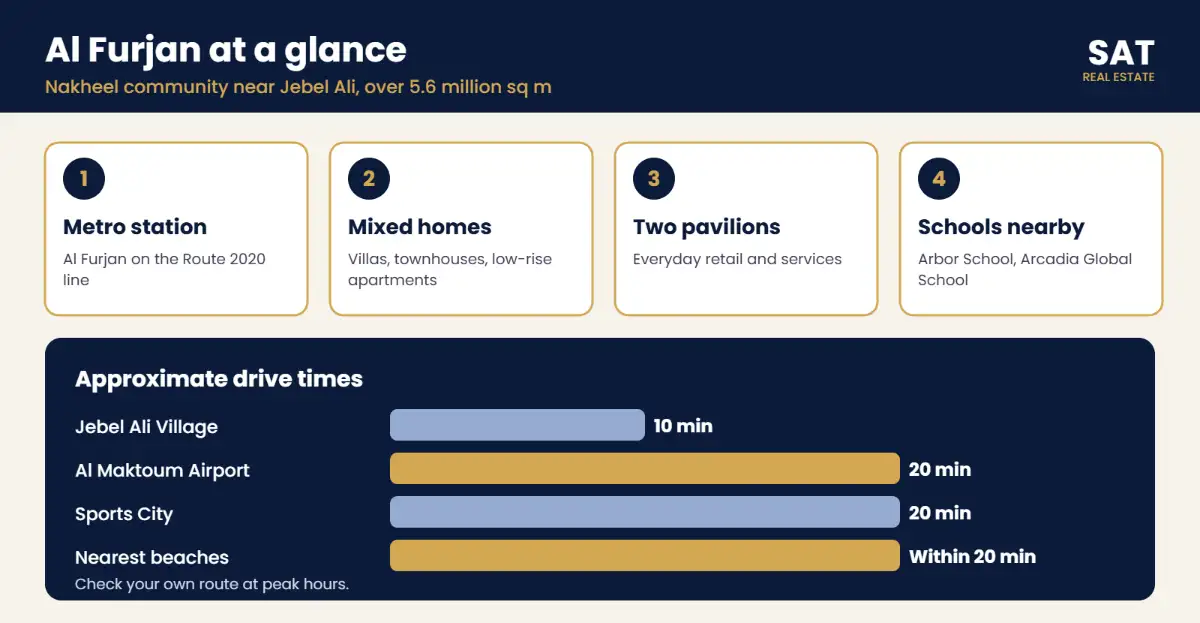
Al Furjan is a master-planned residential community developed by Nakheel. It sits between Sheikh Zayed Road and Sheikh Mohammed Bin Zayed Road, close to Discovery Gardens, Jebel Ali and Jumeirah Park, and covers over 5.6 million sq m.
The community began with Nakheel villa clusters such as Quortaj and Dubai Style, and has since grown with apartment buildings by Nakheel and other developers. It is listed among Dubai’s freehold areas, so foreign buyers can own property. Our guide to freehold areas in Dubai explains what freehold ownership means.
Property types
| Type | Typical layouts |
|---|---|
| Villas | 3 to 5 bedrooms, including Quortaj and Dubai Style clusters |
| Townhouses | 3 and 4 bedrooms |
| Apartments | 1 to 3 bedrooms in low to mid-rise buildings |
Apartments offer the lowest entry and the widest tenant pool. Townhouses and villas suit families who want gardens and space, and usually see longer tenancies.
Location and access
| Destination | Approximate drive |
|---|---|
| Jebel Ali Village | About 10 minutes |
| Al Maktoum International Airport | 20 minutes |
| Sports City and Jumeirah Golf Estates | About 20 minutes |
| Nearest beaches | Within about 20 minutes |
Al Furjan’s position between the two main highways gives access towards Dubai Marina and the city centre in one direction, and towards Jebel Ali, Dubai South and Abu Dhabi in the other. Our guide to investing in Dubai South covers the airport district nearby.
Transport: the metro advantage
Al Furjan Metro Station on the Route 2020 line serves the community. That is a real advantage over many suburban communities, where tenants have to drive. Homes within walking distance of the station tend to appeal to tenants who do not own a car.
For the wider picture on how infrastructure affects property, see our post on the impact of Etihad Rail on Dubai property.
Lifestyle and schools
Residents have two community retail centres, Pavilion Al Furjan and Al Furjan West Pavilion, with supermarkets, cafes and everyday services. Parks and play areas are spread across the villa clusters.
Schools nearby include The Arbor School and Arcadia Global School, along with nurseries such as Chubby Cheeks Nursery and Jebel Ali Village Nursery. Churches and temples in Jebel Ali Village are about 10 minutes away.
Who rents in Al Furjan
- Families renting villas and townhouses near schools.
- Professionals working in Jebel Ali, Dubai South, Dubai Marina and Media City, especially those using the metro.
- Couples and sharers renting apartments at more affordable prices than central districts.
Apartment tenants often look closely at metro access and parking, while villa tenants focus on schools and garden space. Both groups compare Al Furjan with Discovery Gardens, JVC and Jumeirah Park, so price your rent against those areas as well as within the community.
Returns: rental yield and capital growth
Mid-market suburban communities like Al Furjan often offer higher gross yields than prime districts, because purchase prices are lower relative to rents. Net results depend on the building or cluster, the service charge and vacancy. Our guide to rental yield in Dubai explains how gross and net yields differ.
Use this check on any unit:
- Get recent sale prices per sq ft for the same building or cluster.
- Get recent rents from real contracts where possible.
- Subtract the service charge, maintenance and any management fee.
- Allow for vacancy between tenants.
- Compare with JVC and Discovery Gardens.
Our yield and price guides give area benchmarks.
Al Furjan vs JVC
| Factor | Al Furjan | JVC |
|---|---|---|
| Developer | Nakheel master plan | Nakheel master plan |
| Transport | Al Furjan Metro on Route 2020 | No metro inside |
| Homes | Villas, townhouses, low to mid-rise apartments | Mainly apartments, some villas and townhouses |
| Location | Near Jebel Ali and Dubai South | Central, between Al Khail and Sheikh Mohammed Bin Zayed Roads |
Both appeal to value-focused buyers. Al Furjan’s metro access and villa mix are its key strengths, while JVC is more central. Read our guide to investing in JVC Dubai for comparison.
How to choose a home
- Distance to the metro. A short walk to Al Furjan station helps apartment tenants.
- Developer and building quality. Check the developer’s track record and how common areas are kept.
- Villa cluster. Compare Quortaj, Dubai Style and other clusters on condition and price.
- Service charge. Ask for the current charge and history. Our guide to service charges in Dubai explains how to check them.
- Supply nearby. New buildings close by can compete for the same tenants.
Visit at peak hours to check traffic and parking.
Who Al Furjan suits
Al Furjan suits investors who want a mid-market entry with good transport, and end-users who work around Jebel Ali, Dubai South or the Marina. Apartment buyers benefit most from the metro, while villa and townhouse buyers benefit from family demand and nearby schools. It is less suited to buyers who want a central address or a waterfront lifestyle.
Because the community mixes apartments with villas, some investors hold both types here, which spreads risk across two different tenant groups. A one-bedroom apartment near the metro and a townhouse in a family cluster will usually attract different people, so vacancy in one is less likely to coincide with vacancy in the other.
Buying routes: ready, resale and off-plan
Al Furjan has ready villas and apartments as well as newer launches. Ready and resale homes let you see real rents and charges, while off-plan launches offer staged payments, with funds held in escrow until milestones. Our guides on buying a ready property in Dubai, buying off-plan property in Dubai and escrow accounts for off-plan property explain each route.
Letting and managing your home
Tenants compare many similar units in Al Furjan, so condition and price matter. Fresh paint, serviced air conditioning and a clean, well-presented home help you let faster. A property manager can handle viewings, tenant checks, Ejari, maintenance and renewals. See our property management in Dubai service.
Costs to budget for
- DLD transfer fee of 4%, plus trustee, admin and agent costs on a ready purchase.
- Service charges, which vary by building and cluster.
- Garden and pool upkeep for villas.
- Management fees, if you use a property manager.
For a full breakdown, see our guide to the cost of buying property in Dubai.
Risks to weigh before you buy
- Supply. New apartment buildings keep arriving, which can cap rents.
- Building quality. Finishes and management vary between developers.
- Distance from the centre. Commutes to Downtown and Business Bay are longer.
- Traffic. Some internal roads and junctions are busy at peak times.
- Competition. Many similar units can be listed at once.
The Dubai Land Department (DLD) publishes guidance for buyers at dubailand.gov.ae, and it is worth reading before you sign.
Is investing in Al Furjan a smart buy?
Investing in Al Furjan is a smart buy when you choose a well-built home close to the metro or in a popular villa cluster, pay a fair price and the net yield holds after service charges and the 4% DLD fee. It suits investors who want income at a mid-market price with good transport. It is a weaker fit if you need a central address or are relying on fast price growth.
The best next step is to shortlist a few buildings or clusters, compare price, rent and service charge side by side, and visit at peak hours. If you would like help, book a private investment consultation. You can also browse current launches on our off-plan properties page.
Related reading
- Investing in JVC Dubai
- Investing in Dubai South
- Rental yield in Dubai
- Freehold areas in Dubai
- Investing in Town Square Dubai
Frequently asked questions
1. Who developed Al Furjan?
Nakheel is the master developer of Al Furjan.
2. Where is Al Furjan?
Between Sheikh Zayed Road and Sheikh Mohammed Bin Zayed Road, near Discovery Gardens, Jebel Ali and Jumeirah Park.
3. Is there a metro in Al Furjan?
Yes. Al Furjan Metro Station is on the Route 2020 line.
4. What types of property are available?
Villas with three to five bedrooms, three and four-bedroom townhouses, and one to three-bedroom apartments.
5. Can foreigners buy in Al Furjan?
Yes. Al Furjan is listed among Dubai’s freehold areas, and ownership is registered with the Dubai Land Department.
6. Is Al Furjan a good investment?
It can be, if you buy a well-built home at a fair price and the net yield holds after charges.
7. Which schools are near Al Furjan?
The Arbor School and Arcadia Global School, plus nurseries such as Chubby Cheeks Nursery.
8. How far is Al Furjan from Al Maktoum Airport?
About 20 minutes by car.
9. How does Al Furjan compare with JVC?
Al Furjan has its own metro station and more villas, while JVC is more central.
10. What are the main risks?
New supply, uneven building quality, longer commutes to the centre and competition from similar units.