
Property valuation in Dubai decides how much a bank will lend, whether a sale price is realistic and what an estate is worth for heirs, partners or the courts. Yet many buyers only meet a valuer when the bank’s report comes back lower than the agreed price, leaving them to find extra cash at short notice.
This guide explains how valuations work in Dubai, the methods valuers use, typical costs and timelines, when you need a formal valuation, how to handle a valuation gap, and how to get an accurate figure for your own property. It is written for buyers, sellers and owners who want to understand the number before it surprises them.
Key takeaways
- Formal valuations are carried out by RERA-registered valuers, most following RICS and international valuation standards.
- A residential valuation typically costs AED 2,500–5,000 and takes three to seven working days.
- Banks lend on the lower of price and valuation, so a low valuation means a bigger cash contribution.
- Online estimates are useful for a ballpark, but cannot replace an inspected valuation.
In this guide
- What a property valuation is
- How valuers value property in Dubai
- How much a valuation costs
- When you need a formal valuation
- The valuation process and timeline
- What affects your property’s value
- Valuation gaps and how to handle them
- Online estimates vs formal valuations
- How to choose a valuer
- Valuations for off-plan and newly completed property
- Is a property valuation in Dubai worth paying for?
What a property valuation is
A property valuation is an independent professional opinion of the market value of a property on a specific date. In Dubai, formal valuations must be prepared by valuers registered with the Real Estate Regulatory Agency (RERA). Most reputable firms also follow the RICS Valuation Global Standards (the “Red Book”) and the International Valuation Standards.
A formal valuation report usually includes:
- Property details: location, size, layout, view, condition and title information
- Recent comparable sales and, where relevant, rental evidence
- The valuation method and assumptions
- The market value, and sometimes a forced-sale value or rental value
- Date of inspection and the valuer’s registration details
It is different from an agent’s appraisal or an online estimate, which are opinions to help pricing but are not accepted by banks or courts.
How valuers value property in Dubai
Valuers use three main methods, depending on the property type:
| Method | How it works | Typically used for |
|---|---|---|
| Comparable sales | Compares recent sales of similar units, adjusted for size, floor, view and condition | Apartments, villas and townhouses |
| Income (investment) | Values the property from its net rental income using a yield or discounted cash flow | Commercial, tenanted and investment property |
| Cost (depreciated replacement) | Land value plus the cost to rebuild, less depreciation | Specialised buildings, insurance, plots |
For most residential property in Dubai, the comparable method dominates. Valuers draw on DLD transaction data, so the price you agreed is tested against what similar units in the same building or community have actually sold for recently.
How much a valuation costs
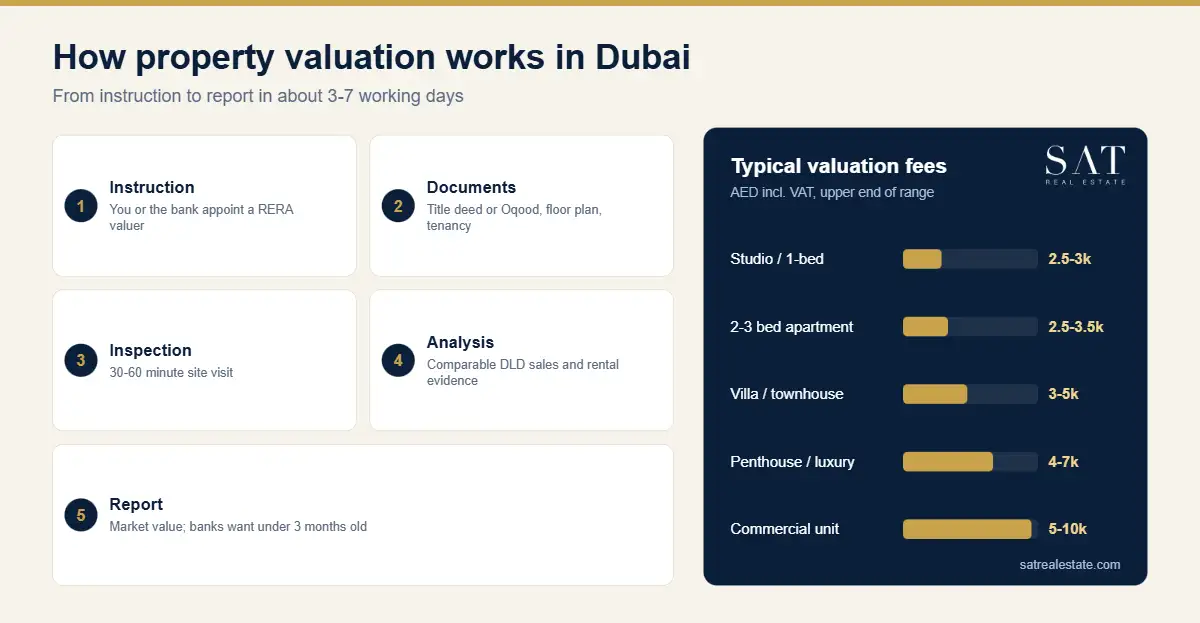
Fees vary by property type, size and urgency. Typical 2026 ranges, including VAT:
| Property | Typical fee (AED) |
|---|---|
| Studio or one-bedroom apartment | 2,500–3,000 |
| Two- to three-bedroom apartment | 2,500–3,500 |
| Villa or townhouse | 3,000–5,000 |
| Penthouse or luxury home | 4,000–7,000 |
| Commercial unit | 5,000–10,000 |
| Urgent 24–48 hour report | Extra AED 500–1,000 |
For a mortgage, the bank appoints the valuer from its panel and sets the fee, which you pay as part of the loan costs. For other purposes, you can appoint a RERA-registered valuer directly and negotiate the fee.
When you need a formal valuation
A formal valuation is usually needed for:
- Mortgages and refinancing: the bank’s panel valuer sets the value it will lend against
- Inheritance and estate administration: to divide or transfer assets between heirs
- Disputes and divorce: where a court or the parties need an independent figure
- Company accounts and audits: properties held at fair value need regular valuations
- Insurance: to set the reinstatement value for buildings cover
- Partnership buy-outs: where co-owners agree a price between themselves
For an ordinary sale, a formal valuation is optional, but a valuation or a detailed comparable analysis can help you price correctly and avoid months on the market. Our guide on how to sell property in Dubai explains how pricing fits into the sale.
The valuation process and timeline
- Instruction: you or the bank appoint the valuer and pay the fee.
- Documents: you provide the title deed or Oqood, floor plan and tenancy contract if let.
- Inspection: the valuer visits the property, usually for 30–60 minutes, to check condition, layout and view.
- Analysis: the valuer reviews comparable sales and rental evidence.
- Report: the report is issued, usually within three to seven working days of the visit.
Valuation reports are a snapshot in time. Banks typically require a report no more than three months old, and most reports are considered current for three to six months at most.
What affects your property’s value
Valuers look closely at factors that buyers sometimes overlook:
- Location within the community: proximity to metro, parks, beach or main roads
- View and floor level: sea, golf or skyline views and higher floors command premiums
- Size and layout: usable space, balconies and storage matter more than headline area
- Condition and upgrades: renovated kitchens and bathrooms can lift value, but only to a point
- Building quality and service charges: well-run buildings with sensible charges hold value better
- Tenancy: a vacant unit can be worth more to owner-occupiers; a well-let unit can appeal to investors
- Market evidence: a building with few recent sales gives the valuer less evidence to support a high figure
Valuation gaps and how to handle them
A valuation gap happens when the bank’s valuation comes in below the agreed price. Because banks lend on the lower of the two, the buyer must cover the difference in cash.
Example: you agree to buy an apartment for AED 2,000,000 with an 80% mortgage, expecting to borrow AED 1,600,000. The bank values it at AED 1,800,000, so the maximum loan becomes AED 1,440,000. Your cash requirement rises from AED 400,000 to AED 560,000.
Your options include:
- Renegotiate the price with the seller using the valuation as evidence
- Fund the gap from your own resources
- Ask another bank with a different valuer panel, if time allows
- Challenge factual errors in the report, such as the wrong size or floor
- Walk away, if Form F makes the sale subject to finance
The best protection is to check recent DLD transactions before you agree a price, and to make your offer subject to a satisfactory valuation where possible. Our guide to a mortgage for non-residents in Dubai covers how banks apply valuations.
Online estimates vs formal valuations
The Dubai REST app and property portals offer instant estimates based on transaction data. They are useful to sense-check a price or track your property’s value over time. But they cannot see the condition, view, upgrades or exact position of a unit, and they are not accepted by banks or courts.
Use online estimates for a ballpark, recent transaction searches for a more refined view, and a formal valuation whenever money is being lent, divided or decided on the number.
How to choose a valuer
When you appoint a valuer yourself:
- Confirm the firm and individual are registered with RERA
- Prefer firms whose valuers are RICS-qualified
- Choose a valuer with experience in your area and property type
- Ask for the scope, fee and timeline in writing before instruction
- Check whether the report will be accepted by your bank or the relevant authority
Valuations for off-plan and newly completed property
Off-plan and newly completed units can be harder to value because there are few resales in the building. Valuers then rely on:
- Sales in comparable nearby projects, adjusted for developer, specification and completion date
- The developer’s launch and subsequent prices, treated with caution because they include incentives and payment plans
- Early resale and assignment prices in the same project, where available
This is why bank valuations at handover sometimes come in below the original purchase price, particularly where buyers paid a premium for a generous payment plan. If you plan to mortgage an off-plan unit at completion, check recent resales in similar completed buildings before handover so you know what the bank is likely to accept. Our guide to buying off-plan property in Dubai covers handover financing in more detail.
Valuations also matter for portfolio decisions. A regular, realistic view of what each property is worth helps you decide whether to sell, hold or refinance, and whether your capital could earn more elsewhere.
Is a property valuation in Dubai worth paying for?
Usually, yes. A few thousand dirhams for a professional property valuation in Dubai can prevent an overpriced purchase, a stalled sale or a mortgage shortfall worth far more. Even when a formal report is not required, understanding how valuers think, and checking the comparable evidence yourself, puts you in a stronger position to negotiate.
SAT Real Estate provides data-led pricing and comparable analysis for buyers and sellers, and coordinates formal valuations with RERA-registered firms. Book a private investment consultation or see our sell, hold or reinvest advisory.
Related reading
- Power of Attorney for Property in Dubai
- Freehold Areas in Dubai: Where Foreigners Can Buy
- How to Sell Property in Dubai
- Mortgage for Non-Residents in Dubai
- Rental Yield in Dubai: How to Calculate Gross and Net ROI
- Dubai Property Inheritance
- Dubai Mortgage Rates 2026
Frequently asked questions
1. How much does a property valuation cost in Dubai?
Residential valuations typically cost AED 2,500–5,000 including VAT, depending on size and type. Commercial valuations usually cost more.
2. Who can carry out a property valuation in Dubai?
Formal valuations must be prepared by valuers registered with RERA. Many reputable firms also follow RICS standards.
3. How long does a property valuation take in Dubai?
Usually three to seven working days from instruction to report, including a site inspection of around 30 to 60 minutes.
4. What happens if the bank valuation is lower than the purchase price?
The bank lends on the lower figure, so you must cover the shortfall in cash, renegotiate the price, try another bank or withdraw if the contract allows.
5. How long is a property valuation valid in Dubai?
Reports reflect value on a specific date. Banks typically require a valuation no more than three months old.
6. Can I use an online estimate instead of a valuation?
For a ballpark figure, yes. For mortgages, inheritance, disputes or audits, you need a formal valuation by a RERA-registered valuer.
7. Which valuation method is used for apartments in Dubai?
Mainly the comparable sales method, which compares recent sales of similar units adjusted for size, floor, view and condition.
8. Can I choose the valuer for my mortgage?
Usually not. Banks assign a valuer from their approved panel, though you pay the fee as part of the mortgage costs.
9. Do renovations increase property value in Dubai?
Quality upgrades to kitchens, bathrooms and finishes can increase value, but valuers rarely credit the full cost of the work.
10. Do I need a valuation to sell my property?
Not legally, but a valuation or detailed comparable analysis helps you set a realistic price and avoid a long time on the market.