
Corporate tax on real estate in the UAE is one of the most common questions from Dubai property investors since the federal corporate tax regime started in 2023. The short answer is reassuring for most private buyers: if you own property in your own name and earn rent without a business licence, that income is generally outside corporate tax. The picture changes if you hold property through a company, run a licensed real estate business or own through a foreign entity.
This guide explains who pays corporate tax on property income, how rental income and gains are treated for individuals and companies, how VAT fits in, and what to think about before you choose an ownership structure. It is a practical overview for investors; always confirm your own position with a UAE-registered tax adviser.
Key takeaways
- Individuals earning rent from personally owned property without a licence are generally outside UAE corporate tax.
- Companies pay 9% on taxable profit above AED 375,000, including rent and property gains.
- Foreign companies earning income from UAE property can have a taxable presence in the UAE.
- Residential rent is VAT-exempt; commercial rent is subject to 5% VAT.
In this guide
- How UAE corporate tax applies to property
- Individuals: personal property investment
- Companies that own property
- Free zone companies and property
- Foreign owners and non-resident companies
- VAT on property in the UAE
- Choosing the right ownership structure
- Record keeping and compliance
- Common misconceptions
- Should you worry about corporate tax on real estate in the UAE?
How UAE corporate tax applies to property
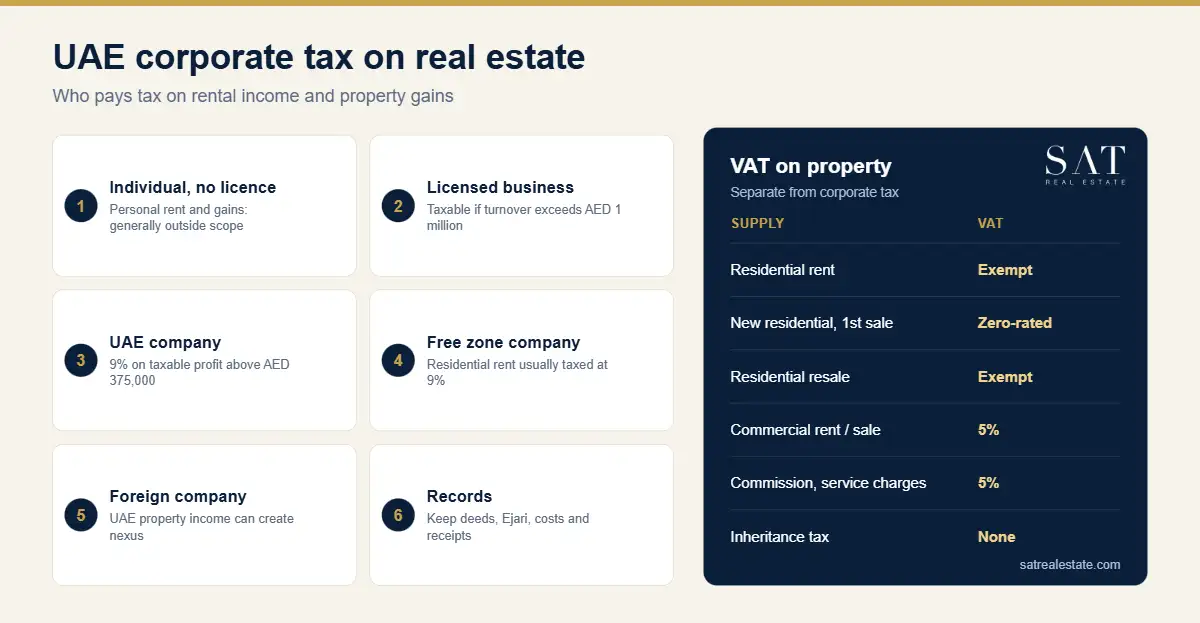
UAE corporate tax was introduced by Federal Decree-Law No. 47 of 2022 and applies to financial years starting on or after 1 June 2023. The standard rate is 9% on taxable income above AED 375,000, with a 0% rate on income up to that amount.
Whether property income is taxed depends mainly on who owns the property and whether the activity requires a licence:
| Owner | Rental income | Gain on sale |
|---|---|---|
| Individual, personal investment, no licence | Generally outside corporate tax | Generally outside corporate tax |
| Individual running a licensed real estate business | Taxable if business turnover exceeds AED 1 million | Taxable within the business |
| UAE company (mainland) | Taxable at 9% above AED 375,000 | Taxable at 9% |
| Free zone company | Depends on qualifying status and property type | Depends on qualifying status |
| Foreign company owning UAE property | May create a taxable nexus in the UAE | May be taxable |
Individuals: personal property investment
For most private investors this is the key point. Under Cabinet Decision No. 49 of 2023, natural persons are only subject to corporate tax on business or business activity income that requires a licence, and only when that turnover exceeds AED 1 million in a calendar year. The Ministry of Finance has confirmed that personal investment income from real estate that does not require a licence is not subject to corporate tax.
In practice, that means:
- You can own one or several apartments or villas in your own name
- You can let them on standard tenancy contracts registered on Ejari
- You do not need to register for corporate tax for that rent alone
- There is no tax on the gain when you sell, and no inheritance tax
The position can change if your property activity looks like a business that needs a licence, for example if you run a large holiday home operation, trade properties frequently, or provide hotel-style services. In those cases take advice on whether a licence, and therefore corporate tax, applies.
Companies that own property
If you hold property through a company, the rental income and any gain on sale form part of the company’s taxable income. A mainland company pays 0% on the first AED 375,000 of taxable income and 9% above that.
Key points for property-owning companies:
- Expenses are deductible, including service charges, maintenance, management fees, insurance and interest (subject to interest limitation rules for larger groups).
- Depreciation can reduce taxable income where the property is held at cost under accounting standards.
- Realisation basis election: companies that carry property at fair value can elect to tax revaluation gains only when they are realised on sale, rather than year by year.
- Small business relief may allow eligible resident companies with revenue under AED 3 million to be treated as having no taxable income, for tax periods ending by 31 December 2026.
- Registration and filing are required even if no tax is payable.
Company ownership can make sense for larger portfolios, joint ventures and investors who want succession or financing flexibility, but it brings accounting, audit and filing costs that do not apply to personal ownership.
Free zone companies and property
Free zone companies can benefit from a 0% rate on qualifying income if they meet the conditions to be a Qualifying Free Zone Person. However, income from immovable property is treated restrictively.
Broadly, income from commercial property located in a free zone and earned from transactions with other free zone persons may qualify. Income from residential property, or from property outside a free zone, generally does not qualify for the 0% rate and is taxed at 9%. Free zone structures should therefore not be assumed to make residential rental income tax-free.
Foreign owners and non-resident companies
Individual foreign nationals who own Dubai property in their own name are treated in the same way as UAE resident individuals for corporate tax: personal rental income without a licence is outside scope.
Foreign companies are different. Under Cabinet Decision No. 56 of 2023, a non-resident juridical person that earns income from immovable property in the UAE is considered to have a nexus in the UAE, and that income can be subject to corporate tax. If you own Dubai property through an overseas company, check whether you need to register and file in the UAE, and how this interacts with tax in your home country.
Remember that your home country may tax your Dubai rental income or gains even when the UAE does not. UK, Indian and many other residents must report foreign property income at home.
VAT on property in the UAE
VAT is separate from corporate tax and applies at 5% unless an exemption or zero rate applies:
| Transaction | VAT treatment |
|---|---|
| Residential rent | Exempt |
| First sale or lease of a new residential building (within 3 years of completion) | Zero-rated |
| Later resale of residential property | Exempt |
| Commercial rent and sales | 5% standard rate |
| Agency commission, service charges and management fees | 5% standard rate |
Landlords of residential property generally do not register for VAT on rent. Owners of commercial property must register once taxable supplies exceed the mandatory threshold of AED 375,000 a year.
Choosing the right ownership structure
The best structure depends on your goals, not just tax:
- Personal name: simplest and usually most tax-efficient for one or a few properties. Pair it with a registered will for succession.
- Mainland company: suits larger portfolios and partnerships, but rent and gains are taxable and accounts must be kept.
- Free zone or foundation structures: may help with succession and governance, but check whether the specific building allows company ownership and how the income will be taxed.
- Overseas company: may create UAE tax exposure and home-country reporting; get advice before buying.
Our guide to Dubai property inheritance covers how structure affects succession.
Record keeping and compliance
Even when no corporate tax is due, good records make life easier when you sell, refinance or report income at home. Keep:
- Title deeds or Oqood, and the purchase contract
- Proof of purchase costs (DLD fees, commission, trustee fees)
- Tenancy contracts and Ejari certificates
- Rent receipts and bank statements
- Service charge invoices and maintenance bills
Companies must also keep financial statements and tax records for at least seven years and file an annual corporate tax return within nine months of the year end.
Common misconceptions
A few myths come up again and again with investors:
- “Dubai now taxes all rental income.” It does not. Personal rental income without a licence remains outside corporate tax.
- “Owning through a free zone company makes rent tax-free.” Residential rent rarely qualifies for the free zone 0% rate, so a company structure can increase tax rather than reduce it.
- “I only pay tax if I sell at a profit.” For companies, rent is taxable every year, not just gains on sale.
- “The AED 375,000 threshold applies to individuals’ rent.” That threshold is for taxable income of persons within scope, mainly companies. Individuals with only personal rental income are outside the regime altogether.
- “No UAE tax means no tax anywhere.” Your home country may still tax your Dubai rent or gains, so report them where required.
Getting these points right early avoids setting up a structure that adds cost and complexity without any tax benefit.
Should you worry about corporate tax on real estate in the UAE?
For most individual investors, no. Corporate tax on real estate in the UAE mainly affects companies, licensed property businesses and foreign entities. If you own property in your own name and let it on normal tenancies, Dubai remains one of the most tax-efficient places in the world to hold rental property. If you are planning a larger portfolio or a company structure, take advice before you buy rather than after.
SAT Real Estate helps investors plan ownership, financing and portfolio structure, and works alongside qualified tax advisers. Book a private investment consultation or see our portfolio advisory service.
Related reading
- Rental Yield in Dubai: How to Calculate Gross and Net ROI
- Dubai Property Inheritance: Protect Your Property With a Will
- How to Sell Property in Dubai
- Cost of Buying Property in Dubai
- Dubai Golden Visa Through Property in 2026
Frequently asked questions
1. Is rental income taxed in Dubai?
Rental income earned by an individual from personally owned property, without a business licence, is generally outside UAE corporate tax. Companies pay corporate tax on rent.
2. What is the UAE corporate tax rate on property income?
Companies pay 0% on taxable income up to AED 375,000 and 9% on taxable income above that, including rent and gains on property.
3. Do individuals pay corporate tax when they sell property in Dubai?
Generally no. Gains on personally held investment property are outside corporate tax, and there is no separate capital gains tax for individuals.
4. Do I need to register for corporate tax if I own a rental apartment?
Not if the rent comes from a personal investment that does not require a licence. Registration is needed if you run a licensed business above the AED 1 million turnover threshold.
5. Does a company that owns Dubai property pay corporate tax?
Yes. A UAE mainland company includes rent and property gains in taxable income and pays 9% on profits above AED 375,000, after deductible expenses.
6. Is residential property rental income in a free zone company tax-free?
Usually not. Income from residential property generally does not qualify for the 0% free zone rate and is taxed at the standard 9%.
7. Do foreign companies owning Dubai property pay UAE tax?
A non-resident company earning income from UAE immovable property can have a taxable nexus in the UAE, so it may need to register and pay corporate tax.
8. Is there VAT on residential rent in Dubai?
No. Residential rent is VAT-exempt. Commercial rent, agency commission and service charges are subject to 5% VAT.
9. Is there inheritance tax on Dubai property?
No. The UAE does not levy inheritance tax, although heirs must still follow the legal process to transfer the property.
10. Should I buy Dubai property in my own name or through a company?
For one or a few properties, personal ownership is usually simpler and more tax-efficient. Company ownership can suit larger portfolios but adds tax and compliance costs.