
Dubai property inheritance is one of the most overlooked risks for expatriate owners. Many investors spend months choosing the right unit and negotiating the price, yet never decide what happens to it if they die. Without a registered will, a Dubai property can be frozen for months, divided in ways the owner never intended and cost the family tens of thousands of dirhams to release.
This guide explains what happens to Dubai property when an owner dies, how the rules differ with and without a will, the main will options for non-Muslim owners, and practical steps to make sure your property passes smoothly to the people you choose.
Key takeaways
- Without a registered will, Dubai property can be frozen for 6 to 18 months while courts decide who inherits.
- A DIFC Property Will costs about AED 5,000 to register and covers up to five UAE properties.
- A will made in your home country is not automatically enforced for Dubai property.
- Joint owners in Dubai do not automatically inherit each other’s share.
In this guide
- What happens to Dubai property when the owner dies
- Inheritance without a will
- How a DIFC will protects Dubai property
- Other will options in Dubai
- Joint ownership is not a will
- Mortgaged property and life cover
- Owning through a company or foundation
- Practical steps for property owners
- What your family will need after a death
- Is planning Dubai property inheritance worth it for investors?
What happens to Dubai property when the owner dies
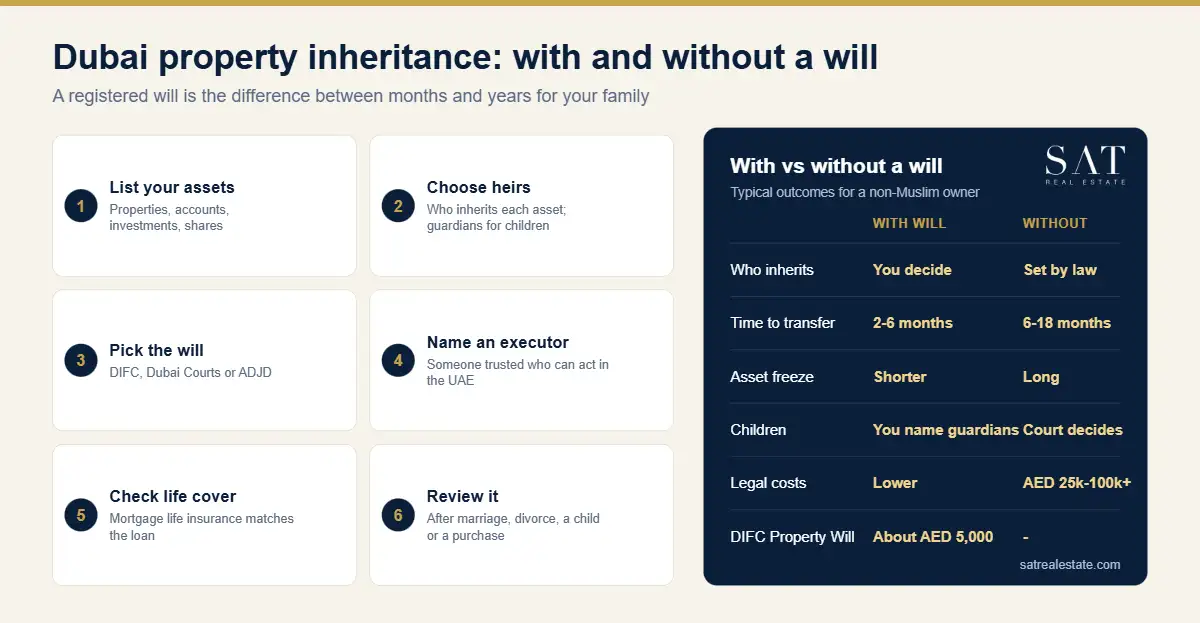
When a property owner dies in the UAE, their assets, including real estate registered with the Dubai Land Department (DLD), cannot simply pass to the family. Bank accounts are frozen, the title deed stays in the deceased’s name and the heirs must obtain a court order before the DLD will transfer ownership.
The path the estate takes depends on two things: whether the owner left a will that UAE authorities recognise, and which law the court applies.
| With a registered will | Without a will | |
|---|---|---|
| Who inherits | The people you name | Set by law |
| Typical time to transfer | About 2–6 months | About 6–18 months |
| Asset freeze | Shorter, with a clear process | Long and uncertain |
| Guardianship of children | Can be named in the will | Decided by the court |
| Legal costs | Lower | Often AED 25,000–100,000+ |
Inheritance without a will
If a non-Muslim owner dies without a valid will, the outcome is uncertain. Historically, UAE courts applied Sharia principles by default. Under Sharia, a wife may receive only one-eighth of the estate when there are children, sons receive twice the share of daughters, and parents or siblings may also have claims.
The UAE has since introduced civil personal status laws for non-Muslims, including Federal Decree-Law No. 41 of 2022. Broadly, it allows a default split for non-Muslims of half to the surviving spouse and half shared equally among the children, and it lets heirs ask the court to apply the deceased’s home-country law. However, families still have to go to court, prove relationships with attested documents and wait for a judgment, during which the property cannot be sold or transferred.
In practice, dying without a will in Dubai means:
- Bank accounts in the deceased’s sole name are frozen
- The property cannot be sold, refinanced or transferred until the court rules
- Mortgage payments, service charges and DEWA keep falling due
- An unmarried partner has no right to inherit
- Heirs abroad must legalise and translate death, marriage and birth certificates into Arabic
How a DIFC will protects Dubai property
The DIFC Courts Wills Service was created so non-Muslims can register a will under common-law principles that UAE authorities enforce. It is the most widely used route for expatriate property owners.
The main options are:
| Will type | Covers | Registration fee |
|---|---|---|
| Property Will | Up to five UAE properties | About AED 5,000 |
| Full Will | All UAE assets and guardianship of minor children | About AED 10,000 |
| Financial Assets Will | Bank accounts, shares and investments | Varies |
| Business Owners Will | Shares in UAE companies | Varies |
| Guardianship Will | Guardians for minor children | Varies |
Couples can register mirror wills at a reduced combined fee. Fees are set by the DIFC Wills Service and can change, so check the DIFC Courts before you register.
To register, you sign the will in front of a DIFC registry officer and two witnesses, in person or by video link. The DIFC keeps the original and issues a certified copy. When you die, your executor applies to the DIFC Courts for probate, which is then executed through the Dubai Courts, and the DLD transfers the property to your named heirs.
Other will options in Dubai
A DIFC will is not the only route:
- Dubai Courts notarised will: non-Muslims can register a will with the Dubai Courts notary public. It is generally cheaper and is executed through the Dubai Courts.
- Abu Dhabi Judicial Department will: non-Muslims can register a will with the ADJD under Abu Dhabi’s civil family law. It covers assets across the UAE.
- Home-country will: a will made in the UK, India or elsewhere is not automatically enforced for Dubai real estate. It has to be legalised, translated and proved in a UAE court, which takes time and is not guaranteed.
The best choice depends on your nationality, the assets you hold, where your family lives and whether you also own property in other emirates. Many owners keep a home-country will for overseas assets and a separate UAE will for their Dubai property.
Joint ownership is not a will
Many couples buy Dubai property in joint names and assume the survivor automatically keeps the whole unit. That is not how it works. Joint owners in Dubai hold shares in the property, and when one owner dies, their share goes into their estate rather than passing automatically to the other owner.
Without a will, the surviving spouse may end up co-owning the property with the deceased’s other heirs, and cannot sell or refinance without agreement and a court order. Each joint owner should therefore have their own will that deals with their share.
Mortgaged property and life cover
Most UAE banks require mortgage life insurance when you take a home loan. If the borrower dies, the policy is meant to clear the outstanding loan, so the property passes to the heirs without the debt.
Check that the cover matches the loan amount, that premiums are up to date and that your heirs know which bank and insurer to contact. If the property is held without life cover, the bank can demand repayment and may take steps to recover the loan if payments stop, which is another reason to plan early.
Owning through a company or foundation
Some investors hold Dubai property through a company or foundation, for example a DIFC or ADGM foundation or a free zone company that is allowed to own real estate. Succession then happens by transferring shares or appointing new beneficiaries, which can avoid probate on the property itself.
These structures have setup and annual costs, may affect corporate tax and are not available for every property. They tend to suit larger portfolios. Take legal and tax advice before you restructure, and check the developer and DLD rules for the specific building.
Practical steps for property owners
You can protect your family in a few clear steps:
- List your UAE assets: properties, bank accounts, investments and company shares.
- Decide who should inherit each asset and who should look after any minor children.
- Choose the right will: DIFC, Dubai Courts or ADJD, based on your situation.
- Appoint an executor you trust, ideally someone who can act in the UAE.
- Check your mortgage life cover and keep policy details with your will.
- Tell your executor where the will and title deeds are kept.
- Review the will after marriage, divorce, a new child or a new property purchase.
Keep a simple record of your title deed numbers, Oqood for off-plan units, tenancy contracts and service charge accounts. It saves your family time when they need it most.
What your family will need after a death
Even with a will in place, your heirs or executor will need to act quickly and with the right documents. Typically they will need:
- The original death certificate, and a translated, attested copy if the death occurred outside the UAE
- Your registered will or its certified copy
- Passports and Emirates IDs of the heirs and executor
- Marriage and birth certificates proving family relationships, attested and translated into Arabic where required
- Title deeds or Oqood certificates for each property
- Mortgage details and the life insurance policy
- Tenancy contracts and Ejari certificates for let properties
If a property is let, the tenancy continues and rent keeps coming in, but it may be held until the estate is settled. A property manager can keep the unit running, collect rent and pay service charges during this period, which avoids arrears building up and protects the value of the property for the heirs.
Is planning Dubai property inheritance worth it for investors?
Yes. A registered will costs a fraction of the property’s value and can save your family months of frozen assets and heavy legal costs. Dubai property inheritance planning should be part of every purchase, alongside the mortgage and the title deed, especially for off-plan buyers who will hold the property for many years.
SAT Real Estate helps investors structure their portfolios so ownership, income and succession are clear from day one, and coordinates with qualified will and legal specialists. Book a private investment consultation or see our portfolio advisory and private office services.
Related reading
- How to Sell Property in Dubai: Steps, Fees and Documents
- Service Charges in Dubai: What Owners Pay
- Buying Off-Plan Property in Dubai: The Complete 2026 Investor Guide
- Off-Plan vs Ready Property in Dubai
- Dubai Golden Visa Through Property in 2026
- Cost of Buying Property in Dubai
- Dubai Real Estate FAQ
Frequently asked questions
1. What happens to my Dubai property if I die without a will?
The property is frozen until a court decides who inherits. Heirs must prove their relationship with attested documents, and the process can take 6 to 18 months.
2. Does Sharia law apply to non-Muslims’ property in Dubai?
Not automatically any more. Civil personal status laws now give non-Muslims alternatives, but without a will the outcome still depends on a court process and can be uncertain.
3. How much does a DIFC will cost?
A DIFC Property Will covering up to five UAE properties costs about AED 5,000 to register. A Full Will covering all UAE assets costs about AED 10,000.
4. Is my UK or Indian will valid for Dubai property?
It is not automatically enforced. A foreign will must be legalised, translated into Arabic and proved in a UAE court, which takes time and is not guaranteed.
5. Does my spouse automatically inherit our jointly owned property?
No. Each joint owner holds a share, and on death that share goes into the deceased’s estate. Each owner needs a will covering their share.
6. What is the difference between a DIFC will and a Dubai Courts will?
A DIFC will is registered with the DIFC Courts under common-law principles. A Dubai Courts will is notarised with the Dubai Courts and is generally cheaper.
7. What happens to a Dubai mortgage when the owner dies?
Mortgage life insurance, which most banks require, should clear the outstanding loan so the property passes to the heirs without the debt.
8. Can I name guardians for my children in a Dubai will?
Yes. A DIFC Full Will or Guardianship Will lets you name guardians for minor children, so the court does not have to decide.
9. Can I hold Dubai property in a company to avoid probate?
Some investors use a company or foundation that is allowed to own real estate. It can simplify succession, but it adds costs and needs legal and tax advice.
10. Do I need to update my will after buying another property?
Usually yes, unless your will already covers all your UAE property. Review it after any new purchase, sale, marriage, divorce or birth.