
Freehold areas in Dubai are the designated zones where foreigners of any nationality can buy property outright, with full ownership recorded on a Dubai Land Department (DLD) title deed. Since freehold ownership opened to non-GCC nationals in the early 2000s, these zones have grown to cover most of the city’s best-known communities, from Palm Jumeirah and Downtown to JVC and Dubai South.
This guide explains what freehold means, the legal basis, which areas are freehold, how freehold differs from leasehold, who can buy and what to check before choosing an area. It is written for overseas investors and expatriates planning their first or next Dubai purchase.
Key takeaways
- Foreigners can buy freehold property in designated areas under Dubai Law No. 7 of 2006 and Regulation No. 3 of 2006.
- There are 60+ freehold zones, including Downtown, Dubai Marina, Palm Jumeirah, Dubai Hills Estate, JVC and Dubai South.
- Freehold gives you a title deed with no expiry date and the right to sell, lease, mortgage and pass on the property.
- Older districts such as Deira, Bur Dubai and Karama are largely reserved for UAE and GCC nationals.
In this guide
- What freehold ownership means in Dubai
- The legal basis for foreign ownership
- Main freehold areas in Dubai
- Areas that are not freehold
- Freehold vs leasehold vs usufruct
- Who can buy freehold property
- How to buy in a freehold area
- How to choose the right freehold area
- Freehold, residency and long-term plans
- Mistakes to avoid
- Are freehold areas in Dubai the best option for foreign investors?
What freehold ownership means in Dubai
Freehold means you own the property and your share of the land it stands on, with no time limit. Your ownership is registered with the DLD and shown on a title deed (or an Oqood certificate while an off-plan unit is under construction).
As a freehold owner you can:
- Live in the property or let it out
- Sell it at any time, subject to clearing service charges and any mortgage
- Mortgage it with a UAE bank
- Pass it on to heirs, ideally through a registered will
- Gift it to family members
You do not need a local partner or sponsor, and you do not need to live in the UAE to buy.
The legal basis for foreign ownership
Foreign freehold ownership rests on two key pieces of legislation:
- Law No. 7 of 2006 concerning Real Property Registration in Dubai, which allows UAE and GCC nationals to own property anywhere in Dubai and allows foreigners to own freehold property in areas designated by the Ruler.
- Regulation No. 3 of 2006, which sets out the areas where non-UAE nationals may own freehold property or hold long-term leasehold and usufruct rights.
The list of designated areas has been expanded several times since, most recently with conversions of some leasehold plots along Sheikh Zayed Road and Al Jaddaf to freehold. The DLD maintains the official, current list.
Main freehold areas in Dubai
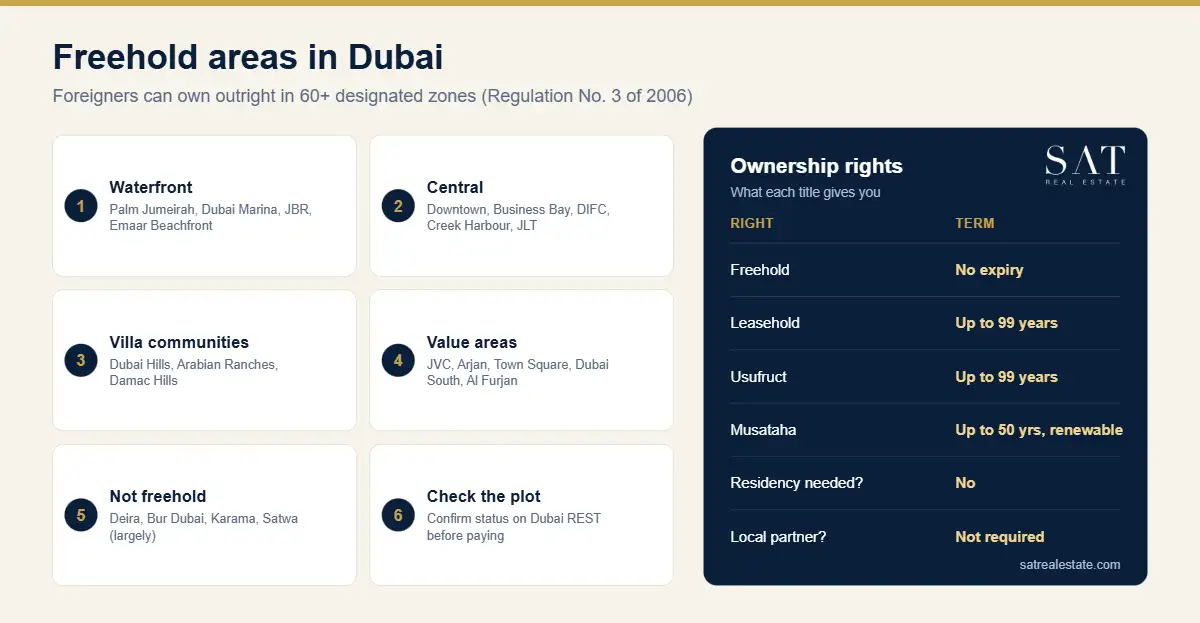
There are more than 60 designated freehold zones. The best-known fall into four broad groups:
| Category | Freehold areas |
|---|---|
| Waterfront and iconic | Palm Jumeirah, Dubai Marina, JBR, Emaar Beachfront, Bluewaters, La Mer, Dubai Harbour |
| Central and urban | Downtown Dubai, Business Bay, DIFC, Dubai Creek Harbour, City Walk, Jumeirah Lake Towers |
| Master-planned villa communities | Dubai Hills Estate, Arabian Ranches, Damac Hills, Tilal Al Ghaf, The Springs and Meadows, Jumeirah Golf Estates |
| Mid-market and value | Jumeirah Village Circle (JVC), Jumeirah Village Triangle, Arjan, Al Furjan, Town Square, Dubai South, Dubai Silicon Oasis, International City, Discovery Gardens |
Each area suits a different strategy. Waterfront and central areas tend to offer stronger tenant demand and capital values; mid-market areas usually offer higher rental yields at lower entry prices. Our area guides cover Downtown-adjacent Business Bay, Dubai Marina, Palm Jumeirah, Dubai Hills Estate, JVC and Dubai South.
Areas that are not freehold
Many of Dubai’s older and traditional neighbourhoods are not designated for foreign ownership. These include large parts of:
- Deira and Bur Dubai
- Karama, Satwa and Oud Metha
- Al Qusais, Al Muhaisnah and Hor Al Anz
- Al Rashidiya and Naif
In these areas, property is generally reserved for UAE and GCC nationals. Foreigners may still rent there, and in some cases hold leasehold or usufruct rights, but not freehold title. Always confirm the status of a specific plot with the DLD before you pay a deposit.
Freehold vs leasehold vs usufruct
| Right | What you get | Typical term |
|---|---|---|
| Freehold | Full ownership of unit and land share | No expiry |
| Leasehold | Right to use the property for a fixed term | Up to 99 years |
| Usufruct | Right to use and benefit from a property, without owning it | Up to 99 years |
| Musataha | Right to build on and use land owned by someone else | Up to 50 years, renewable |
Leasehold and similar rights can still be valuable, but they lose value as the term runs down and may be harder to finance and resell. For most overseas investors, freehold is the simpler and more liquid choice.
Who can buy freehold property
Freehold areas are open to:
- Foreign individuals of any nationality, resident or non-resident
- Joint buyers, who can be of different nationalities
- Companies, subject to the developer’s and DLD’s rules for the specific property
You do not need a UAE residence visa or a local bank account to buy with cash, though a UAE account makes paying fees and service charges easier and is usually required for a mortgage. Buying property can also support residency: a qualifying investment can make you eligible for a Dubai Golden Visa through property, subject to the current rules.
How to buy in a freehold area
The process is the same across freehold zones:
- Choose the area and property based on your budget, goals and target tenants.
- Check the property on the Dubai REST app: freehold status, ownership and any mortgage.
- Agree terms and sign Form F for a resale, or the reservation form and SPA for an off-plan purchase.
- Obtain the developer NOC for a resale, confirming service charges are paid.
- Transfer at a trustee office, paying the 4% DLD fee and other costs.
- Receive the title deed in your name, or the Oqood certificate for an off-plan unit.
Our guides to buying ready property in Dubai and buying off-plan property in Dubai walk through each route in detail, and the cost of buying property in Dubai lists every fee.
How to choose the right freehold area
Freehold status is only the starting point. To choose between areas, compare:
- Rental yield and tenant demand: mid-market areas often yield 6–7% gross, prime areas 4.5–5.5%
- Future supply: areas with large pipelines of new launches can see slower price and rent growth
- Infrastructure: metro lines, Etihad Rail stations, new schools and road links support demand
- Service charges: they vary widely and affect net returns
- Exit liquidity: established communities with many transactions are easier to sell in
A balanced portfolio may combine a prime unit for capital stability with a mid-market unit for income.
It also pays to visit, or have someone visit, at different times of day. Traffic, noise, construction nearby and access to schools, shops and transport can look very different on a weekday morning than in a sales brochure, and they all shape what tenants will pay and how quickly the unit lets.
Freehold, residency and long-term plans
Owning freehold property in Dubai is separate from living there, but the two often connect. A freehold purchase can support residency through property-linked visas, subject to the current value thresholds and conditions, and many investors buy first with a view to relocating later.
When you plan for the long term, consider:
- Who will use the property: your family, tenants or a mix over time
- How you will hold it: in your own name, jointly or through a permitted company
- How it will pass on: a registered will avoids delays for your heirs
- How you will exit: areas with deep resale markets make it easier to sell when plans change
Freehold ownership also means you are responsible for service charges, maintenance and compliance with community rules. For overseas owners, a property manager can handle tenancies, Ejari, DEWA and owners association matters, so the investment stays income-producing without you being on the ground. Our property management in Dubai service covers these tasks for absent owners.
Mistakes to avoid
- Assuming every new project is freehold. Most are, but always check the plot on the DLD.
- Buying from unregistered sellers or projects that are not listed on the DLD.
- Ignoring service charges when comparing areas.
- Overlooking exit demand, especially for unusual units in thinly traded buildings.
- Skipping a will. Freehold property should be covered by a registered will to protect your heirs.
Are freehold areas in Dubai the best option for foreign investors?
For most international buyers, yes. Freehold areas in Dubai offer full ownership, a transparent registration system, no annual property tax and a wide choice of locations and price points. The key decision is not whether to buy freehold, but which freehold area and which building best match your budget, income needs and time horizon.
SAT Real Estate helps overseas investors compare freehold communities on yield, supply, service charges and exit demand before they commit. Book a private investment consultation or explore our investment advisory service.
Related reading
- Power of Attorney for Property in Dubai
- Buying Ready Property in Dubai
- Buying Off-Plan Property in Dubai
- Rental Yield in Dubai: How to Calculate Gross and Net ROI
- Dubai Golden Visa Through Property in 2026
- Dubai Property Market Outlook 2027
Frequently asked questions
1. Can foreigners buy property in Dubai?
Yes. Foreigners of any nationality can buy freehold property in designated areas of Dubai, with full ownership registered with the Dubai Land Department.
2. How many freehold areas are there in Dubai?
There are more than 60 designated freehold zones, including Downtown Dubai, Dubai Marina, Palm Jumeirah, Dubai Hills Estate, JVC and Dubai South.
3. What law allows foreigners to own property in Dubai?
Dubai Law No. 7 of 2006 on real property registration and Regulation No. 3 of 2006, which designates the areas where non-UAE nationals may own property.
4. Does freehold property in Dubai expire?
No. Freehold ownership has no expiry date. You can sell, lease, mortgage and pass on the property to your heirs.
5. Which areas in Dubai are not freehold for foreigners?
Older districts such as Deira, Bur Dubai, Karama, Satwa and Al Qusais are largely reserved for UAE and GCC nationals.
6. Do I need a UAE visa to buy freehold property in Dubai?
No. You can buy without a residence visa. A qualifying purchase may, however, make you eligible for a property-linked visa such as the Golden Visa.
7. What is the difference between freehold and leasehold in Dubai?
Freehold gives permanent ownership of the unit and land share. Leasehold gives the right to use a property for a fixed term, usually up to 99 years.
8. Can I get a mortgage on freehold property as a foreigner?
Yes. UAE banks lend to residents and non-residents on freehold property, with deposit requirements depending on residency, value and property type.
9. How do I check whether a property is freehold?
Check the property on the Dubai REST app or with the DLD, and confirm the title deed or Oqood is registered in the seller’s or developer’s name.
10. Which freehold area has the best rental yield?
Mid-market communities such as JVC, Town Square and Arjan usually offer the highest gross yields, often around 6–7%, while prime areas yield less.