
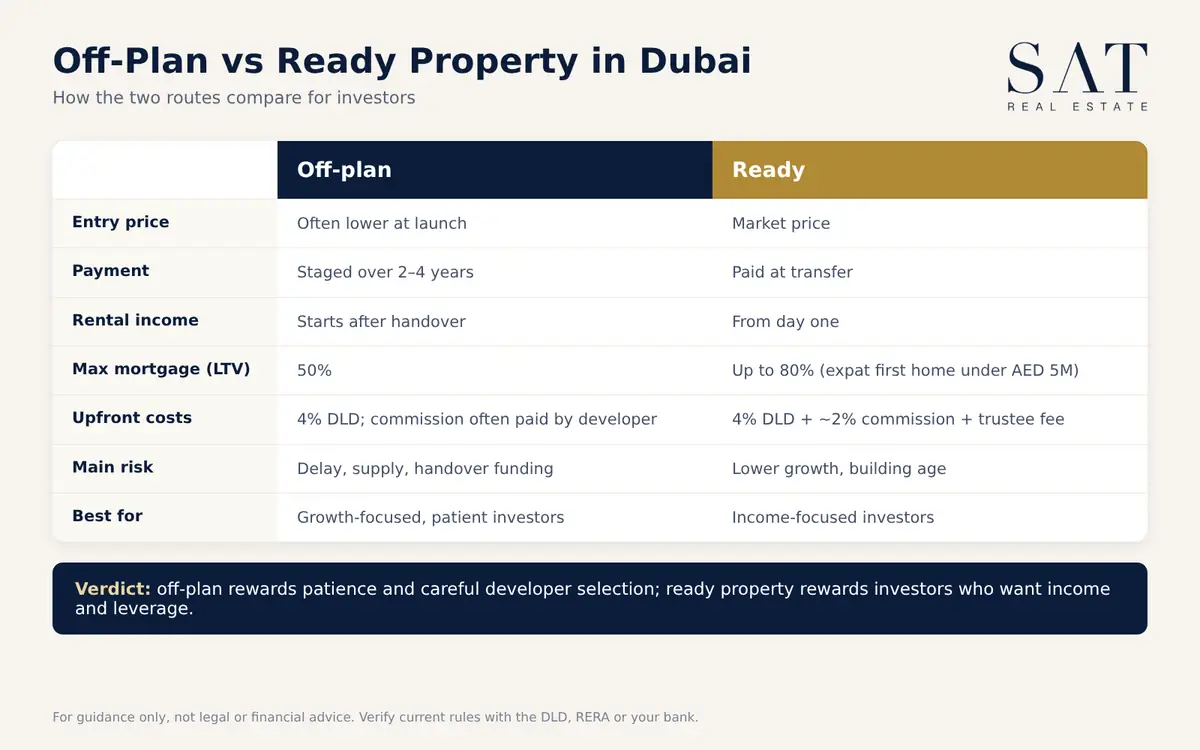
Choosing between off-plan vs ready property in Dubai is the first big decision most investors face. Off-plan offers launch pricing and staged payments but no income until handover. Ready property costs more upfront but starts earning rent almost immediately. Neither is “better” on its own. The right choice depends on your capital, your timeline and whether you need income or growth.
This guide compares both routes side by side: cash flow, financing, costs, risk, returns and exit. It also walks through a worked example on a AED 2 million budget, so you can see how the numbers really play out.
Key takeaways
- Off-plan suits growth-focused investors who can wait two to four years for income and want to spread payments.
- Ready property suits income-focused investors who want rent from day one and full mortgage options.
- Off-plan mortgages are capped at 50% loan-to-value; ready homes can reach 80% for expatriate first-time buyers under AED 5 million.
- Both routes pay the 4% DLD fee. The real difference is when your capital is tied up and when it starts earning.
In this guide
- Off-Plan vs Ready Property: The Core Difference
- Cash Flow and Payment Structure
- Financing: Mortgage Limits Compared
- Costs: What Each Route Really Costs
- Returns: Capital Growth vs Rental Yield
- Risk Comparison
- Which Is Right for You?
- Off-Plan vs Ready Property in Dubai: The Verdict
- Frequently Asked Questions About Off-Plan vs Ready Property in Dubai
Off-Plan vs Ready Property: The Core Difference
Off-plan property is bought from a developer before completion. You pay in instalments during construction, the sale is registered on the Dubai Land Department (DLD) Oqood register, and you receive the keys at handover. Ready property is a completed home, bought either from a developer or on the secondary (resale) market, with an immediate title deed transfer.
That simple difference changes almost everything else: how much cash you need on day one, when income starts, how you can finance the deal and what can go wrong. Our Dubai Real Estate Investment Guide covers both formats in its “Ready & Off-Plan” chapter; this article goes deeper on the numbers.
Cash Flow and Payment Structure
How off-plan payments work
Off-plan purchases spread the price over the build period. A typical plan asks for 10–20% at booking, instalments linked to construction milestones and a final balance at handover. Some projects offer post-handover plans, where 30–60% is paid over one to five years after completion.
The advantage is clear: less capital is tied up early. The trade-off is that you earn nothing while you pay. You also need a firm plan for the handover balance, which is often the largest single payment.
How ready property payments work
A ready purchase is paid in full at transfer, either in cash or with a mortgage. Your capital is committed at once, but the asset can be leased within weeks. For many investors, that immediate rent is what makes ready stock attractive, especially in established communities with proven tenant demand. SAT’s ready property investment advisory focuses on exactly this: verified rents, real service charges and building condition before you commit.
Financing: Mortgage Limits Compared
Financing rules differ sharply between the two routes. The Central Bank of the UAE sets these maximum loan-to-value (LTV) limits:
| Buyer and property | Maximum LTV (expatriates) | Maximum LTV (UAE nationals) |
|---|---|---|
| First home under AED 5 million | 80% | 85% |
| First home over AED 5 million | 70% | 75% |
| Second or later property | 60% | 65% |
| Off-plan, any buyer | 50% | 50% |
These are regulatory maximums; banks set their own criteria within them, and non-residents usually receive lower limits. Off-plan finance is also only available from lenders that fund the specific project, and many release funds only near completion. Our mortgage and specialist coordination team checks lender appetite before you sign anything.
Costs: What Each Route Really Costs
Both routes pay the 4% DLD transfer fee. The other costs differ:
| Cost | Off-plan | Ready (resale) |
|---|---|---|
| DLD fee | 4% at Oqood registration (sometimes waived by the developer) | 4% at transfer |
| Agency commission | Often paid by the developer | Usually 2% + VAT, paid by the buyer |
| Trustee office fee | Not usually applicable | AED 2,000 + VAT under AED 500,000; AED 4,000 + VAT above |
| Developer NOC | Only if you resell before handover | Required from the seller’s developer |
| Service charges | From handover | From day one |
| Furnishing | Full fit-out needed | Often partly furnished or ready to lease |
On a resale, buyer costs of around 6–7% of the price are common once commission and fees are added. On off-plan, upfront costs are often lower, but you carry the opportunity cost of capital that earns nothing until handover.
Returns: Capital Growth vs Rental Yield
Where off-plan returns come from
Off-plan returns are mostly capital growth. If you buy at launch and the market or the community matures by handover, the unit may be worth more than you paid. Because you have only paid part of the price, gains on the capital you actually committed can be large. Losses are magnified the same way if prices fall.
Where ready property returns come from
Ready returns combine rental income and growth. Gross yields in many established Dubai communities are often quoted in the mid-single digits, but the figure that matters is net yield after service charges, maintenance, vacancy and management. Check current figures in our yield and price guides and compare communities with our area comparisons.
A worked example on AED 2 million
The table below is illustrative only. It assumes a ready unit at AED 2,000,000 renting at 6% gross, and an off-plan unit of similar size launched at AED 1,800,000 on a 20/40/40 plan over three years.
| Assumption | Ready apartment | Off-plan apartment |
|---|---|---|
| Price | AED 2,000,000 | AED 1,800,000 |
| Upfront costs | About AED 126,000 (DLD, commission, trustee fee) | About AED 72,000 (DLD fee) |
| Cash in year one (no mortgage) | About AED 2,126,000 | About AED 432,000 (20% + DLD) |
| Rent in years one to three | About AED 360,000 gross | Nil |
| Value at year three if prices are flat | AED 2,000,000 | AED 2,000,000 at completion, if launch pricing was 10% below market |
| Main risk | Lower growth; ageing stock | Delay, oversupply, handover funding |
The ready unit produces steady income. The off-plan unit produces no income but ties up far less capital early, and its return depends on the launch discount holding through completion. Real outcomes depend on the building, the developer and the market cycle.
Risk Comparison
| Risk | Off-plan | Ready |
|---|---|---|
| Delivery and delay | Yes: handover dates can slip | None |
| Market moves before income | High: prices can change before you earn anything | Low: income starts immediately |
| Funding risk | Handover balance and limited finance | Mostly settled at purchase |
| Quality surprise | Finished product may differ from brochure | You inspect what you buy |
| Maintenance | Low in early years; warranty period | Higher in older buildings |
| Liquidity | Resale limited until a set share is paid | Can be sold any time |
Dubai’s escrow and Oqood rules protect how off-plan payments are used, but they do not guarantee timing or resale value. See how SAT approaches risk in our advisory approach.
Which Is Right for You?
Off-plan usually fits investors who:
- Want capital growth and can wait two to four years for income
- Prefer to spread payments rather than commit full capital at once
- Are comfortable assessing developer and supply risk
- May want a Golden Visa route and can meet the paid-amount conditions
Ready property usually fits investors who:
- Need rental income from the start
- Want to use higher mortgage leverage
- Prefer to inspect the exact unit, building and service charges
- Value easier resale at any time
Many SAT clients hold both. A ready apartment in a proven area such as Dubai Marina or Downtown Dubai can fund running costs, while an off-plan unit in a growth area such as Dubai Creek Harbour or Dubai South targets future appreciation. Our portfolio advisory service helps balance the two.
Off-Plan vs Ready Property in Dubai: The Verdict
There is no universal winner in the off-plan vs ready property Dubai debate. Off-plan rewards patience, careful developer selection and solid funding plans. Ready property rewards investors who want income, leverage and certainty about what they own. The best decision starts with your goals, then tests each option against real evidence: prices, rents, supply and exit.
Browse current off-plan properties and ready properties for sale, or speak to an adviser who will compare both on the same basis.
Book a private investment consultation
Related reading
- Buying Off-Plan Property in Dubai: The Complete 2026 Investor Guide
- Best Areas to Invest in Dubai Real Estate (2026 Guide)
- Best Places to Invest in Rental Property in Dubai
- Investing in Palm Jebel Ali
Frequently Asked Questions About Off-Plan vs Ready Property in Dubai
1. Is off-plan or ready property better for investment in Dubai?
Neither is better in every case. Off-plan suits investors focused on capital growth who can wait for income, while ready property suits investors who want rental income immediately and higher mortgage leverage.
2. Is off-plan property cheaper than ready property in Dubai?
Launch prices are often below comparable ready homes, but not always. Each off-plan price should be tested against nearby completed stock, the developer’s record and future supply before you assume a discount.
3. Can I get a mortgage on off-plan property in Dubai?
Yes, but the Central Bank of the UAE caps off-plan mortgages at 50% of the value, and only lenders that fund the specific project can lend. Many banks release funds only near completion.
4. How much deposit do I need for a ready property in Dubai?
Expatriate first-time buyers under AED 5 million need at least 20% plus costs, because the maximum LTV is 80%. Second properties and non-residents usually need 40% or more.
5. Which earns rental income faster?
Ready property. It can be leased within weeks of transfer, while off-plan property earns nothing until handover, which is often two to four years after purchase.
6. Are the purchase costs different for off-plan and ready property?
Both pay the 4% DLD fee. Resale buyers usually also pay about 2% agency commission plus VAT and a trustee office fee, while off-plan commission is often covered by the developer.
7. Which is riskier, off-plan or ready property?
Off-plan carries more risk because of delivery delays, market changes before completion and the handover payment. Ready property risks are mostly about building age, maintenance and lower growth.
8. Can I sell off-plan property before it is completed?
Usually yes, once you have paid the developer’s minimum share, often 30–40% of the price. You will need a developer NOC, and transfer fees apply.
9. Do service charges apply to off-plan property?
Service charges start at handover for off-plan units. Ready property owners pay them from the day of transfer, so include them in any yield calculation.
10. Should I buy one of each?
Many investors do. Combining a ready unit for income with an off-plan unit for growth balances cash flow and appreciation. An adviser can help size each part to your budget and goals.