Buying off-plan property in Dubai lets you secure a home at launch pricing, pay in stages while it is built, and own a new, rental-ready asset at handover. It is also where most of Dubai’s new-home demand sits. When the deal is chosen well, it can deliver strong capital growth. When it is chosen badly, it can mean delays, cash-flow strain or a unit that is hard to resell.
Dubai gives off-plan buyers some of the strongest protections in the region, including RERA-regulated escrow accounts and mandatory Dubai Land Department (DLD) registration. Protection, however, is not the same as performance. This guide explains how off-plan works, what it really costs, where the risks are and how SAT Real Estate assesses a project before an investor commits.
Key takeaways
- Off-plan property is bought from a developer before completion, paid for in stages and registered with the DLD through Oqood.
- Buyer payments go into a project escrow account supervised by RERA. This protects how your money is used, but it does not guarantee returns.
- Budget for the 4% DLD fee and the handover balance. Off-plan mortgages are capped at 50% loan-to-value by the Central Bank of the UAE.
- Returns depend on the developer, the location, the entry price against nearby ready homes and how easily you can exit.
In this guide
- What Is Off-Plan Property in Dubai?
- Off-Plan Payment Plans, Escrow Accounts and RERA Rules
- The Real Costs of Buying Off-Plan Property in Dubai
- Risks of Off-Plan Property and How to Reduce Them
- How to Choose the Right Off-Plan Project and Developer
- How to Buy Off-Plan Property in Dubai: Step by Step
- Exit Strategies for Off-Plan Investors
- Is Buying Off-Plan Property in Dubai Worth It in 2026?
- Frequently Asked Questions About Off-Plan Property in Dubai
What Is Off-Plan Property in Dubai?
Off-plan property is a home you buy directly from a developer before construction is finished, and often before it starts. You fix the price today, pay in instalments as the building rises, and receive the keys and title deed at handover.
Every off-plan sale in Dubai must be registered on the DLD’s interim register, known as Oqood. This record protects your interest in the unit until the project is complete and the final title deed is issued. You can browse current launches on our off-plan properties for sale in Dubai page.
Why Off-Plan Investment in Dubai Remains Popular
Launch pricing: Early-phase prices can sit below comparable ready homes nearby, leaving room for growth by handover. This is never automatic, so every price should be tested against evidence.
Flexible payment plans: Payments are spread over two to five years, sometimes beyond handover, instead of being paid upfront.
New, in-demand stock: Modern layouts, amenities and energy standards attract tenants and resale buyers.
Tax efficiency: Dubai has no annual property tax and no personal income tax on rental income.
Residency route: Property investments of AED 2 million or more can support a UAE Golden Visa application, subject to current criteria.
Long-term demand: Population growth and the Dubai 2040 Urban Master Plan continue to support housing demand.
Off-Plan vs Ready Property at a Glance
| Factor | Off-plan property | Ready property |
|---|---|---|
| Entry price | Often lower at launch | Market price |
| Payment | Staged over construction | Mostly upfront or by mortgage |
| Rental income | Starts after handover | Immediate |
| Growth potential | Higher, with more risk | Steadier |
| Mortgage | Up to 50% LTV, project-specific | Up to 80% LTV for expatriate first-home buyers under AED 5m |
| Main risk | Delays, market shifts before completion | Older stock, higher maintenance |
Neither route is better in every case. Many SAT clients hold both: ready properties for immediate yield and off-plan for future growth. Our Dubai Real Estate Investment Guide compares the two in more depth.
Off-Plan Payment Plans, Escrow Accounts and RERA Rules
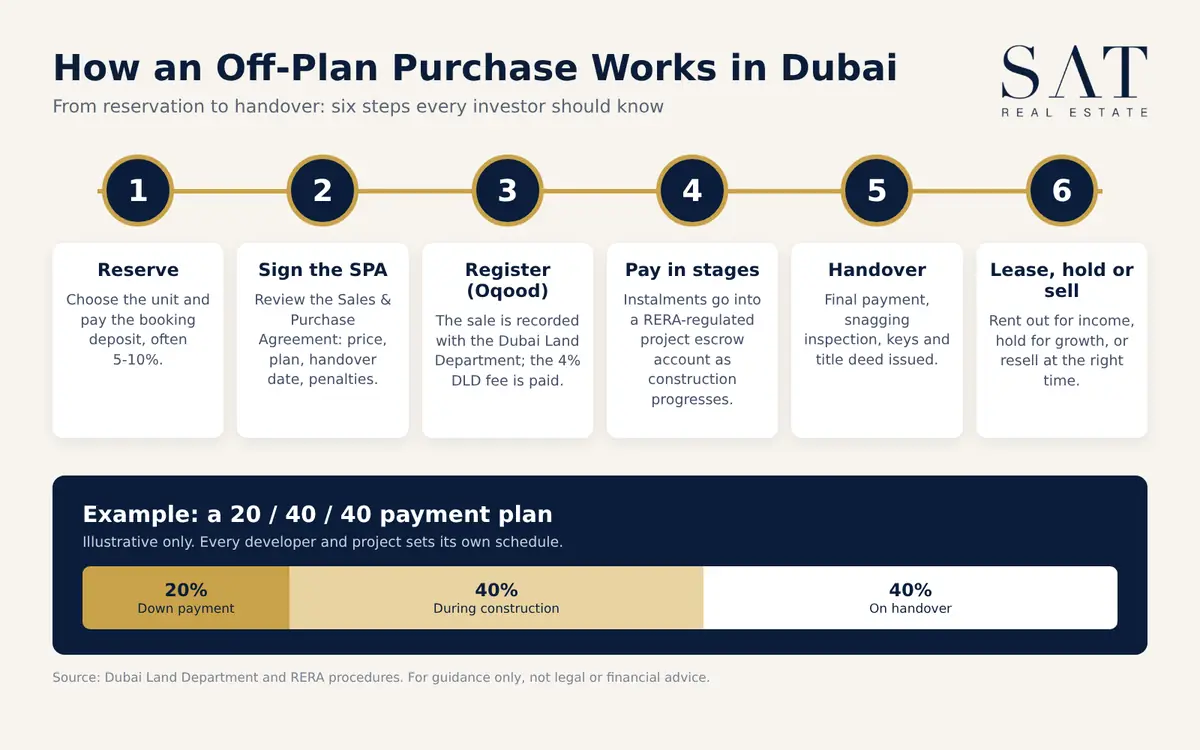
An off-plan purchase follows a fixed path: reservation, Sales and Purchase Agreement (SPA), Oqood registration, staged payments into escrow, and handover. The infographic below shows each step.
Common Off-Plan Payment Plans in Dubai
| Plan type | Typical structure | Who it suits |
|---|---|---|
| Construction-linked | 10–20% down, instalments tied to build milestones, balance on handover | Investors who want payments matched to visible progress |
| 60/40 or 50/50 | 50–60% during construction, 40–50% on handover | Buyers planning to finance at completion |
| 80/20 or 70/30 | Most of the price paid before handover | Cash buyers who may negotiate a better price |
| Post-handover | 30–60% paid over one to five years after handover | Investors who want rent to help cover instalments |
| Monthly (e.g. 1% a month) | Small fixed monthly payments | Buyers who want predictable outflows |
A longer plan is not automatically better. What matters is the total price, the timing of each payment and how you will fund the handover balance. Our off-plan investment advisory team maps this “payment-adjusted” exposure before any commitment.
How Escrow Accounts Protect Off-Plan Buyers
Under Dubai Law No. 8 of 2007, developers must register each project and pay buyers’ money into a dedicated project escrow account with an approved bank. RERA supervises these accounts, and funds are released to the developer in stages as construction progresses.
What this means for you:
Your payments can only be used for your project.
Always pay into the project’s escrow account, never into a personal or agency account.
You can check a project’s registration and escrow details through the Dubai Land Department before paying.
Escrow is a regulatory safeguard. It does not guarantee build quality, delivery dates or resale value, which is why project selection still matters.
Key RERA and DLD Off-Plan Rules
Project registration: A developer must register the project with RERA before marketing or selling units.
Oqood registration: Every off-plan sale is recorded on the DLD interim register under Law No. 13 of 2008.
Developer obligations: The developer must build to the approved plans and the specifications in your SPA.
Buyer default: If a buyer stops paying, the law sets how much the developer may keep, based on how far construction has progressed.
Project cancellation: If RERA cancels a project, buyers are refunded from escrow under the regulator’s supervision.
For a full breakdown of the rules, see the regulation chapter of our investment guide and how SAT keeps every transaction secure and transparent.
The Real Costs of Buying Off-Plan Property in Dubai
The purchase price is only part of your total capital exposure. Budget for these items before you commit:
| Cost | Typical amount | When it is paid |
|---|---|---|
| DLD registration fee | 4% of the purchase price | At Oqood registration |
| Oqood and admin fees | Smaller fixed fees set by the DLD and developer | At registration |
| Agency commission | Often paid by the developer on new launches; confirm in writing | At booking, if applicable |
| Mortgage costs | Arrangement, valuation and registration fees | At handover, if you finance |
| Service charges | Per square foot per year, per the RERA service charge index | From handover |
| Resale NOC fee | Set by the developer | Only if you sell before handover |
| Furnishing and setup | Varies by unit and rental strategy | Before renting the unit |
Off-plan financing needs early planning. The Central Bank of the UAE caps off-plan mortgages at 50% of value, and only lenders that fund the specific project can lend. Our mortgage and specialist coordination service checks this before you sign a payment plan.
Some developers waive or share the 4% DLD fee. These offers can be valuable, but compare the full price, not just the incentive.
Risks of Off-Plan Property and How to Reduce Them
Every off-plan investment carries risk. Knowing the main ones makes them far easier to manage.
Construction delays. A late handover pushes back rental income. Check the developer’s delivery record and the SPA’s delay clauses.
Market shifts before completion. Prices can soften where many units complete at once. Study the supply pipeline in your area.
Cash-flow pressure. A large handover payment is hard to meet if financing falls through. Plan funding from day one.
Specification changes. Your SPA should define materials, layout and permitted changes.
Limited early resale. Many developers only allow resale after 30–40% of the price has been paid.
Oversupply in some segments. Location, access and masterplan quality matter more than launch hype.
How to Choose the Right Off-Plan Project and Developer
Careful selection is the best protection. SAT’s advisory approach puts evidence before opinion and tests every off-plan opportunity against these criteria:
Developer track record: Completed projects, on-time delivery and resale performance. Established names such as Emaar, Nakheel, Meraas and Aldar have long delivery histories; newer developers need closer scrutiny.
Location fundamentals: Transport, schools, jobs and planned infrastructure. Compare growth drivers in Dubai Creek Harbour, Dubai Hills Estate and Dubai South.
Price against ready stock: If the launch price is close to finished homes nearby, growth potential is limited. Our yield and price guides explain how SAT benchmarks this, and you can request the current edition.
Rental evidence: Check what similar completed units rent for today, not what the brochure promises.
Unit selection: View, floor, layout and orientation can change resale value within the same building.
Exit liquidity: Ask who will buy the unit from you in five years, and at what price.
Want area-by-area context? Read our guide to the best areas to invest in Dubai real estate or use our Dubai area comparisons.
How to Buy Off-Plan Property in Dubai: Step by Step
Foreign nationals can buy off-plan property in Dubai’s freehold areas without living in the UAE. The process usually runs in seven steps:
Set your goal and budget. Decide between yield, growth or residency, and reserve funds for the 4% DLD fee and the handover balance.
Shortlist projects with an adviser. Compare developers, locations, payment plans and nearby ready-home prices.
Reserve the unit. Sign a reservation form and pay the booking deposit, often 5–10%.
Review and sign the SPA. Check the handover date, payment schedule, specifications, delay clauses and resale terms. Take legal advice if anything is unclear.
Complete Oqood registration. The developer registers the sale with the DLD and you pay the registration fee.
Pay instalments into escrow. Pay each instalment into the project escrow account as milestones are reached.
Inspect and take handover. Complete a snagging inspection, pay the balance, collect your keys and get the title deed issued.
Exit Strategies for Off-Plan Investors
Plan your exit before you buy. Most off-plan investors choose one of three routes:
Sell before handover. Once you have paid the developer’s minimum share, you can assign your contract. This can lock in early gains but depends on demand and carries a developer NOC fee. See our real estate trading and exit service.
Hold and rent. Lease the unit for steady income, or run it as a licensed holiday home in tourist areas. SAT’s property management in Dubai team handles tenants, maintenance and compliance for overseas owners.
Hold for long-term growth. Keep the asset through market cycles and sell once the community has matured.
Not sure which route fits? Our sell, hold or reinvest review uses live transaction and rental data to guide the decision.
Is Buying Off-Plan Property in Dubai Worth It in 2026?
Buying off-plan property in Dubai can be one of the most effective ways to build long-term real estate wealth. You get launch pricing, staged payments, strong legal protection and a city with sustained demand. The result, however, depends on choosing the right developer, location, unit and price.
Since 2013, SAT Real Estate has advised more than 7,500 clients on over AED 15 billion in transactions. If you are weighing an off-plan purchase, our advisers will compare projects on evidence and structure a deal that fits your goals. Learn more about why investors choose SAT.
Book a private investment consultation
Related reading
Frequently Asked Questions About Off-Plan Property in Dubai
1. Is it safe to buy off-plan property in Dubai?
Yes, it is safer than in many markets, as long as you buy a RERA-registered project. Your payments go into a regulated escrow account, and your purchase is registered with the Dubai Land Department through Oqood. You should still check the developer’s track record and read the SPA carefully.
2. Can foreigners buy off-plan property in Dubai?
Yes. Foreign nationals can buy off-plan property in Dubai’s designated freehold areas, with full ownership rights. You do not need to be a UAE resident, and you can complete most of the process remotely.
3. How much deposit do I need for off-plan property in Dubai?
Most projects ask for a booking deposit of 5–20% of the price. You will also pay the 4% DLD registration fee at the start, unless the developer is offering a fee waiver.
4. What is an escrow account in Dubai off-plan property?
An escrow account is a dedicated bank account for a single project, required by Dubai Law No. 8 of 2007. Buyer payments go into it and are released to the developer only as construction progresses, under RERA supervision. It protects how your money is used but does not guarantee delivery dates, build quality or resale value.
5. What is Oqood registration?
Oqood is the Dubai Land Department’s interim register for off-plan sales. It records your purchase before the building is complete, protects your ownership interest and is replaced by a title deed at handover.
6. Can I sell my off-plan property before handover?
Usually yes, once you have paid the minimum share set by the developer, often 30–40% of the price. You will need a no-objection certificate (NOC) from the developer, and a resale fee normally applies.
7. What happens if an off-plan project in Dubai is delayed?
Your SPA sets out the developer’s obligations and any compensation for delays. If RERA cancels a project, buyers are entitled to refunds from the escrow account under the regulator’s supervision. Choosing an experienced developer is the best way to reduce delay risk.
8. Can I get a mortgage for off-plan property in Dubai?
Yes, but with limits. The Central Bank of the UAE caps off-plan mortgages at 50% of the property value, and only banks that fund that specific project can lend. Non-residents usually face stricter criteria. SAT’s mortgage coordination team checks financing options before you commit.
9. Does off-plan property qualify for the UAE Golden Visa?
Property investments of AED 2 million or more can support a UAE Golden Visa application. Whether an off-plan unit qualifies depends on the current rules and the developer, so confirm eligibility with the official UAE Golden Visa guidance or your adviser before you buy.
10. Is off-plan or ready property better for investment in Dubai?
It depends on your goals. Off-plan suits investors who want capital growth and flexible payments and can wait for income. Ready property suits investors who want rental income right away. Many investors hold both to balance growth and yield.
Have another question? Browse our full Dubai real estate FAQs or speak to an adviser.